

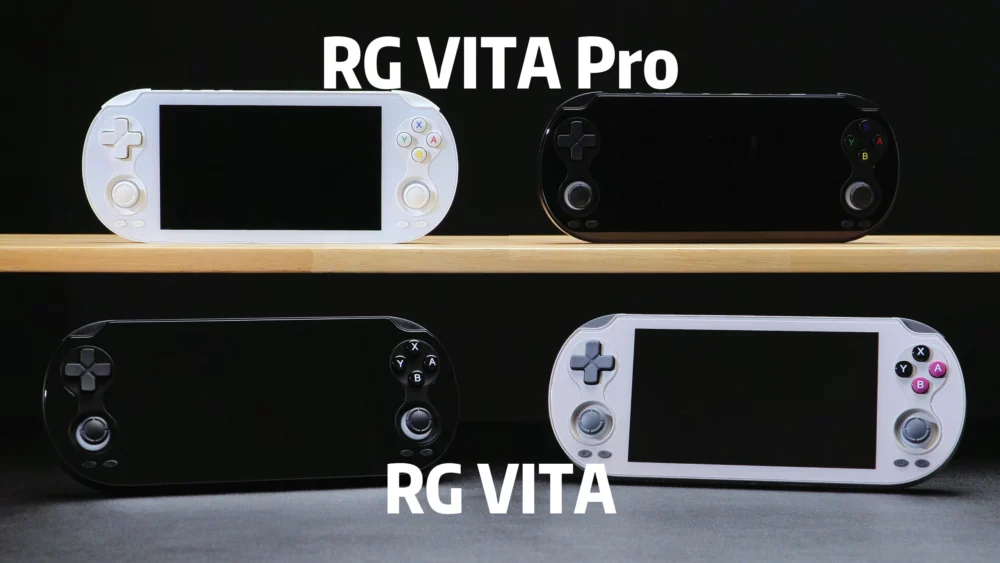
The portable emulation hardware landscape is witnessing a significant inflection point as ANBERNIC, a dominant force in the retro handheld market, breaks from its established aesthetic lineage with the introduction of the RG VITA and RG VITA Pro. This dual-device announcement, following a relatively subdued 2025, signals an aggressive shift toward modern industrial design, directly challenging the conventional form factors that have characterized the company’s output. The immediate and unavoidable influence is Sony’s pioneering, yet commercially underappreciated, PlayStation Vita.
For years, ANBERNIC—alongside competitors like Retroid and Miyoo—has successfully capitalized on nostalgia, favoring the 4:3 aspect ratios reminiscent of classic Game Boy or early PSP models. This new venture jettisons that convention entirely, embracing the widescreen 16:9 display format synonymous with the Vita. Examination of the initial reveals showcases a commitment to replicating the Vita’s ergonomic blueprint: the distinctive wide screen, the pronounced shoulder button recesses, and a unified, all-glass front fascia where the controls appear seamlessly integrated into the panel structure. This deliberate mirroring is not merely coincidental; it is a calculated design decision aimed at a specific segment of the enthusiast market—those who cherished the Vita’s premium feel and display quality.
However, ANBERNIC is not merely cloning; it is iterating. A crucial departure from the original Sony hardware lies in the control scheme implementation. Where the original PS Vita famously substituted traditional shoulder buttons (L2/R2) with capacitive touch zones on the rear panel—a feature often cited as a point of failure for precise gameplay—the RG VITA series appears to integrate genuine, tactile analog triggers. This suggests a functional upgrade designed for modern gaming demands, even within the emulation sphere. While the rear panel retains sculpted indentations suggestive of the Vita’s touch pads, these are likely aesthetic nods rather than functional inputs, confirming a prioritization of conventional, reliable tactile feedback. Furthermore, the face buttons adhere to ANBERNIC’s established convention, utilizing the familiar Nintendo-style ABXY layout, rather than adopting Sony’s circle, cross, square, triangle nomenclature, subtly asserting their platform identity despite the chassis homage.
The implications of this design choice extend beyond mere aesthetics. The transition to a 16:9 aspect ratio in ANBERNIC’s mainstream offerings is noteworthy. The company’s previous foray into this format, such as the RG 577, was a larger, more specialized device. By anchoring the RG VITA models around a form factor that was inherently focused on multimedia consumption and modern 3D gaming, ANBERNIC is positioning these devices not just for retro 8-bit or 16-bit titles, but squarely in the territory of PlayStation Portable (PSP), Nintendo DS (via dual-screen mapping solutions), and, most critically, the PlayStation Vita itself.
The central challenge, and the inherent tension in this hardware announcement, revolves around software compatibility. The RG VITA nails the external look, but the ability to truly harness that look hinges entirely on the performance of PlayStation Vita emulation on Android. This specific emulation niche has historically been fraught with difficulty. Unlike the mature and highly optimized emulation cores available for older generations (e.g., N64, PS1, PSP), Vita emulation, primarily spearheaded by the Vita3K project, remains in a relatively nascent state on mobile operating systems. The most recent public update for the Android port of Vita3K, dated mid-2024, underscores the uneven pace of development compared to PC-based emulation.
This presents a fascinating paradox for ANBERNIC. They are building hardware specifically tailored to a challenging emulation target. If the underlying chipset proves insufficient to run demanding Vita titles at playable frame rates, the hardware’s most compelling design feature becomes its greatest weakness. The industry is keenly watching to see which chipset powers these devices. Preliminary indications regarding the standard RG VITA—citing a 5,000mAh battery capacity and 10W charging speed—suggest a mid-range processing unit, possibly foregoing the high-end MediaTek Dimensity 8300 found in performance-oriented models like the RG 477M/V. This spec profile suggests a focus on efficiency and battery life over raw, high-end emulation throughput, which might temper expectations for demanding Vita titles but could still provide a solid experience for PSP and earlier systems in a form factor people actually desire. The "Pro" variant, one hopes, will feature a substantially more potent SoC to justify the nomenclature and address the emulation hurdle.
The industry context surrounding this launch is ripe for disruption. The handheld emulation sector has matured into a fierce competition dominated by cost-to-performance ratios. While Retroid typically excels at offering powerful devices at aggressive price points, and AYANEO targets the premium, high-performance Windows/Linux niche, ANBERNIC has historically occupied the space between, often prioritizing sheer catalog breadth. The RG VITA introduces a new axis of competition: nostalgia-driven form factor emulation. By adopting the Vita aesthetic, ANBERNIC is attempting to capture the hearts of those who felt the original Vita’s ecosystem was unjustly terminated or those who simply prefer its superior ergonomics and OLED/high-quality LCD display profile over the often utilitarian designs of competitors.
This move also serves as a direct commentary on the state of proprietary handhelds. The success of emulation hardware over the past few years has proven that a significant, addressable market exists for hardware that leverages open-source software to access legacy game libraries. By cloning the look of a failed proprietary device, ANBERNIC is effectively offering the experience that Sony could not sustain, free from digital storefront restrictions or hardware obsolescence.
From a broader technological perspective, the RG VITA line forces a re-evaluation of display standards in the emulation space. The industry has been heavily invested in the 4:3 standard for years, largely due to the native aspect ratios of dominant retro consoles (SNES, Genesis, GBA). The Vita, however, represented a commitment to widescreen presentation, often leading to letterboxing when playing older titles or, conversely, offering a visually superior experience for PSP and 3D console libraries. ANBERNIC’s commitment to 16:9 suggests they believe the consumer base is now ready to accept, or even demand, this modern aspect ratio as the default for their emulation devices, especially those targeting the PSP/Vita era.
The timing of the announcement, preceding the Chinese New Year holiday, suggests that mass production and final specifications will be revealed shortly thereafter, likely targeting a March release window. This places the RG VITA directly into the path of other expected releases from key rivals, setting the stage for a significant early-year battle in the handheld computing arena.
Expert analysis suggests that ANBERNIC’s success here will depend on three key factors:
- Chipset Selection for the Pro Model: If the Pro model utilizes a high-tier chip capable of reliably running 720p Vita titles at 60fps, it justifies the design homage and creates a genuine "Vita killer" in the emulation space. If it remains mid-range, the device risks being perceived as a high-quality PSP/N64/Dreamcast emulator encased in a desirable shell.
- Pricing Strategy: Given the design sophistication implied by the glass front and dedicated triggers, the RG VITA series may command a slightly higher price point than ANBERNIC’s entry-level offerings. This pricing must be carefully calibrated against Retroid’s powerful, but often more plasticky, alternatives.
- The Emulation Ecosystem’s Momentum: The longevity of the RG VITA’s appeal is tethered to the continued, and hopefully accelerated, development of Vita3K for Android. If the emulator stagnates, the device’s unique selling proposition erodes rapidly.
Looking toward future trends, the RG VITA series may signal a splintering of the emulation market. We could see a bifurcation where companies explicitly cater to "Retro Aspect Ratio" purists (favoring 4:3) and "Modern/Widescreen" enthusiasts (favoring 16:9). This allows manufacturers to segment their product lines more effectively, addressing distinct ergonomic and visual preferences without forcing compromises on a single chassis design. The focus on true triggers over touchpads also indicates that user feedback regarding tactile quality consistently outweighs aesthetic fidelity to legacy hardware features—a valuable lesson learned from Sony’s own hardware missteps.
Ultimately, the ANBERNIC RG VITA is more than just a hardware refresh; it is a strategic pivot leveraging deep brand recognition from a defunct console. It speaks volumes about the enduring appeal of Sony’s industrial design language and the community’s ongoing desire to play the games that defined that generation, irrespective of the original manufacturer’s commercial success. If ANBERNIC can align powerful internals with this nostalgic form factor, they may finally unlock the potential of a handheld that many users believed was prematurely retired. The next few weeks, post-holiday slowdown, will be crucial for official specification reveals to confirm whether this homage is backed by sufficient silicon muscle.