

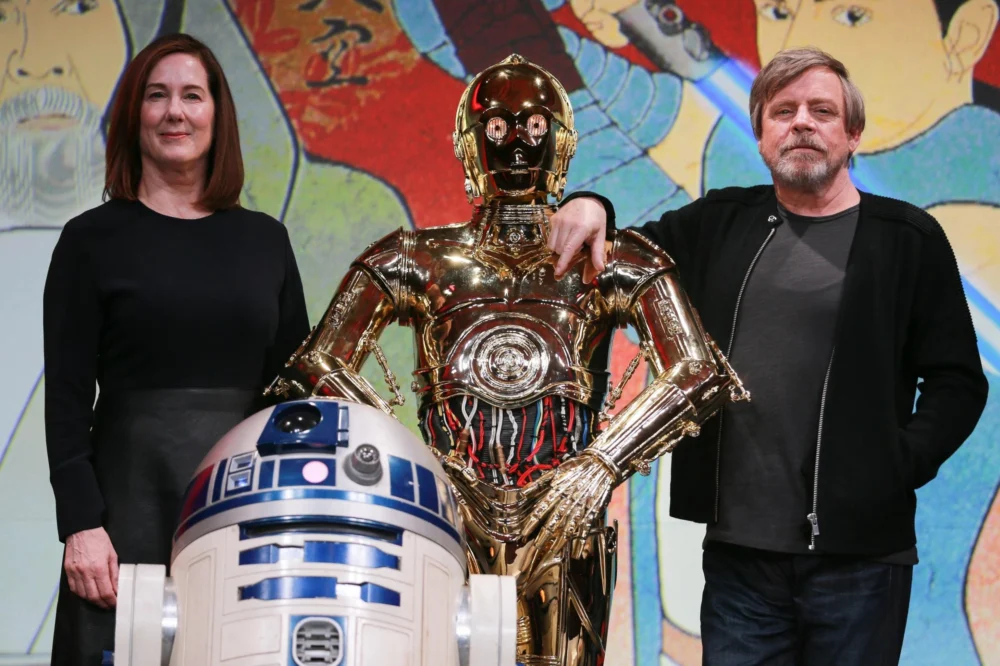
The landscape of modern franchise filmmaking shifted fundamentally this Thursday as The Walt Disney Company announced that Kathleen Kennedy, the long-standing President of Lucasfilm, has stepped down from her position effective immediately. In a move that signals a significant pivot for the Star Wars and Indiana Jones brands, Kennedy will be succeeded by a dual-leadership structure featuring Lucasfilm veterans Dave Filoni and Lynwen Brennan. While Kennedy will transition into a producing role for specific upcoming projects, the handover marks the end of an era that began in 2012 when Disney acquired the studio from George Lucas for approximately $4.05 billion.
Kennedy’s departure is not merely a personnel change; it is a watershed moment for one of the most valuable intellectual property portfolios in entertainment history. Hand-picked by George Lucas himself to lead the company into the Disney era, Kennedy’s tenure was defined by staggering commercial highs, experimental creative shifts, and a fandom that grew increasingly fractured. In a departing statement, Kennedy reflected on her decade-plus journey, stating that she could not have imagined the path ahead when she first took the reins. She expressed pride in the studio’s accomplishments and an eagerness to continue developing content with both veteran collaborators and new creative voices.
To understand the weight of this transition, one must look at the financial and cultural ledger of the Kennedy years. Under her watch, the Star Wars sequel trilogy—comprising The Force Awakens (2015), The Last Jedi (2017), and The Rise of Skywalker (2019)—generated a combined worldwide box office of nearly $4.5 billion. On paper, these figures represent a massive return on investment. However, a closer look at the trajectory reveals a concerning trend of diminishing returns: The Force Awakens debuted to a historic $2.06 billion, but by the time the trilogy concluded, The Rise of Skywalker struggled to cross the $1 billion mark. This downward slope, coupled with the theatrical failure of Solo: A Star Wars Story, forced a strategic retreat from the big screen that has lasted for over half a decade.
The creative management of the sequel trilogy remains perhaps the most scrutinized aspect of Kennedy’s legacy. Unlike the Marvel Cinematic Universe, which benefited from the centralized narrative oversight of Kevin Feige, the Star Wars sequels appeared to suffer from a lack of a unified roadmap. The transition from J.J. Abrams’ mystery-box nostalgia in Episode VII to Rian Johnson’s subversive deconstruction in Episode VIII, followed by Abrams’ frantic course-correction in Episode IX, left many fans feeling the franchise had lost its narrative North Star. This lack of cohesion is often cited by industry analysts as the primary reason for the brand’s cooling theatrical momentum.
However, Kennedy’s tenure was also responsible for some of the most innovative leaps in television history. With the launch of Disney+, Lucasfilm pivoted toward high-budget live-action series, spearheaded by the global phenomenon The Mandalorian. The show not only introduced "Baby Yoda" (Grogu) into the cultural zeitgeist but also pioneered "The Volume"—cutting-edge LED-wall technology that has since revolutionized how digital environments are captured on camera. Under Kennedy, the studio also produced Andor, a Peabody-nominated series that many critics argue is the finest piece of Star Wars storytelling since the original 1977 film. Created by Tony Gilroy, Andor demonstrated that the franchise could survive, and even thrive, as a mature, politically complex spy thriller, largely avoiding the "culture war" controversies that dogged other projects.
The appointment of Dave Filoni and Lynwen Brennan as co-presidents suggests a "best of both worlds" strategy by Disney CEO Bob Iger. Filoni, who will also retain his title as Chief Creative Officer, is widely regarded as George Lucas’s creative protégé. Having cut his teeth on the animated Clone Wars and Rebels series, Filoni has spent years building out the deep lore of the galaxy. His elevation signals a commitment to "core" Star Wars values—a move likely intended to appease long-time fans who felt the franchise had strayed too far from its mythological roots.

Brennan, on the other hand, brings the operational and technical expertise required to manage a studio of this scale. Having started at Industrial Light & Magic (ILM) in 1999, she has been the "engine room" of Lucasfilm for years, overseeing the complex interplay between production, technology, and business operations. Together, Filoni and Brennan represent a leadership team that understands both the soul of the story and the mechanics of the machine.
Yet, the challenges facing the new leadership are formidable. The "Filoni-verse"—the interconnected web of shows including The Mandalorian, The Book of Boba Fett, and Ahsoka—has recently shown signs of fatigue. While these shows have high engagement among "super-fans," they have struggled to maintain the broad, casual audience appeal of the early Mandalorian seasons. Ahsoka, in particular, was criticized for being too reliant on homework; viewers who hadn’t seen seven seasons of the animated Clone Wars often felt alienated by the narrative. Filoni’s primary challenge will be to prove that his deep-lore approach can translate into a blockbuster theatrical experience that doesn’t require a prerequisite viewing list.
Furthermore, the studio is still reeling from the fallout of The Acolyte, a high-budget series that became a lightning rod for online controversy and failed to justify its reported $180 million price tag. The cancellation of The Acolyte after just one season highlighted a growing problem at Disney: the sustainability of "prestige" budgets for shows that fail to achieve "four-quadrant" success. Filoni and Brennan must now navigate a "quality over quantity" mandate from Bob Iger, who has publicly stated that Disney needs to reduce its output and focus on surefire hits.
The future of Star Wars now rests on a slate of upcoming films intended to bring the franchise back to theaters. This includes The Mandalorian and Grogu (2026), directed by Jon Favreau, and Shawn Levy’s Star Wars: Starfighter (2027). There is also the lingering question of the "New Jedi Order" film starring Daisy Ridley, which aims to continue the story of Rey. For Filoni and Brennan, the goal is clear: they must find a way to unify a fractured fanbase while attracting a new generation of viewers who have grown up in a world where Star Wars is a television brand rather than a cinematic event.
Industry experts suggest that this leadership change reflects a broader trend in Hollywood toward "creative-led" executive suites. By placing a storyteller like Filoni at the helm, Disney is betting that narrative purity will lead to financial stability. However, the transition also acknowledges the incredible foundation laid by Kennedy. Despite the controversies, she transformed Lucasfilm from a dormant volcano into a 24/7 content engine, producing more hours of Star Wars content in a decade than had existed in the previous thirty years. Her background as a producer on classics like E.T., Jurassic Park, and Schindler’s List provided a level of prestige and industry clout that helped the studio navigate the complex Disney merger.
As Kennedy moves into her new role, her influence will still be felt on the 2026 and 2027 releases. But the "New Hope" for the franchise now lies with the duo of Filoni and Brennan. They inherit a studio that is technically peerless and financially massive, but narratively at a crossroads. To "right the starship," they will need to balance the nostalgia of the past with a bold, coherent vision for the future. Whether they can recapture the lightning-in-a-bottle magic of the original trilogy remains the multi-billion-dollar question. For now, the galaxy waits to see if this change in leadership will result in a true renaissance or simply more of the same. The Force, as always, remains in flux.