

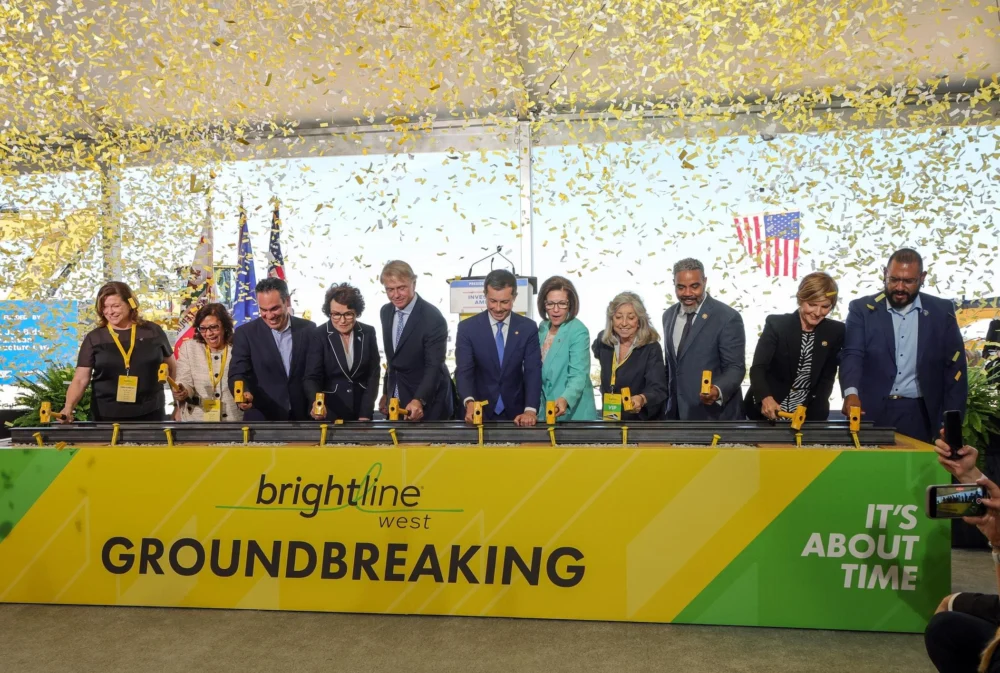
The landscape of American transportation is undergoing a seismic shift, characterized by a high-stakes transition from traditional freight-dominated corridors to a new era of high-speed passenger rail. At the center of this transformation is Brightline, the private rail venture that has become the vanguard of modern transit in the United States. In a strategic move designed to professionalize its operations and stabilize its ambitious expansion plans, the company recently announced a major leadership reorganization. Nicolas Petrovic, a seasoned veteran and former chief executive of the cross-channel high-speed line Eurostar, has been appointed as Brightline’s new CEO. This leadership pivot comes at a critical juncture as the company grapples with the ballooning costs of its marquee project: the Brightline West "bullet train" connecting Las Vegas to Southern California.
The appointment of Petrovic is a clear signal to the global infrastructure market that Brightline is moving beyond its "startup" phase and into the complex reality of large-scale international rail operations. Petrovic brings a formidable pedigree to the role; during his tenure at Eurostar, he managed one of the world’s most recognizable high-speed rail brands, navigating the intricate logistics and political sensitivities of connecting London to Paris and Brussels. Most recently, he led Etihad Rail Mobility in the United Arab Emirates, further cementing his reputation as an executive capable of delivering world-class transit solutions in diverse environments. At Brightline, Petrovic will focus his energy on the existing Florida corridor, where the company operates a service between Miami and Orlando. His primary mandate will be to drive ridership and operational efficiency in the Sunshine State, providing the steady revenue stream necessary to support the company’s broader national aspirations.

While Petrovic stabilizes the Florida foundation, Mike Reininger, the outgoing CEO, will transition into the role of Managing Director for Brightline West. This shift is tactical rather than a demotion. Reininger has been the public face of the company’s expansion efforts and possesses an intimate understanding of the regulatory and logistical hurdles inherent in the California-Nevada project. By narrowing his focus to Brightline West, the company is dedicating its most experienced internal strategist to the task of delivering the $21 billion, 218-mile high-speed system by its newly revised 2029 deadline. The leadership team is further bolstered by the addition of Mauricio Anderson as Chief Financial Officer, a role that will be pivotal as the company seeks to navigate a increasingly complex financing environment.
The backdrop to these executive maneuvers is a sobering reality check regarding the cost of building 21st-century infrastructure in the United States. Recent estimates for the Brightline West project have climbed to approximately $21.5 billion, a staggering increase from the $12 billion target initially discussed in 2024. This nearly 80% jump in projected costs reflects a broader trend in the American construction industry, where inflation, labor shortages, and supply chain bottlenecks have wreaked havoc on capital-intensive projects. However, the reasons cited by Brightline leadership for this escalation offer a fascinating glimpse into the unintended consequences of the modern tech economy.
According to Reininger, one of the most significant drivers of cost is the explosive growth of the data center industry. As the world pivots toward artificial intelligence and cloud computing, tech giants are investing tens of billions of dollars into massive server farms across the American West. These data centers compete directly with rail projects for the same finite resources: specialized labor, massive quantities of cement, and thousands of tons of structural steel. Furthermore, the power generation infrastructure required to support these "AI factories" is putting a premium on electrical engineering services and grid upgrades—the very same resources Brightline West needs to power its fleet of Siemens electric trains. In essence, the race for digital supremacy is making it significantly more expensive to build physical connectivity.

The financial architecture of Brightline West is a hybrid model that serves as a litmus test for the future of public-private partnerships (P3) in American transit. The project has already secured a $3 billion federal grant from the Biden administration’s Bipartisan Infrastructure Law, but the remaining funding gap is substantial. To bridge the divide, the company is actively pursuing a $4 billion federal infrastructure loan while simultaneously seeking billions more in private equity and bond financing. This multi-layered approach is necessary to fund a project that involves laying tracks through the unforgiving Mojave Desert, primarily along the median of Interstate 15.
The technical specifications of the line are ambitious. Brightline has partnered with Siemens to provide trainsets capable of exceeding 200 miles per hour, which would make it the first "true" high-speed rail system in the United States. Unlike the Florida service, which shares tracks with freight lines and operates at speeds well below the 150-mph threshold, Brightline West is being built as a dedicated, electrified corridor. This distinction is vital for the project’s marketing and operational viability. The goal is to reduce the four-hour-plus drive between Las Vegas and the Los Angeles basin to a sleek, two-hour journey, complete with high-end amenities and reliable Wi-Fi.
Critics of the project often point to its western terminus as a potential fatal flaw. The line will end in Rancho Cucamonga, a suburban city in San Bernardino County, rather than in downtown Los Angeles. Passengers will be required to transfer to the existing Metrolink commuter rail system to reach the city center. However, Reininger remains dismissive of these concerns, citing the sheer volume of traffic that flows through the region. With approximately 50 million annual trips between L.A. and Las Vegas—80% of which are currently made by car—the project only needs to capture a fraction of the existing market to be successful. The logic is simple: anyone driving from the Los Angeles basin to Las Vegas must pass through the Inland Empire. By placing a station at a major transit node like Rancho Cucamonga, Brightline is positioning itself to intercept millions of travelers before they hit the most congested stretches of the Mojave desert highway.

The success of Brightline is inextricably linked to the vision of its founder and chairman, Wes Edens. A co-founder of Fortress Investment Group and a prominent owner in the world of professional sports, Edens views rail not just as a transportation utility, but as a real estate and lifestyle play. His strategy mimics the Great Northern Railway barons of the 19th century: own the tracks, own the stations, and develop the land around them. In Florida, Brightline’s stations in Miami, Fort Lauderdale, and West Palm Beach have become catalysts for massive mixed-use developments, including luxury apartments, office towers, and retail hubs. This "transit-oriented development" model is designed to diversify revenue and ensure that the project is profitable even if ticket sales fluctuate.
However, the path to becoming a 21st-century rail baron is fraught with more than just economic hurdles. The political climate for high-speed rail in the U.S. remains polarized. While the current administration has been a staunch supporter, providing record levels of funding, future political shifts could impact the availability of federal loans and grants. Moreover, Brightline faces the daunting task of proving that Americans can be lured out of their cars and off of short-haul flights. While the Florida line saw a 13% increase in ridership through late 2025, reaching 2.8 million passengers, it still has a long way to go to reach its full capacity. The addition of new Siemens rail cars in 2026 and the potential expansion to Tampa are seen as necessary steps to achieving the scale required for long-term sustainability.
Looking toward the end of the decade, the implications of Brightline’s success or failure will extend far beyond the desert sands of Nevada. If Petrovic and Reininger can deliver the West project by 2029, it will serve as a definitive proof-of-concept for private high-speed rail in America. It could trigger a wave of similar projects in high-traffic corridors like the Texas Triangle (Dallas-Houston-San Antonio) or the Pacific Northwest. Conversely, if costs continue to spiral or if the 2029 deadline slips further, it may reinforce the narrative that the United States is uniquely incapable of building modern transit infrastructure at a competitive price.

The hire of Nicolas Petrovic represents more than just a change in personnel; it is a professionalization of a dream. By bringing in an executive who has managed the complexities of the Eurostar, Brightline is acknowledging that the "frontier" days of its development are over. The focus has now shifted to the grueling, detail-oriented work of civil engineering, financial management, and operational excellence. As the company navigates the supply-demand imbalances caused by the data center boom and the logistical challenges of the Mojave, the eyes of the global transportation industry will be on the 218 miles of track stretching toward Las Vegas. The stakes are nothing less than the future of American mobility.
