

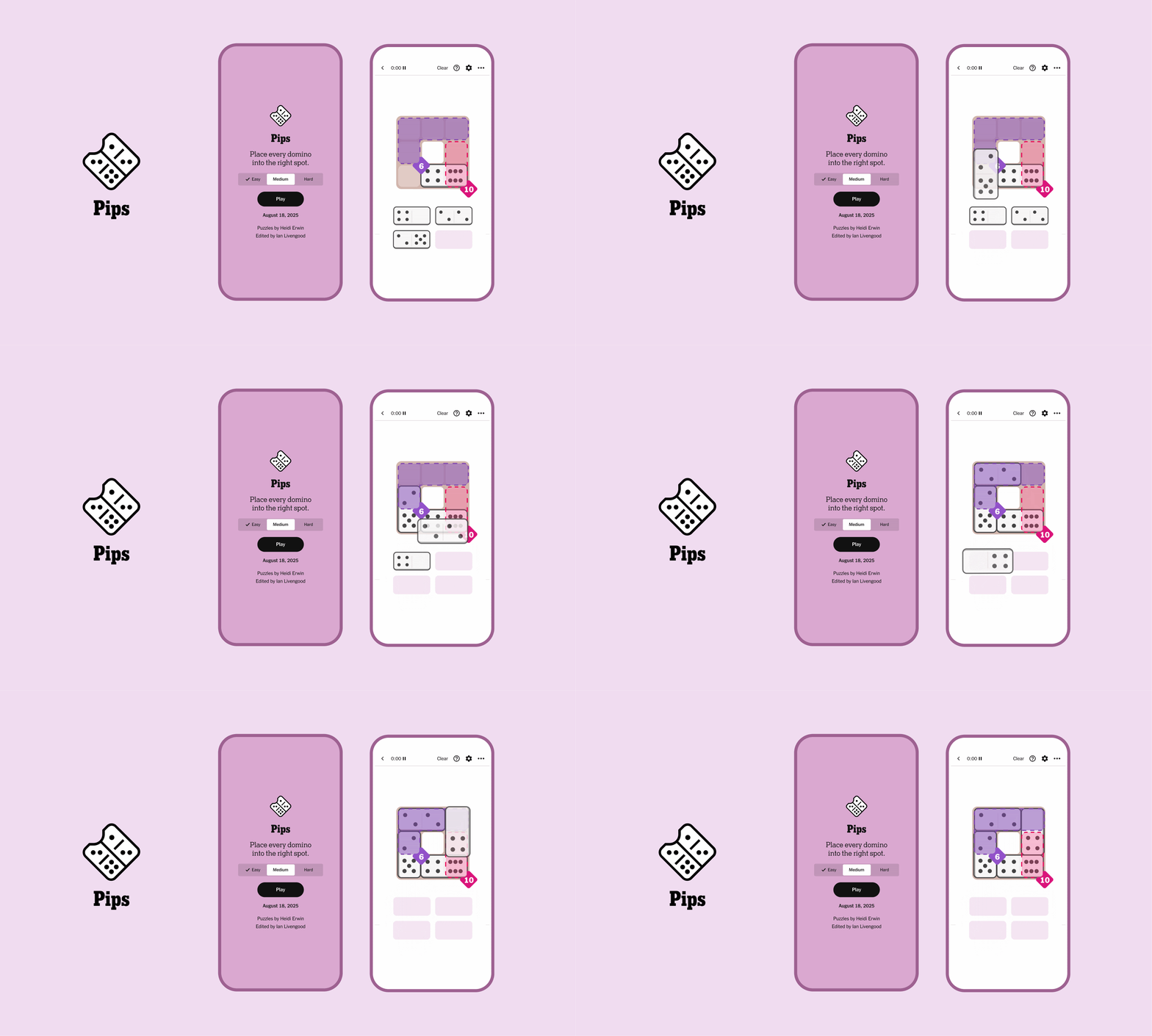
The digital puzzle landscape has undergone a seismic shift over the last half-decade, transitioning from niche pastimes to a central pillar of daily media consumption. At the forefront of this movement is the emergence of logic-based challenges that prioritize spatial reasoning and mathematical constraints over traditional vocabulary-based games. Pips, the latest sensation to capture the attention of the "daily streak" community, represents a sophisticated evolution of the classic domino game, reimagined for a touch-screen interface and an audience hungry for cognitive stimulation. As we navigate the mid-week slump of Wednesday, January 14, the latest iteration of Pips offers a particularly compelling set of challenges across its Easy, Medium, and Hard tiers, demanding both tactical foresight and a mastery of arithmetic conditions.

To understand the appeal of Pips is to understand the modern "snackable" gaming strategy employed by major digital publishers. Unlike long-form video games, Pips is designed to be completed in the margins of a busy day—during a morning commute, a lunch break, or a quiet moment before bed. However, its simplicity is deceptive. The game requires players to populate a grid of multicolored squares using a finite set of dominoes. Each colored region within the grid is governed by a specific "condition"—a logical or mathematical rule that must be satisfied for the solution to be valid. These conditions range from simple summation (where the dots on the dominoes must total a specific number) to complex relational constraints (such as inequality, greater-than/less-than symbols, or identical values). Because every domino provided must be utilized and every condition must be met simultaneously, the game functions as a high-stakes constraint satisfaction problem, a staple of computational logic.
The Anatomy of the January 14 Puzzle
The January 14 puzzle set demonstrates a keen awareness of its audience, even incorporating subtle "Easter eggs" into its design. For instance, the Medium-tier puzzle features a target sum of 14, a clever nod to the date that rewards observant players. While the Easy and Medium tiers serve as effective warm-ups, the Hard-tier puzzle for this Wednesday is a standout example of complex spatial design. Arranged in a shape that many enthusiasts have noted resembles a capital letter "A," the Hard grid presents a formidable barrier to entry with no immediate, obvious starting point.

In professional logic gaming, the "entry point" is the first move that can be made with 100% certainty. In the January 14 Hard Pips, the entry point is found in the Dark Blue 12 region. Because the maximum number of pips on a single domino half is six, a two-square region requiring a sum of 12 can only be satisfied by two sixes. This single anchor point allows the rest of the puzzle to unfurl, though not without significant trial and error.
Step-by-Step Walkthrough: The Hard Tier "A" Grid
Solving the Hard Pips for Wednesday requires a methodical approach. The following walkthrough breaks down the logic required to clear the "A" formation.

Phase 1: The Left Foundation
The journey begins at the Dark Blue 12 constraint. As established, this requires two 6s. By placing the 6/0 domino across the Dark Blue 12 and into the adjacent Pink 0 region, the player satisfies the first major constraint. This move is critical because the 0 in the Pink region must be matched by another 0 to maintain the "0 total" condition. Consequently, the 0/3 domino is placed from the Pink 0 area into the Green "=" region. To complete the Green "=" constraint, which demands identical values, the 3/3 domino is slotted in. Finally, the 1/1 domino is placed into the Orange 2 region to satisfy that specific sum.
Phase 2: Navigating the Right Leg
With the left side stabilized, attention shifts to the right side of the "A." This section is defined by a mix of inequality and summation constraints. The player should place the 4/3 domino extending from the Pink "> 3" region into the Purple "=" area. Following this, the 1/3 domino is moved from the Blue "< 3" region into the same Purple "=" zone. The complexity increases as we look at the Blue 15 area. A 5/1 domino is laid across from Blue 15 into Dark Blue 1, while the 6/6 domino is slotted into the Purple 12 region. This phase requires careful management of the remaining high-value dominoes, as the Blue 15 region is a notorious "resource sink" that can leave a player short of high numbers if handled poorly.

Phase 3: Connecting the Crossbar
The final sequence involves bridging the gaps. The 5/3 domino is placed from the Blue 15 area into the Green "> 2" section. Simultaneously, a 5/2 domino from the Blue 15 region is placed into the first available free tile. A critical check at this stage involves ensuring a "2" remains available for the Blue 2 region; the 2/1 domino is placed there, extending into the Pink "not equal" region. To finish the upper section, the 6/1 domino is moved from Dark Blue 12 up into the Orange "=" section.
Phase 4: The Final Resolution
The closing moves require precision. The 1/4 domino from the Orange "=" area is moved into the Purple 12 region, followed by the 4/4 domino into the final two Purple 12 tiles. This leaves only the 0/0 domino, which fits perfectly from the Pink "not equal" region into the last remaining empty tile.

Industry Implications: The Business of Brainteasers
The success of Pips is not an isolated phenomenon; it is a calculated move within the broader "gamification of news" trend. For digital media outlets, games serve as a powerful tool for subscriber retention. While a hard-hitting investigative report might draw a reader in, it is the daily habit of solving a puzzle that keeps them coming back. This "habit-loop" is a goldmine for data and engagement metrics.
From a technology perspective, the development of Pips highlights the increasing sophistication of browser-based gaming. The interface must be responsive across a variety of devices, from high-end desktop monitors to aging smartphones. The underlying algorithms that generate these puzzles must also ensure that every daily grid is solvable, yet challenging enough to prevent boredom—a delicate balance known in game design as "the flow state."

Furthermore, Pips taps into the growing market for "educational wellness." In an era of doom-scrolling and short-form video fatigue, many users view logic puzzles as a form of "digital detox" or cognitive exercise. This positioning allows publishers to market their gaming suites not just as entertainment, but as a beneficial component of a healthy lifestyle, similar to a meditation app or a fitness tracker.
Future Trends and Cognitive Impact
Looking ahead, the evolution of Pips and its contemporaries will likely involve the integration of artificial intelligence and social competition. We can expect to see AI-generated puzzles that adapt in real-time to a player’s skill level, offering a "Goldilocks" difficulty that is never too easy nor frustratingly hard. Social integration, where users can compare their "path to solution" with friends, will likely deepen the community aspect of the game.

The cognitive benefits of such games are also a subject of ongoing research. Experts in neuropsychology suggest that the "constraint satisfaction" required by Pips helps maintain neuroplasticity. By forcing the brain to juggle multiple conflicting rules while visualizing spatial rotations, players are engaging in high-level executive function. This type of mental stimulation is increasingly seen as a vital tool in delaying age-related cognitive decline.
As we conclude the January 14 puzzle cycle, it is clear that Pips is more than just a digital version of dominos. It is a testament to the enduring human desire to find order in chaos. Whether you are a casual player or a logic-puzzle veteran, the "A" grid of this Wednesday serves as a reminder that with the right starting point and a methodical approach, even the most intimidating problems can be solved, one pip at a time. The light at the end of the work-week tunnel may still be a few days away, but for those who conquered today’s grid, the sense of accomplishment provides a much-needed mid-week boost.
