

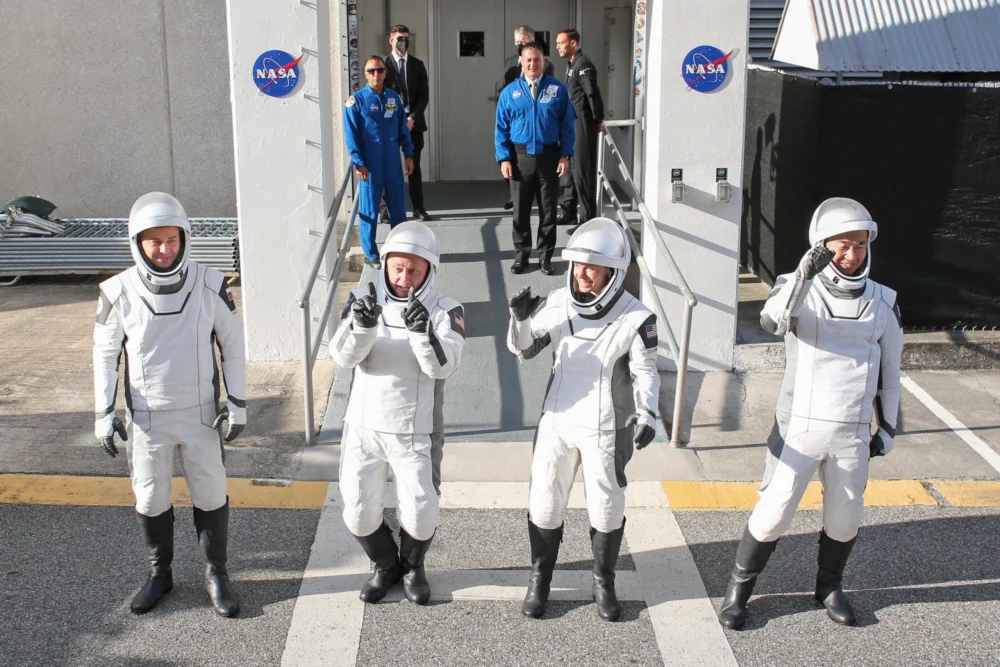
The International Space Station (ISS), a marvel of human engineering orbiting 250 miles above the Earth, is often described as the most remote laboratory in existence. Yet, for all its sophistication, it remains tethered to the terrestrial medical infrastructure of our home planet. This reality was brought into sharp focus this week as the four members of the Crew-11 mission—NASA astronauts Zena Cardman and Mike Fincke, Japan Aerospace Exploration Agency (JAXA) astronaut Kimiya Yui, and Roscosmos cosmonaut Oleg Platonov—began their final, hurried preparations to vacate the station. Their early departure, necessitated by an undisclosed but significant medical concern involving one of the crew members, serves as a poignant reminder of the biological vulnerabilities inherent in long-duration spaceflight.
The transition from a routine scientific mission to an emergency medical evacuation is a complex logistical feat. Since the announcement of their early return, the Crew-11 quartet has balanced the rigorous requirements of a spacecraft undocking with the continuation of critical orbital research. While the primary driver of their departure is a health issue, the crew has remained remarkably productive, utilizing their final hours to advance our understanding of how the human body and technology behave in microgravity.
On Monday, the station’s interior was a hive of activity that underscored the dual nature of their current situation: part scientific endeavor, part medical diagnostic mission. Zena Cardman, a scientist-astronaut whose background in biology and geology makes her uniquely suited for orbital research, conducted high-resolution ultrasound scans on the arteries of fellow NASA astronaut Chris Williams. Williams is part of the resident crew that will remain aboard the ISS after Crew-11 departs, bridging the gap until the arrival of Crew-12 in February. These scans, coupled with blood pressure monitoring, are part of a broader effort to track cardiovascular health in space—a field of study that has become increasingly relevant given the current medical circumstances.
Cardman’s work did not stop with her colleagues. She also utilized advanced medical imaging hardware to document the state of her own ocular health, recording detailed data on her retina, cornea, and lens. This research is vital for understanding Space-Associated Neuro-ocular Syndrome (SANS), a condition where the fluid shifts in microgravity can reshape the eye and affect vision. In the context of an early medical return, such data points are invaluable, providing a "before" snapshot that will be compared with clinical findings once the crew is back under the care of flight surgeons at the Johnson Space Center.
While the American and Japanese modules focused on biology, the Russian segment saw Cosmonaut Oleg Platonov assisting his colleagues, Sergey Kud-Sverchkov and Mikaev, with the more industrial side of station life. Their work involved the maintenance of electronic and ventilation systems—the life-support "lungs" of the station—and a comprehensive inventory of hardware. In a multi-national environment like the ISS, the departure of four crew members requires a meticulous handoff of equipment and responsibilities to ensure that those remaining are not left with a deficit of tools or a surplus of unorganized cargo.
In the Japanese experiment module, Kibo, Kimiya Yui joined Chris Williams for research into the frontiers of spacecraft hygiene. They worked within a sealed area to test the efficacy of ultraviolet (UV) light for disinfecting surfaces. In the enclosed environment of a spacecraft, where microbes can evolve and spread differently than they do on Earth, developing automated, chemical-free disinfection methods is a high priority for future deep-space missions. Yui’s involvement in this research, even on the eve of his departure, reflects the "mission-first" ethos that defines the astronaut corps.
Yui has also provided a more human perspective on this sudden conclusion to their mission. On social media, he shared breathtaking images of the aurora borealis dancing over the Earth’s limb, a sight he viewed with the bittersweet clarity of someone who knows his time in orbit is being cut short. "Soon, I too will become one of those small lights on the ground," he mused in a timelapse post, capturing the existential transition from celestial explorer back to terrestrial citizen.

The decision to end the Crew-11 mission early is unprecedented in the era of the commercial crew program. NASA officials have described the medical issue as "stable" but serious enough to warrant a full diagnostic workup that simply isn’t possible in orbit. Dr. James Polk, NASA’s Chief Health and Medical Officer, clarified the limitations of the station’s medical bay during a recent briefing. While the ISS is equipped with a robust suite of medical hardware, it lacks the comprehensive diagnostic power of a modern hospital emergency department. The agency’s priority is a definitive diagnosis and treatment, which necessitates the return of the crew to a facility where MRI machines, specialized labs, and a full spectrum of medical specialists are available.
This situation has sparked a broader conversation within the aerospace community about the future of space medicine. Retired NASA astronaut Clayton Anderson, writing in a recent editorial, noted that as we move beyond low-Earth orbit (LEO) toward the Moon and Mars, the option of a "quick" return to Earth disappears. A trip back from the Moon takes days; a return from Mars takes months. If a medical emergency of this nature were to occur during a transit to the Red Planet, the crew would be entirely dependent on whatever technology they carried with them. Anderson’s warning is clear: the current "Earth-dependent" model of space medicine must evolve into an autonomous, AI-driven clinical capability if we are to become a truly multi-planetary species.
The formal transition of authority occurred on Monday during a change-of-command ceremony. Mike Fincke, a veteran of multiple spaceflights, handed over the symbolic key to the station to Roscosmos cosmonaut Sergey Kud-Sverchkov. Fincke described the departure as "bittersweet," a sentiment that likely resonates with the entire team. They joined Expedition 74 in August and were prepared to stay until February. Cutting a mission short by months means leaving planned experiments unfinished and spacewalks—like the one postponed just before the medical announcement—unperformed.
The final phase of their stay is now focused on the mechanics of reentry. On Monday evening, the crew reviewed procedures on computer tablets inside the SpaceX Dragon spacecraft, the vehicle that will serve as their lifeboat and transport. The Dragon is not just a taxi; it is a sophisticated medical transport in this context, designed to provide a stable environment during the high-G forces of atmospheric reentry.
The schedule for the return is precise. Crew-11 is slated to undock from the Harmony module’s forward-facing port at 5:05 ET on Wednesday. Following a series of departure burns to distance itself from the ISS, the Dragon will perform a deorbit burn, shedding velocity to fall back into the atmosphere. The spacecraft is expected to splash down in the Pacific Ocean off the coast of California less than 12 hours after undocking. This specific splashdown location is chosen for its proximity to recovery vessels and medical teams prepared to provide immediate care.
The implications of this early return extend beyond the health of the individual crew member. It affects the broader scheduling of the ISS, requiring NASA and its international partners to reshuffle upcoming launches and cargo deliveries. It also serves as a real-world test of the contingency protocols developed by NASA and SpaceX. The ability to pivot from a long-duration mission to an emergency extraction demonstrates the flexibility of the current commercial crew infrastructure, yet it also highlights the inherent risks of the profession.
As the aerospace industry looks toward the Artemis missions and the eventual human exploration of Mars, the lessons learned from Crew-11’s departure will be integrated into future mission architecture. There will be a renewed focus on "telemedicine" and the development of compact, high-fidelity diagnostic tools that can function without a direct link to Earth. The "bittersweet" end of this mission may very well be the catalyst for the next great leap in space-based healthcare.
For now, the focus remains on the safe return of Cardman, Fincke, Yui, and Platonov. As they prepare to trade the weightless silence of the ISS for the roar of reentry and the heavy pull of Earth’s gravity, they leave behind a station that is slightly quieter, but no less busy. Their work continues in the hands of the remaining crew, while the global space community waits for the news of a safe splashdown and a successful medical recovery. The lights on the ground that Kimiya Yui admired from above are ready to welcome them home, bringing a close to a mission that reminded the world that even in the stars, our humanity—and our health—remains our most precious cargo.
