

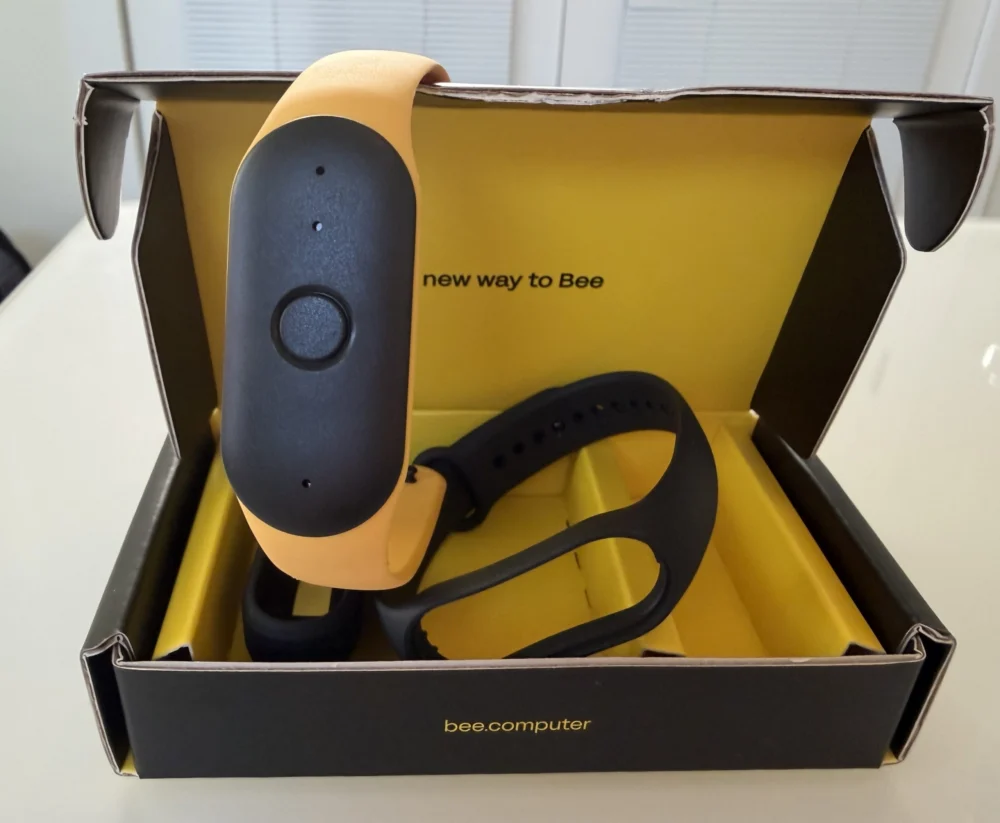
The emergence of personalized, conversational AI wearables marks a critical inflection point in consumer technology, shifting the focus from screen-centric interaction to ambient, proactive assistance. Amazon’s latest foray into this evolving segment, the Bee wearable, offers a streamlined approach to conversational capture and synthesis, differentiating itself from the crowded field of simple transcription tools. Our preliminary evaluation of a review unit confirms that the device prioritizes user simplicity and contextual intelligence over raw data archiving, signaling Amazon’s vision for a companion AI deeply integrated into daily life.
Hardware Simplicity Meets Software Sophistication
From a hardware standpoint, the Bee is engineered for immediate accessibility. The primary interaction is managed through tactile controls: a single button press initiates or terminates audio recording. The companion application offers a layer of sophisticated customization for secondary gestures. Users can configure a double press to perform actions like bookmarking a crucial segment of a conversation, immediately processing the recorded audio, or executing both simultaneously. Similarly, a press-and-hold gesture can be toggled between initiating a quick voice note or engaging the core AI assistant for conversational queries. This modular control scheme acknowledges the necessity of speed and discretion in capturing fleeting real-world information.
However, the initial physical design exhibits uneven quality. While the option for a sturdy clip-on pin suggests resilience, the accompanying sports band proved notably flimsy, detaching on multiple occasions even during minimal movement, such as riding in a vehicle. For a device intended to be an ever-present, passive accessory, consistency and durability in mounting options are paramount.
The accompanying mobile application, by contrast, demonstrates a level of polish and intuitive design that surpasses Amazon’s legacy in-house efforts, such as the often-clunky Alexa mobile experience. The interface is clean and straightforward, focusing on the processed output rather than the raw inputs.

The Semantic Segmentation Advantage
Bee’s core technological value proposition lies not in its ability to record—a capability now standard across a wide range of devices and software platforms—but in its advanced conversational processing. In a marketplace saturated with transcription services like Otter, Fireflies, Fathom, Plaud, and Granola, which typically provide either raw transcripts or superficial summaries, Bee employs a method of semantic segmentation.
Instead of generating a massive, undifferentiated block of text, the AI segments the recorded audio based on topic shifts, speaker intent, or distinct phases of a discussion. For example, a single interview recording is broken down into thematic chunks, potentially labeled as "Introduction," "Product Details Discussion," or "Analysis of Industry Trends." This structured output significantly reduces the cognitive load on the user who needs to quickly recall specific information. Visually, these segments are organized within the app using distinct background colors, facilitating rapid differentiation and navigation. Tapping into any segment reveals the exact, time-synced transcription, bridging the gap between summary and source data.
This segmentation capability is a direct function of modern Large Language Models (LLMs) being applied to real-time audio streams. It represents a crucial step toward ambient intelligence, where the AI doesn’t just record sound; it understands the structure of the conversation, turning unstructured speech into categorized, actionable knowledge.
The Trade-offs: Professional Limits vs. Personal Utility
Despite the advanced summary capabilities, Bee makes critical design choices that clearly delineate its intended audience: the everyday consumer seeking memory augmentation, not the professional requiring stringent documentation.
A major limitation immediately apparent in testing is the rudimentary speaker labeling functionality. While the application permits the user to confirm their own identity within a conversational segment, it lacks the robust, labeled speaker separation (Speaker 1, Speaker 2, John Doe) common in dedicated professional transcription platforms. More critically, Bee discards the raw audio file once the transcription and segmentation process is complete. This decision, likely made to minimize data storage and simplify privacy guarantees, renders the device unsuitable for any use case—such as legal proceedings, detailed academic research, or investigative journalism—where the original audio must be preserved for verification and accuracy assurance.

Amazon explicitly positions Bee not as an enterprise or work tool, but as a lifestyle companion. This focus is evidenced by its integration capabilities, particularly with Google services. The AI proactively links recorded conversations to potential tasks or follow-up actions. Meeting a contact at a conference, for instance, could trigger an automatic suggestion to connect on LinkedIn or initiate a product research task via a linked calendar or to-do list.
Beyond conversational processing, the app includes features designed for long-term personal synthesis. Users can create simple voice notes as an alternative to typing, and dedicated sections track "past memories" and facilitate personal growth. The "Grow" section is intended to deliver personalized insights as the AI accumulates more data about the user’s habits, interests, and conversational patterns. Furthermore, the "Facts" section acts as a user-curated knowledge base, mirroring the persistent memory capabilities that are becoming standard in advanced consumer chatbots, allowing the AI to recall specific details previously shared by the user. Amazon has indicated that the Bee platform is slated to receive a continuous stream of new features throughout the coming year, suggesting this is a minimum viable product iteration rather than a complete vision.
Navigating the Ethical and Social Landscape
The introduction of devices like Bee, which inherently blur the line between personal memory and digital record, reignites complex ethical and social debates surrounding ambient recording. Amazon has wisely taken a conservative approach compared to some rivals, such as the highly scrutinized Friend AI pendant, by ensuring Bee is not always listening by default.
Recording must be manually activated, and crucially, the device emits a distinct green indicator light when active. This visual cue serves as an explicit notification to surrounding parties, enforcing a mechanism of consent. This is a vital design choice, as the legal landscape governing audio recording often requires "one-party consent" in many jurisdictions, but social expectations often demand "two-party consent."
However, relying on a small light and a user’s commitment to asking permission does not guarantee adherence to the social contract. The increasing normalization of personal recording devices risks creating an environment of perpetual surveillance—an "ambient auditing" culture. As these devices become mainstream, the potential for public self-censorship increases, where individuals modify their speech and behavior knowing that they might inadvertently be "on the record."

The palpable awkwardness this creates was highlighted by a recent interaction at CES, where a representative, appreciating a comment made about a competitor, playfully urged the reviewer to "Say that louder into my microphone," pointing to their subtly pinned, active Bee device. This anecdote underscores the profound psychological shift required when every casual utterance in the real world could be instantly digitized, analyzed, and permanently archived, irrespective of the speaker’s consent or intent.
Industry Implications and the Post-Smartphone Future
Bee enters the AI wearable market alongside a wave of ambitious devices, including the Humane AI Pin and the Rabbit R1, all seeking to establish a dominant interaction paradigm beyond the traditional smartphone glass slab. Amazon’s strategy here appears less focused on replacing the phone entirely and more on augmenting the user’s intelligence and memory capacity passively.
The Bee platform’s competitive advantage lies in its specific focus on conversational synthesis, contrasting sharply with devices that emphasize multimodal interactions (like visual processing via a camera). By concentrating purely on ambient audio, Bee can achieve deep semantic understanding without incurring the higher regulatory and privacy burdens associated with continuous visual capture.
This push into ambient intelligence is strategically vital for Amazon. As the utility of Alexa plateaus in the stationary home environment, capturing the mobile, real-world data stream is essential for training the next generation of generative AI models and maintaining relevance in users’ lives. The success of Bee will serve as a crucial test case for Amazon, determining the consumer appetite for a dedicated, always-on personal memory layer.
Expert analysis suggests that the true long-term value of devices like Bee will not be in transcription accuracy, but in the generative insights they provide. The "Grow" section, which promises deeper personalization as the AI learns, represents the future: an AI that synthesizes years of captured conversation, identifies recurring patterns (e.g., stress triggers, successful negotiation tactics, favorite topics), and offers meaningful, proactive advice. This transitions the device from a mere recorder to a personalized life coach built on empirical data derived from the user’s own experiences.

If the market embraces conversational wearables, it necessitates a widespread cultural adaptation. Consumers must weigh the undeniable benefit of frictionless memory capture—never forgetting a name, a detail, or an action item—against the profound implications for privacy and social trust. The traction, or lack thereof, that Amazon achieves with Bee will not only shape its product roadmap but will also provide a definitive indicator of whether society is truly ready to embrace the era of the ambient auditor. Until that cultural acceptance is secured, devices like Bee will remain pioneering technologies navigating complex regulatory and social waters.
