

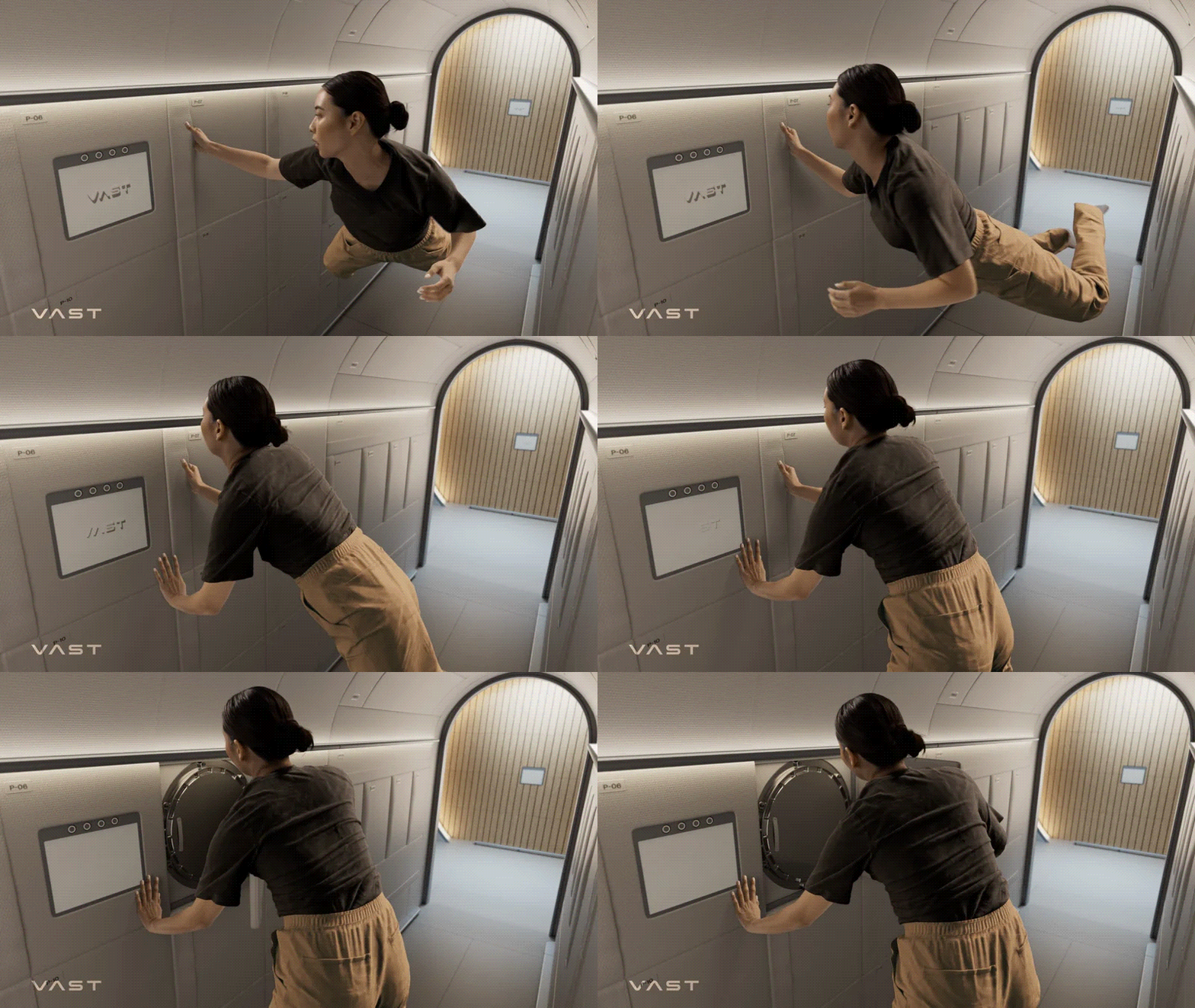
For more than two decades, the operational control and staffing of orbital outposts have been the exclusive domain of national space agencies and a select consortium of global partners. This established paradigm, centered primarily around the International Space Station (ISS), is rapidly dissolving as the public sector prepares to hand over the reins of Low Earth Orbit (LEO) infrastructure to commercial entities. A new era is dawning where LEO will function as a diversified marketplace, offering services ranging from dedicated scientific microgravity research to orbital tourism.
This commercial transition is spearheaded by several ambitious ventures, including Axiom Space, Sierra Space, and Vast. These companies are not merely proposing extensions of government-run programs; they are designing entirely new orbital destinations intended to operate on commercial principles, catering to sovereign nations seeking research access, corporations requiring in-space manufacturing facilities, and, crucially, wealthy private citizens seeking an unparalleled travel experience.

Leading this vanguard is the California-based company, Vast, which is targeting the launch of its initial orbital facility, Haven-1, in May 2026. This ambitious timeline positions Haven-1 as potentially the first privately funded, fully commercial space station to host crew. Following a successful launch and commissioning phase, the earliest paying clientele is expected to arrive within weeks. Preparing these non-career space travelers for the rigors of orbital life is a critical and complex task, managed by former NASA astronaut Drew Feustel, who serves as Vast’s lead astronaut.
Feustel brings unparalleled expertise, having logged 226 days in space across three pivotal missions, including extended stays aboard the ISS and a servicing mission to the Hubble Space Telescope. His transition from government mission specialist to commercial orbital experience architect underscores the fundamental shift occurring in the industry: the codification of space expertise to serve a consumer-driven market.
Designing the Human Experience in Orbit
Feustel’s role extends far beyond training; he has been instrumental in advising Vast on the foundational design and habitability of Haven-1 and its planned successor, the larger, permanent Haven-2. This input is crucial because commercial space stations must balance operational efficiency and safety (the core NASA requirements) with human comfort and psychological well-being—factors often secondary in purely scientific outposts.

One of the most tangible examples of this human-centric design philosophy is the redesign of the sleep cores. In microgravity, astronauts typically sleep strapped vertically into small compartments, often finding it difficult to achieve restorative rest without the familiar sensation of gravity. Feustel guided the development of an innovative air bladder system designed to mimic terrestrial sleeping conditions. This system generates distributed, gentle pressure across the body, effectively emulating the pressure field provided by gravity when lying down.
The concept is functionally analogous to a weighted blanket, though structurally more complex, requiring an inflatable bladder that pushes the occupant gently against the core’s wall. This small engineering detail represents a significant quality-of-life improvement, recognizing that customer satisfaction and operational effectiveness are inextricably linked, especially for short, high-cost missions.
Beyond sleep, Feustel has influenced the architecture of the crew interface, from the clarity of system notifications and display layouts to the psychological necessity of windows. While engineers must prioritize structural integrity and radiation shielding, the astronaut perspective advocates for maximizing the view. The size, quality, and orientation of orbital windows are paramount. As Feustel notes, a window that perpetually faces deep space is a missed opportunity; the ability to view and photograph Earth is essential for crew morale, scientific observation, and fulfilling the profound psychological impact known as the Overview Effect.

The New Standard of Commercial Spaceflight Training
The primary challenge for commercial operators like Vast is translating decades of hyper-specialized government astronaut training into a streamlined, efficient, and accessible curriculum for private citizens who may lack any background in aerospace or high-risk operations. The typical commercial mission to Haven-1 is slated for approximately 10 days, yet the preparatory phase spans nearly a year.
Vast has structured its training flow over an 11-month period, interspersed with gaps, which condenses down to about three to four months of intensive, day-to-day instruction. This long lead time is necessary to allow for the absorption of complex material and the development of necessary muscle memory.
Approximately half of this training curriculum is dedicated to the transport vehicle: the SpaceX Dragon spacecraft. Since the greatest inherent risks in space travel occur during launch and atmospheric reentry, comprehensive training on the Dragon’s systems is mandated by both SpaceX and the regulatory environment. Vast coordinates its in-house training to align perfectly with SpaceX’s schedule, ensuring seamless continuity. When crews are at the SpaceX facilities in California, they simultaneously integrate with Vast’s teams to learn the specifics of the orbital habitat.

The core focus of Vast’s proprietary training is emergency preparedness and habitat operations. Crew members, regardless of their background, must achieve proficiency in critical emergency response protocols, ensuring they can safely secure the station or execute an immediate departure via the docked Dragon vehicle if a catastrophic system failure occurs. This is not about being a backup pilot; it is about self-rescue and crew safety.
The remaining curriculum addresses the mundane but vital aspects of orbital existence: daily living logistics. How to consume meals (often freeze-dried, as Vast’s food systems demonstrate), hygiene practices in microgravity, waste management, and the proper use of scientific payload racks are all practiced multiple times. The goal, as Feustel emphasizes, is to automate these processes, minimizing the steep learning curve during the actual mission so that crew members can focus on their assigned experiments, outreach activities, and the experiential aspects of being in orbit.
Industry Implications and the CLD Ecosystem
The launch of Haven-1 is not an isolated event; it is a direct consequence of the planned retirement of the ISS, which is nearing the end of its operational life after almost 30 years. NASA and its international partners recognize that replacing the ISS with another publicly funded, monolithic structure is economically untenable. Instead, the agency initiated the Commercial LEO Destinations (CLD) program, providing seed funding and contracts to stimulate the private sector development of new orbital laboratories.

Vast, along with competitors like Axiom Space (which plans its own orbital modules) and the Sierra Space/Blue Origin partnership (developing Orbital Reef), is actively responding to this demand. The strategic intent is for these commercial stations to become the future research platforms for NASA and other global space agencies, effectively transforming government entities into anchor tenants and service purchasers rather than owners and operators.
This shift promises to democratize LEO access. The ISS program was strictly limited to 16 or 17 primary partner nations. Commercial platforms, by contrast, can become service providers to any sovereign nation, research institution, or corporation that can afford the operational costs—which currently sit in the tens of millions of dollars per seat for orbital trips, reflecting the extreme logistical and safety overheads.
The commercialization model facilitates greater global participation and accelerates innovation by introducing market competition. Feustel views this as fundamentally about "creating access"—a departure from the restricted geopolitical nature of legacy spaceflight. The expansion of orbital capacity allows smaller nations to build nascent human spaceflight programs by purchasing orbital time rather than investing billions in proprietary infrastructure.

The Psychology of Orbit and the Multi-Planetary Future
The experience of witnessing Earth from orbit—often called the Overview Effect—is a profound outcome of human spaceflight. As more civilians, albeit wealthy ones initially, gain access to LEO, the societal impact of this perspective will grow. Feustel draws a parallel to the psychological reactions observed during sub-orbital flights offered by companies like Blue Origin and Virgin Galactic, where passengers experience fleeting moments of microgravity and a view of the curvature of the Earth.
However, orbital travel offers a sustained, immersive experience from an altitude five times greater than sub-orbital flights. Astronauts consistently report that viewing Earth as a fragile, borderless sphere fundamentally changes their perspective on environmental stewardship and global unity. The hope is that by increasing civilian access, this transformative realization will ripple outward, fostering a broader understanding of Earth as a unified "spacecraft" sustained by its own delicate environmental control systems.
Looking further into the future, the ambition driving these commercial ventures extends beyond LEO tourism or even microgravity manufacturing. It is about laying the groundwork for humanity to become a multi-planetary species. Feustel firmly supports this vision, arguing that capability demands exploration and expansion.

The rationale for establishing off-world habitats is rooted in existential risk mitigation. Historically, planetary hazards—such as the asteroid impact that contributed to the extinction of the dinosaurs—demonstrate the necessity of a planetary "backup plan." By learning to live and work sustainably in space, humanity diversifies its resources, expands its economic footprint, and insures against singular catastrophic events on Earth.
Commercial space stations like Haven-1 and its larger, permanent successor Haven-2, are the crucial first steps in this grand strategy. They validate private operational models, refine human-centric design for sustained microgravity habitation, and—most importantly—establish the training pipelines necessary to prepare the next generation of non-professional space inhabitants, transforming space travel from a government mission into a viable, though currently exclusive, commercial endeavor. This infrastructural expansion is pivotal to extending human presence permanently beyond Earth’s atmosphere.
