

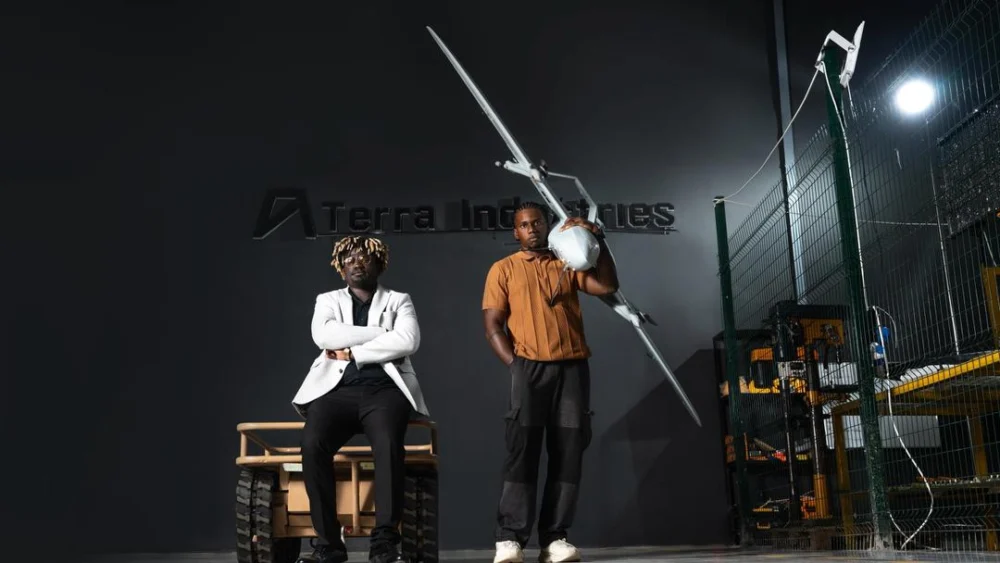
The emerging narrative of African economic ascendancy is inextricably linked to the continent’s capacity to secure its burgeoning infrastructure and critical resources. This foundational challenge—the intersection of rapid industrialization and pervasive security threats—has spurred the rise of a new generation of defense technology entrepreneurs aiming to establish endogenous capabilities. Leading this charge is Terra Industries, a company founded by Gen Z visionaries, which recently announced its emergence from stealth mode, underpinned by a substantial $11.75 million funding round.
This significant capital infusion, spearheaded by Joe Lonsdale’s 8VC, signals a powerful validation of Terra’s mission: to become Africa’s first true defense prime contractor, specializing in autonomous systems and intelligence infrastructure tailored for the continent’s unique operational environment. The funding round also saw participation from prominent global deep-tech investors, including Valor Equity Partners, Lux Capital, SV Angel, and Nova Global, alongside key African capital sources like Tofino Capital, Kaleo Ventures, and DFS Lab. The investment follows an initial $800,000 pre-seed round, indicating rapid investor confidence following early commercial traction.
The Crossroads of Opportunity and Insecurity
At the core of Terra Industries’ genesis lies the stark realization by its founders, 22-year-old CEO Nathan Nwachuku and 24-year-old CTO Maxwell Maduka, that Africa stands at an inflection point. Nwachuku, leveraging insights gleaned from five years spent building an edtech enterprise, observed the confluence of abundant capital, immense opportunity, and a dynamic, youthful demographic driving the continent toward what he describes as the “edge of an industrial revolution.”
Yet, this economic promise is perpetually shadowed by acute insecurity. Africa tragically accounts for a disproportionately high share of global terror-related fatalities, a crisis that acts as a profound brake on sustained economic development and foreign direct investment. Nwachuku emphasized that this persistent threat of terrorism and instability constitutes Africa’s most significant "Achilles heel," possessing the potential to severely impede or even halt the continent’s trajectory of growth.
Terra Industries was established to directly address this strategic vulnerability. Its mandate is to design and deploy sophisticated defense infrastructure and autonomous intelligence platforms, enabling African governments and private enterprises to proactively monitor, analyze, and respond to threats across vast and complex territories.
Building the African Defense Prime
The objective articulated by Nwachuku is monumental: to construct a pan-African defense technology ecosystem capable of protecting critical infrastructure and resources from armed aggression. This ambition necessitates more than mere hardware procurement; it demands the creation of sovereign intelligence systems.
Historically, many African nations have depended heavily on intelligence derived from external powers—be they Western nations, China, or Russia. While African armies may not lack conventional firepower, they often lack the decisive advantage of real-time, contextually relevant, and domestically controlled intelligence. This dependence introduces strategic vulnerabilities, potential conflicts of interest, and delays in crucial response times. Terra seeks to reverse this paradigm by placing the operational intelligence apparatus directly under African stewardship.
The company, headquartered in Abuja, Nigeria, has adopted a robust, multi-domain strategy to product development. This comprehensive approach acknowledges that modern security threats manifest across diverse vectors:
- Air Domain: Terra develops long-range and short-range Unmanned Aerial Systems (UAS), commonly known as drones, optimized for persistent surveillance and reconnaissance over expansive areas, crucial for border security and monitoring remote resource extraction sites.
- Ground Domain: Solutions include advanced surveillance towers and specialized ground-based autonomous vehicles (ground drones) designed for perimeter security, patrol, and rapid threat interception within defined operational zones.
- Maritime Domain: Recognizing the immense value and vulnerability of offshore assets, Terra is actively developing advanced maritime technology aimed at protecting offshore oil and gas rigs, port infrastructure, and critical underwater pipelines—a sector where piracy and illicit activities pose massive economic risk.
The ArtemisOS Backbone: Sovereign Intelligence
The operational effectiveness of Terra’s multi-domain hardware is centralized and driven by its proprietary software platform, ArtemisOS. This operating system is the intellectual core of the company, designed for the rigorous, real-time demands of defense operations.
ArtemisOS performs continuous data collection, sophisticated analysis, and synthesis of inputs from all deployed sensors and autonomous vehicles. Its primary function is rapid threat identification and classification. When a threat is detected, the system immediately generates high-fidelity alerts, routing actionable intelligence to relevant security agencies and response forces for swift interception.
Nwachuku described this as an effort to "geofence all of Africa’s critical infrastructure and resources." Geofencing, in this context, transcends simple geographic mapping; it means establishing a digital security perimeter where any intrusion or deviation from the norm triggers an intelligent, automated response sequence. This focus on intelligence superiority—rather than simply adding more conventional weapons—is the key differentiator for Terra, shifting the security paradigm from reaction to prevention.
Expert Analysis: Military Pedigree Meets Deep Tech
The successful emergence of Terra Industries is highly dependent on marrying technological innovation with deep domain expertise. The company’s structure reflects a deliberate strategy to integrate military operational knowledge directly into its engineering output.
Significantly, 40% of Terra’s engineering staff consists of former engineers from the Nigerian military. This internal expertise ensures that the autonomous systems developed are not merely technologically advanced, but also ruggedized, operationally relevant, and compliant with the stringent requirements of government defense procurement across the continent.
The advisory board further reinforces this strategic depth. Vice Air Marshal Ayo Jolasinmi of Nigeria serves as a crucial advisor, providing high-level insight into regional defense strategy and military readiness needs. Furthermore, the presence of Alex Moore, a defense investing specialist from lead investor 8VC, on the board underscores the alignment between Terra’s ambitions and the global venture capital trend favoring dual-use defense technology. Moore’s involvement, alongside the deep operational background of CTO Maxwell Maduka (who previously served as an engineer in the Nigerian Navy and founded a drone company at the age of 19), creates a formidable blend of technological foresight and institutional trust.
This fusion of military pedigree and venture-backed agile development is fundamentally disruptive to the traditional, often bureaucratic, state-to-state defense procurement model that has characterized African security spending for decades. By offering locally-developed, context-aware, and proprietary intelligence systems, Terra positions itself as a strategic partner rather than just a vendor.
Market Traction and Financial Momentum
The investment community’s confidence is not solely based on future promise; Terra has already demonstrated significant commercial traction. The company recently secured its inaugural federal contract, details of which remain confidential, validating its ability to navigate complex government procurement processes.
Financially, Terra generates revenue through two primary streams: the outright sale or deployment of Terra systems to government and commercial clients, followed by an annual recurring subscription fee for data processing, storage, and the continuous intelligence feeds provided by the ArtemisOS platform.
Nwachuku disclosed that the company has already surpassed $2.5 million in commercial revenue. Crucially, the systems currently deployed are actively protecting assets valued at approximately $11 billion. This asset base spans both public and private critical national infrastructure (CNI). Commercial revenue specifically targets private infrastructure, including gold mines, energy generation facilities, and telecommunications nodes. The company currently protects at least two major hydropower plants and several smaller mining operations, with its initial clientele heavily concentrated within Nigeria.
This early revenue generation in a high-barrier-to-entry sector validates the urgent market need for reliable, sovereign defense technology and provides a strong foundation for scaling operations across the continent.
Industry Implications: The Quest for Technological Sovereignty
Terra Industries’ rise has profound implications for the global defense market and African geopolitical stability. The concept of "technological sovereignty" is becoming increasingly critical for developing nations. By establishing a local defense prime, Africa reduces its reliance on external suppliers who may impose export restrictions, come with geopolitical strings attached, or lack the nuanced understanding of local threat matrices.
This move aligns with broader global trends where nations are realizing that the intelligence derived from defense systems—the data gathered on internal movements, border crossings, and critical resource stability—is as valuable, if not more so, than the hardware itself. By controlling the ArtemisOS data pipeline, African nations maintain control over their most sensitive security information.
Furthermore, the expansion of Terra’s manufacturing capabilities across Africa, fueled by the new capital, represents a significant boost to local industrial capacity and job creation. While software development offices will be established in global technology hubs like San Francisco and London to attract world-class AI and engineering talent, the commitment to keeping manufacturing operations firmly rooted in Africa reinforces the mission of economic empowerment alongside security enhancement. This local production model shortens supply chains, reduces costs, and builds a sustainable industrial base.
Future Trajectory and Long-Term Vision
The $11.75 million in fresh capital is earmarked for aggressive expansion across several key operational fronts. A significant portion will be dedicated to scaling production, establishing additional defense manufacturing facilities across the continent to meet anticipated demand from multiple African states.
Simultaneously, the company plans a major investment in its software and artificial intelligence capabilities. Growing the AI team is central to enhancing ArtemisOS’s predictive analytics capabilities, allowing security forces to anticipate threats based on complex patterns of life and historical data, moving beyond simple reactive alerts.
Nwachuku concluded with a sober assessment of the stakes involved, positioning Terra’s mission within a larger historical context: “It’s clear Africa today is undergoing what I see as an epic struggle for its very survival. The only way for us to truly break ourselves from the shackles that have held us back for the last decade or two is ensuring the core resources, the core infrastructures of the continent, are entirely protected.”
Terra Industries represents a crucial technological pivot. It is not merely a startup building drones; it is a strategic initiative aimed at weaponizing intelligence and leveraging autonomous systems to safeguard the foundations of Africa’s industrial future. The successful integration of locally developed, sovereign defense technology is poised to be a defining factor in determining whether the continent fully realizes its economic potential in the 21st century, transitioning from a region defined by vulnerability to one empowered by self-reliance and robust security architecture. The backing of leading global venture capital firms suggests that this transition is not only necessary but is now viewed as a commercially viable and strategically essential undertaking.
