

The landscape of the European automotive industry is currently undergoing a period of profound structural realignment, following a fiscal year in 2025 that many analysts have characterized as a "perfect storm" of volatility. For institutional investors who have spent the last eighteen months navigating a minefield of plummeted profits, trade tariff turbulence, and the rigid enforcement of electric vehicle (EV) mandates, the horizon for 2026 is finally beginning to show signs of hard-won stability. While the industry is far from returning to its pre-pandemic "golden age," the emerging consensus suggests that the worst of the external shocks may have peaked, giving way to a more predictable, albeit highly competitive, operational environment.
The recent Brussels Motor Show served as a critical barometer for this sentiment. It was not merely a showcase of new sheet metal, but a strategic theater where the tension between legacy European craftsmanship and the aggressive expansion of Chinese manufacturing was on full display. As car buyers prepare for the 2026 model year, they are being met with a market that is more diverse, more electrified, and more price-sensitive than ever before. However, for the manufacturers themselves, the road to 2026 is paved with the necessity for drastic internal restructuring and a sober reassessment of global supply chain dependencies.
The 2025 Hangover and the 2026 Low-Base Advantage
To understand the cautious optimism surrounding 2026, one must first acknowledge the depth of the 2025 downturn. Last year, Western European auto sales—encompassing the powerhouse markets of Germany, France, the United Kingdom, Italy, and Spain—stagnated at approximately 11.8 million units. While this represented a marginal 2% increase over the previous year, the figure remains a staggering four million units below the pre-COVID baseline of nearly 16 million annual sales.

This massive delta in volume has created a crisis of unused capacity. When factories built to produce five million cars are only churning out three million, the fixed costs become an anchor on profitability. This reality forced the hands of industry giants like Volkswagen and Stellantis, both of whom manage a sprawling portfolio of brands that account for nearly 45% of the total European market. The plant closures and temporary furloughs witnessed in 2025 were painful but necessary "right-sizing" maneuvers intended to protect balance sheets ahead of the 2026 recovery.
Investment researchers at Jefferies have noted that because the industry is starting from such a depressed "low base," the growth prospects for Europe in 2026 may actually outpace those of the United States and China. This is a rare reversal of recent trends, driven largely by the continued, if uneven, transition toward electrification and the realization of cost-cutting measures initiated during the previous year’s crisis.
The Brussels Debutants: Defensive Volleys Against the East
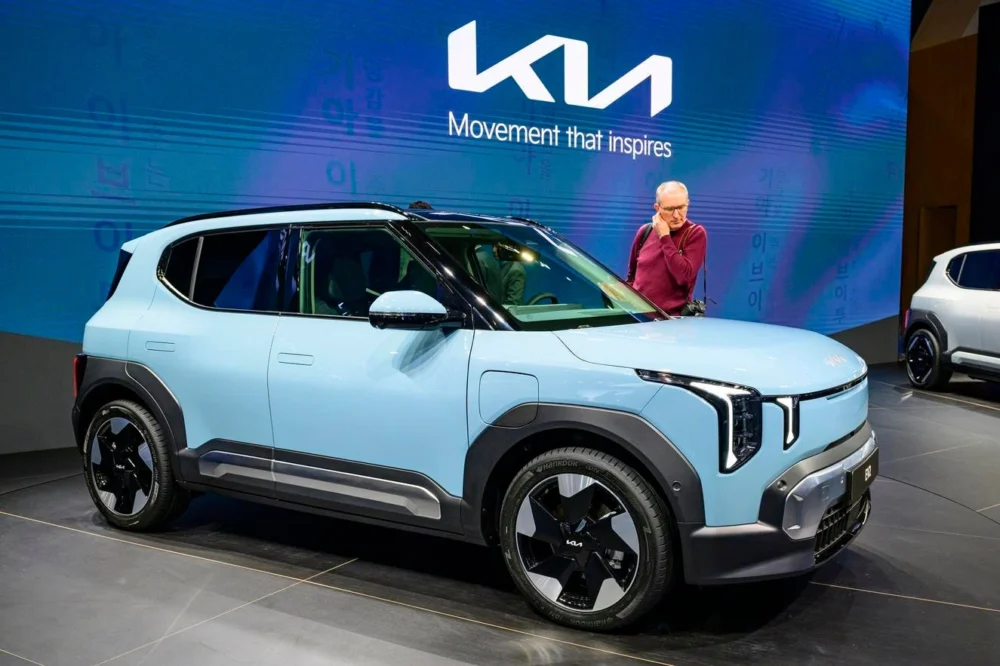
The product strategy for 2026, as evidenced by the debuts in Brussels, is centered on the "mass-market EV." For years, European manufacturers focused on high-margin luxury EVs, leaving the entry-level segment vulnerable to Chinese disruption. That is now changing. The global debut of the Kia EV2, a compact electric SUV, signals a direct assault on the sub-€30,000 segment, placing it in direct competition with the Renault 4 and the Citroën e-C3.
Citroën’s unveiling of the ELO concept—a multipurpose electric vehicle featuring innovative sliding doors—further emphasizes the shift toward utility and affordability. Meanwhile, Mazda’s CX-6e represents the Japanese manufacturer’s second serious attempt to capture the European electric SUV market. These vehicles are not just new products; they are defensive fortifications designed to prevent further market share erosion.

However, the "threat from the East" is no longer a looming shadow; it is a present reality. The Brussels show floor featured no fewer than nine new models from BYD, including the Atto 2 DM-i, a compact plug-in hybrid SUV that targets the heart of the European family car market. With additional entries from Chery, Leapmotor (a Stellantis affiliate), SAIC’s MG, and Xpeng, the Chinese offensive is utilizing a multi-pronged approach: superior battery technology, integrated software stacks, and aggressive pricing that legacy OEMs are struggling to match.
Profitability and the Margin Dilution Dilemma
Despite the projected increase in sales volume for 2026, analysts from Fitch Ratings warn that profitability will remain "subdued." The primary culprit is a shift in the sales mix. To meet stringent EU emissions mandates, manufacturers are being forced to push lower-margin electric vehicles and smaller, mass-market models. While these sales help avoid massive regulatory fines, they do not offer the same "cushion" as the high-margin internal combustion engine (ICE) SUVs that have historically funded the industry’s R&D.
Renault, in particular, is navigating this margin dilution. As it aggressively expands its EV lineup, the company is finding that the cost of batteries and the price-war environment created by Tesla and Chinese manufacturers are squeezing its traditionally healthy margins. For investors, the 2026 story is less about record earnings and more about "strategic survival"—who can transition to EVs without incinerating their cash reserves?
The Geopolitical Supply Chain: Chips, Magnets, and Protectionism
Perhaps the greatest risk to the 2026 outlook lies in the fragile web of global trade. European automakers are net importers of the very components that define the modern vehicle: semiconductors and rare-earth elements. The ongoing trade friction between the U.S., the EU, and China has turned the automotive supply chain into a geopolitical chessboard.

Recent restrictions on the export of advanced semiconductors to China, coupled with China’s retaliatory curbs on rare-earth magnets—essential for EV motors—have heightened the risk of production stoppages. Fitch Ratings suggests that while near-term disputes may see temporary thaws, the underlying tensions are likely to re-emerge in 2026. This puts pressure on working capital, as manufacturers are forced to stockpile critical components, and weighs on production volumes if "just-in-time" logistics fail once again. The resilience of the European supply chain is being tested, prompting a frantic search for localized mineral processing and battery manufacturing within the Eurozone.
Corporate Forecasts: Winners and Laggards
In this environment of "stable disruption," investment houses are beginning to pick winners. Stellantis and Volkswagen are currently favored to show the most significant operational improvements in 2026. For Stellantis, the focus is on rebuilding share price through a reset of capital allocation and a clearer articulation of its multi-brand strategy. After a period of perceived strategic drift, the company is expected to leverage its massive scale to drive down EV production costs.
Volkswagen’s progress, though historically slow, is finally becoming "tangible." The German giant is beginning to see the fruits of its labor in core margin improvement and fixed-cost reduction. Crucially, VW appears better positioned for CO2 compliance in 2026 than it was two years ago.
Conversely, the premium segment—represented by BMW and Mercedes-Benz—is entering what many describe as a "transition year." Both companies face flat profit projections as they navigate the high costs of dual-platform manufacturing (maintaining both ICE and EV architectures) while waiting for their next-generation electric platforms to reach full scale.

The Regulatory Pivot: A "Timid" Concession
One of the most significant developments for the 2026 outlook is the European Commission’s recent adjustment of the CO2 emissions regime. In a nod to the immense pressure facing the industry, the 2035 target for zero-emission vehicles was slightly relaxed from 100% to 90%. While Jefferies described these concessions as "timid," they represent a vital psychological shift in Brussels.
The emerging focus on "local content" and "European preference" suggests that the EU may finally be willing to implement protectionist measures similar to those seen in the U.S. Inflation Reduction Act. Plans to stimulate the sale of small, European-made EVs could provide a much-needed lifeline for local suppliers. However, these measures still require the approval of a fragmented European Parliament, making the regulatory environment a key area of "known unknown" for 2026.
Conclusion: Preparing for the Unpredictable
As the industry pivots toward 2026, the watchword is "resilience." The era of easy growth and predictable margins has been replaced by a landscape defined by strategic shifts and impairment risks. European automakers are no longer just competing with each other; they are fighting for their relevance in a global market that is being redefined by software, battery chemistry, and geopolitical alignment.
While 2026 promises more stability than the chaotic years that preceded it, investors remain prepared for surprises. The ability of legacy brands to "cooperate with their Chinese counterparts" while simultaneously defending their home turf will be the defining narrative of the decade. For the battered auto investor, 2026 represents not a return to the past, but the first stable footing in a very different future.
