

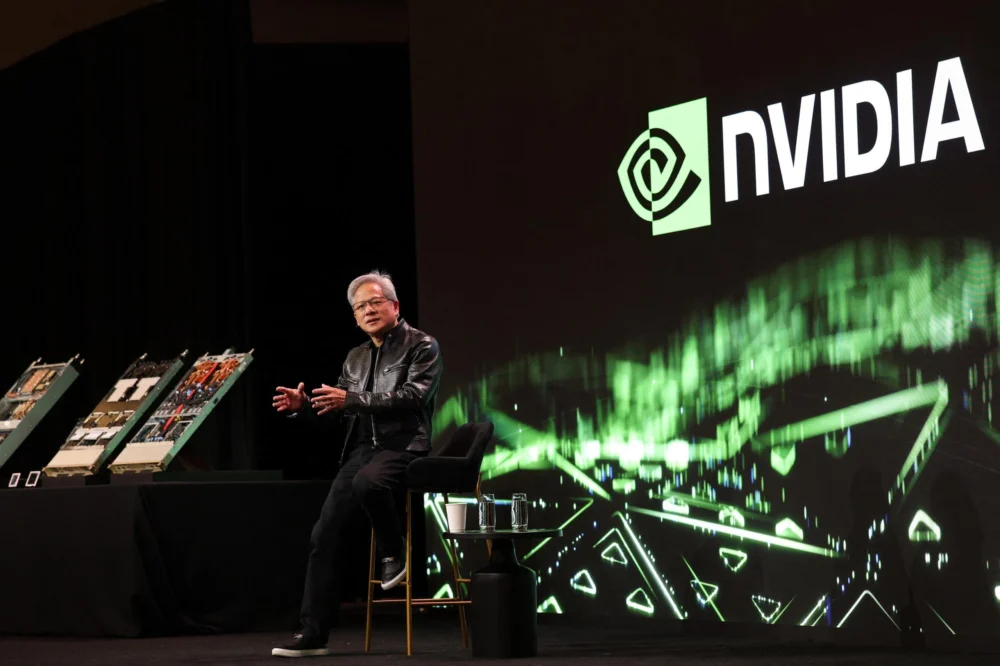
The annual Consumer Electronics Show in Las Vegas has historically served as a neon-lit playground for the latest in consumer hardware, from ultra-thin televisions to experimental wearable tech. However, as the 2026 edition of the event demonstrated, the gravitational pull of the technology sector has shifted. Under the leadership of Jensen Huang, Nvidia has effectively transcended its origins as a provider of high-end graphics cards for enthusiasts. Today, the company functions as the primary architect of the global artificial intelligence economy. At CES 2026, the narrative was not about individual gadgets, but about the total integration of AI into the physical and industrial fabric of modern society.
The centerpiece of this transition is the unveiling of Rubin, Nvidia’s next-generation AI platform. Named in honor of the pioneering astrophysicist Vera Rubin—whose work provided the first evidence of dark matter—the platform represents a fundamental shift in how computing power is conceptualized. In the previous decade, a "product launch" in the semiconductor space meant a faster chip with more transistors. With Rubin, Nvidia is signaling that the era of isolated components is over. We have entered the age of the integrated AI factory.
To understand the significance of Rubin, one must look past the raw specifications of its GPUs and CPUs. The architecture is designed as a holistic system that synthesizes processing power, high-speed networking, and sophisticated software layers into a single, cohesive unit. This approach addresses the most pressing bottleneck in modern AI development: the "data movement" problem. As large language models (LLMs) and generative systems grow in complexity, the challenge is no longer just how fast a processor can calculate, but how quickly data can move between thousands of processors. Rubin’s new interconnects and networking protocols are engineered specifically to eliminate these stalls, ensuring that the massive clusters used by cloud providers operate at peak efficiency.
Furthermore, Rubin addresses the escalating crisis of energy consumption. As global data center capacity struggles to keep pace with the demands of AI training, the "work per watt" metric has become the most critical KPI for enterprise leaders. Nvidia’s new architecture promises a dramatic reduction in the energy required to generate a single unit of AI output. By making AI cheaper and less environmentally taxing to run, Nvidia is not just selling hardware; it is ensuring the long-term economic viability of the AI boom itself.
This shift from "digital AI" to what Huang describes as "physical AI" was perhaps the most compelling theme of the conference. While the first wave of the AI revolution was defined by chatbots and image generators—systems that live entirely within the digital realm—the second wave is about atoms. Nvidia is positioning itself as the brain for the machines that will navigate our world. The introduction of Alpamayo, a sophisticated AI model and reasoning platform for autonomous vehicles, serves as the vanguard for this movement.
Unlike traditional autonomous driving systems that rely heavily on pattern recognition and object detection, Alpamayo is built for reasoning. It is designed to handle the "edge cases" that have long plagued the self-driving industry—the unpredictable human behaviors and complex environmental scenarios that require a level of contextual understanding beyond simple vision. By focusing on intent and logic rather than just pixel-matching, Nvidia aims to move the needle from driver assistance toward true autonomy. The announcement that Mercedes-Benz will integrate Alpamayo into its future fleet is a significant validation of this approach. It signals that the automotive industry is moving away from proprietary, fragmented software stacks toward a standardized AI infrastructure provided by Nvidia.
This push into the physical world extends beyond the asphalt. Through partnerships with industrial giants like Siemens, Nvidia is demonstrating how AI-driven simulation can revolutionize manufacturing and energy research. The concept of the "Digital Twin"—a perfect virtual replica of a physical system—is being supercharged by Rubin’s processing power. Whether it is optimizing a factory floor for maximum throughput or simulating the complex physics of nuclear fusion with Commonwealth Fusion Systems, Nvidia is providing the tools to solve real-world engineering challenges in virtual environments before a single brick is laid or a bolt is turned.

Despite the heavy emphasis on enterprise and industrial applications, Nvidia did not entirely abandon its gaming roots. The announcement of DLSS 4.5 (Deep Learning Super Sampling) represents the latest evolution in AI-driven graphics. For years, Nvidia has used AI to "hallucinate" high-resolution frames and increase performance without increasing the load on the hardware. DLSS 4.5 pushes this further, utilizing more advanced neural models to provide image quality that often surpasses native resolution.
However, the role of gaming within Nvidia’s broader strategy has changed. It is no longer the primary driver of revenue, but it remains the company’s most vital research and development sandbox. The same real-time inference and model optimization techniques developed for gamers are eventually refined and ported into mission-critical enterprise systems. Moreover, updates to the GeForce NOW cloud gaming service reflect a move toward recurring service revenue. By decoupling high-end gaming from the need for expensive local hardware, Nvidia is essentially turning its data center prowess into a consumer utility.
One of the most revealing aspects of CES 2026 was what remained unsaid. There was no grand reveal of a new mainstream consumer GPU, a move that might have disappointed some enthusiasts but speaks volumes about Nvidia’s current market position. The company is currently operating in a state of high-demand saturation. It does not need to chase headlines with incremental hardware refreshes for consumers when its enterprise backlog remains the envy of the tech world. This restraint suggests a company that is confident in its long-term roadmap and focused on the high-margin, high-impact world of infrastructure.
The strategic implications of Nvidia’s current trajectory are profound. By providing a "full-stack" solution—spanning from the silicon and the networking to the software libraries and the pre-trained models—Nvidia is creating a level of platform lock-in that is unprecedented in the history of computing. For an enterprise, switching away from Nvidia is no longer as simple as buying a different chip; it would mean rebuilding an entire software and networking ecosystem. This "moat" is what differentiates Nvidia from competitors like AMD or Intel, who are still largely focused on the component level of the market.
For the broader technology industry, this dominance presents a complex set of challenges. While Nvidia’s standardized architectures reduce risk and accelerate deployment for businesses, they also create a centralized point of failure and a significant dependency on a single vendor. As AI becomes as fundamental to the economy as electricity or telecommunications, the question of who controls the underlying infrastructure becomes a matter of national and economic security.
Looking ahead, the trends established at CES 2026 suggest a future where AI is invisible yet omnipresent. We are moving toward a world where the "intelligence" of a car, a robot, or a factory is not an add-on feature, but a core component of its identity. Nvidia’s Rubin platform is the foundation upon which this future is being built. By shifting the focus from chips to factories, from pixels to atoms, and from perception to reasoning, Nvidia has effectively redefined the boundaries of the semiconductor industry.
As the curtains close on another year in Las Vegas, the message for business leaders and technologists is unmistakable. The era of experimenting with AI as a peripheral tool is over. We are entering an era where AI is the system. Whether or not companies are comfortable outsourcing the "brains" of their future operations to a single provider, Nvidia has made it clear that they are the only ones currently capable of delivering the scale, efficiency, and integration required for the next industrial revolution. The leather-clad CEO has traded the graphics card for the keys to the global data center, and based on the revelations of 2026, the world is eager to see where he leads it next.
