

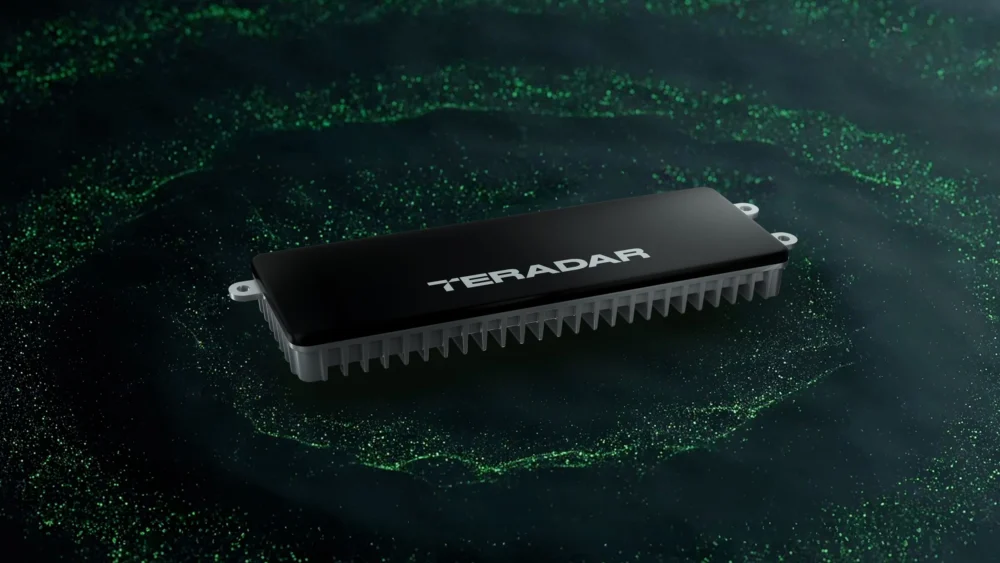
The global race toward achieving robust, all-weather autonomous driving capabilities has long been characterized by a sensor stack war, primarily pitting high-resolution Light Detection and Ranging (Lidar) against cost-effective Radio Detection and Ranging (Radar). A formidable new entrant, Boston-based Teradar, has officially thrown down the gauntlet, unveiling its flagship terahertz-band sensor, the Summit, at the highly anticipated 2026 Consumer Electronics Show (CES). This public debut comes just two months after the company successfully exited stealth mode, armed with a substantial $150 million Series B funding round, positioning the firm to fundamentally challenge the incumbent sensor architecture dominating the Advanced Driver-Assistance Systems (ADAS) and autonomous vehicle (AV) markets.
Teradar is aggressively marketing the Summit as a paradigm shift, claiming it is the industry’s first long-range, high-resolution sensor specifically engineered to maintain peak performance irrespective of meteorological conditions. The company’s core thesis centers on filling a critical, persistent vulnerability inherent in current sensor suites: the performance degradation of Lidar in dense fog, heavy rain, or snow, and the inherent lack of spatial resolution that plagues traditional microwave radar.
The Physics of the ‘T-Ray’ Advantage
The foundational innovation underpinning Teradar’s strategy lies in its exploitation of the terahertz (THz) band of the electromagnetic spectrum, often referred to as the "terahertz gap." This frequency range occupies the space between the high end of microwaves (where traditional automotive radar operates, typically 77 GHz) and the low end of infrared light (used by Lidar). Spanning roughly 0.1 THz to 10 THz, terahertz waves—or T-rays—possess unique propagation characteristics that grant them superior imaging capability in environments that scatter or absorb visible and infrared light.
While Lidar, which uses near-infrared wavelengths, provides exceptional angular resolution and 3D point cloud mapping, its effectiveness plummets when atmospheric particulates (water droplets, snowflakes) are present, as these elements effectively block or scatter the optical signal. Conversely, traditional radar waves penetrate these conditions easily but suffer from poor angular separation, making it difficult to differentiate between small, closely spaced objects, such as a pedestrian standing near a guardrail.
Terahertz waves offer a compelling compromise. They operate at frequencies high enough to enable imaging with resolutions approaching that of Lidar—capable of resolving fine geometric details and distinguishing material types—yet their longer wavelengths, relative to infrared, allow them to significantly penetrate fog and dust with minimal attenuation. This technological synthesis promises the best attributes of both legacy systems: the all-weather resilience of radar coupled with the high-definition spatial mapping crucial for Level 4 and Level 5 autonomy.
Furthermore, the Summit sensor utilizes a solid-state architecture. The absence of moving mechanical components—a major cost and reliability bottleneck for many early-generation Lidar units—ensures enhanced robustness, faster manufacturing scalability, and easier integration into the aesthetic and physical constraints of modern vehicle design. For OEMs focused on reliability over a decade-long product lifecycle, a solid-state, weather-agnostic sensor presents a highly attractive total cost of ownership proposition.
Navigating the Autonomous Sensor Market Turmoil
Teradar’s entry into the mobility sector is perfectly timed to capitalize on significant upheaval within the established sensor ecosystem. The autonomous sensor market is undergoing a painful correction following a period of massive speculative investment fueled by Special Purpose Acquisition Companies (SPACs).
The most telling sign of this volatility came in December 2025, when Luminar, once a leading U.S. Lidar innovator with high-profile production deals, filed for bankruptcy protection. This collapse followed the disintegration of major contracts with automotive titans like Volvo and Mercedes-Benz. Industry analysts cite multiple factors for these reversals: high unit costs, challenges in achieving automotive-grade durability, and, critically, the inability of the technology to consistently perform in all driving conditions—the exact technological Achilles’ heel Teradar aims to exploit.
The competitive landscape is further complicated by intense pricing pressure originating from Asia. Chinese Lidar firms, exemplified by Hesai, have achieved staggering manufacturing scale, dramatically driving down the average selling price (ASP) of sensor units. Hesai’s announcement in October 2025 that it had produced over one million Lidar sensors that year underscores a fundamental shift: the race is no longer just about technical specifications, but about achieving industrial-scale, cost-effective production. For US and European sensor providers, this necessitates either radical technological differentiation or a fundamental restructuring of business models.
The resulting market consolidation has already begun, as seen when Ouster acquired and merged with rival Velodyne. For companies like Ouster, diversification beyond the turbulent automotive sector—targeting lucrative, less volatile markets such as robotics, logistics, and smart infrastructure—has become a necessary survival strategy.
The OEM Validation Challenge and 2028 Horizon
For Teradar, the technological promise must now be translated into verifiable, production-ready contracts. The company has set an ambitious shipping commencement target of 2028, contingent upon securing firm contracts with leading automakers. This two-year validation window is standard for safety-critical components and reflects the rigorous testing cycles required by Tier 1 suppliers and Original Equipment Manufacturers (OEMs).
Encouragingly, Teradar is not starting from zero. The firm reports active development programs with five major automakers spanning the U.S. and European markets, alongside collaboration with three prominent Tier 1 automotive suppliers. These partnerships are crucial, as Tier 1 suppliers often act as the gatekeepers, handling the integration, ruggedization, and quality control necessary to move a raw technology into a mass-market vehicle platform. If successful, Teradar anticipates the Summit sensor will be instrumental in enabling vehicle manufacturers to deploy sophisticated ADAS features (Level 2+ autonomy) and potentially, true Level 4 (L4) autonomy in defined operational design domains (ODDs).
Expert Analysis: The New Calculus of Sensor Fusion
The automotive industry has traditionally relied on a principle of sensor redundancy, fusing data from dissimilar modalities to create a robust environmental model. The introduction of a high-resolution terahertz modality fundamentally alters the cost-benefit analysis of this fusion stack.
Dr. Eleanor Vance, a consultant specializing in automotive electronics and perception systems, suggests that Teradar’s offering could lead to "Sensor Fusion 3.0." "Current Lidar systems often require heavy computational resources to clean up data corrupted by weather, or they simply fail to provide necessary range in critical conditions," Vance explains. "If Terahertz sensing can deliver high-resolution imagery with the resilience of radar, it could potentially replace high-cost, high-maintenance Lidar units in certain applications, or at least significantly reduce the reliance on complex, expensive sensor stacks currently required to compensate for Lidar’s weather limitations."
The primary appeal for automakers is not just performance, but total system cost and complexity. Lidar remains prohibitively expensive for most mass-market vehicles, and even advanced, high-definition radar (HD Radar) struggles to meet the resolution requirements for urban L4 driving. By offering a technology that is inherently solid-state and leverages relatively mature semiconductor manufacturing processes (compared to exotic laser assemblies), Teradar may achieve an ASP that is palatable for high-volume vehicle production, thereby democratizing L4 enabling technology.
However, the path to mass adoption is fraught with engineering challenges. Introducing a new frequency band requires extensive validation regarding interference, regulatory compliance (especially concerning global spectrum allocation), and the development of entirely new signal processing and perception algorithms tailored to T-ray data. Automakers, stung by the recent instability in the Lidar sector, will demand absolute proof of reliability, durability, and a clear path to cost reduction before committing to long-term supply contracts.
Dual-Use Technology and Strategic Investment
The potential impact of Teradar’s technology extends well beyond passenger vehicles. The firm’s recent $150 million Series B funding round provides critical insight into its strategic diversification plans. The funding included investments from Lockheed Martin’s venture arm and VXI Capital, a new defense-focused fund led by the former CTO of the U.S. military’s Defense Innovation Unit.
This defense investment signals a strong interest in the dual-use applications of terahertz technology. The military and aerospace sectors require imaging systems capable of penetrating highly dense obscurants (smoke, dust storms) or materials for non-destructive testing (NDT) and secure, high-bandwidth short-range communications. The ability of terahertz waves to function effectively through challenging media translates directly to superior surveillance, navigation, and targeting systems in adverse conditions. This defense backing provides Teradar with capital runway, access to specialized engineering expertise, and, crucially, a diversified revenue stream that can stabilize the company during the long, arduous automotive validation phase.
Beyond defense, the T-ray sensor is highly relevant for robotics, industrial automation, and smart infrastructure. These sectors demand high-fidelity, reliable perception in environments often polluted by steam, dust, or industrial debris, areas where camera and Lidar systems often struggle.
The Future Landscape: Affordability and the Path to Ubiquity
Despite the recent setbacks faced by Lidar providers, the demand for advanced sensor technology remains robust. Rivian’s December announcement that it would integrate a roof-mounted Lidar sensor (from an unnamed supplier) into its upcoming R2 SUV platform confirms that high-resolution 3D mapping technology is still viewed as essential for delivering competitive autonomy features to the consumer market, provided the cost can be managed.
Teradar CEO Matt Carey has articulated a clear, highly ambitious goal for the company: ubiquity. In November 2025, Carey stated that the company’s "main job is to make sure our sensor gets on all automobiles, and whatever the best way to do that is, that’s what we’re going to pursue."
This statement is a direct acknowledgment that succeeding in the automotive space requires more than just performance; it requires strategic partnerships and an aggressive pricing strategy. If Teradar can successfully transition its novel technology from the lab to high-volume manufacturing while maintaining cost control—an objective aided significantly by the solid-state design—it has the potential to become the third pillar in the automotive sensor trifecta, potentially displacing Lidar or forcing its cost point down dramatically.
Ultimately, the viability of the Summit sensor hinges on its ability to prove, unequivocally, that it can deliver the Lidar-level resolution required for safe, high-speed decision-making, while operating reliably under the adverse weather conditions that have historically paralyzed the industry’s progression toward mass-market L4 autonomy. The 2028 production target marks the beginning of the crucial validation period that will determine if terahertz technology is truly the missing link in the quest for fully realized self-driving vehicles.
