

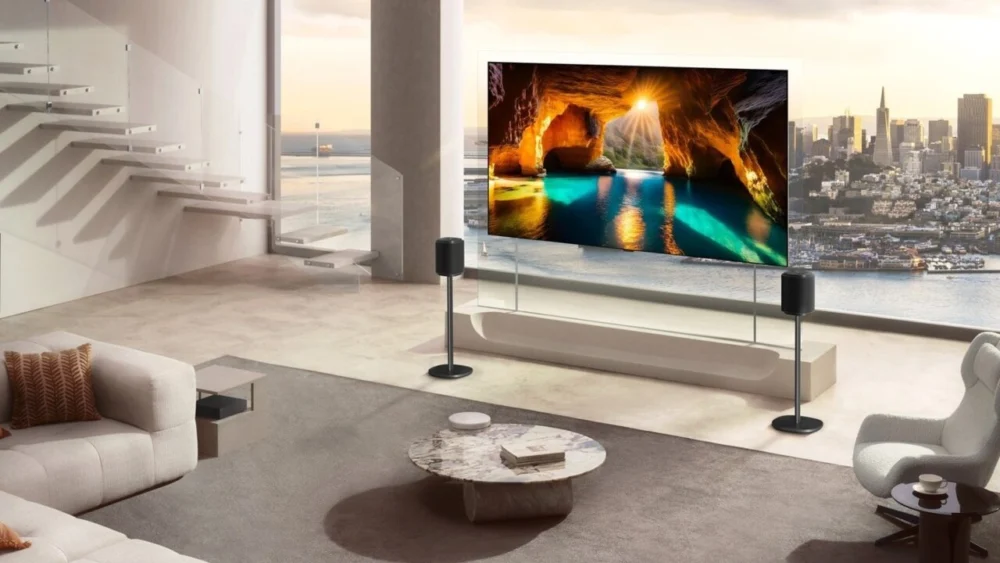
The landscape of home entertainment technology has perpetually chased the ideal of seamless integration, a vision where sophisticated hardware disappears into the domestic environment, leaving only the content. LG Electronics, a perennial pioneer in display innovation, has recently signaled a significant step toward this zenith at the recent iteration of CES 2026, formally reintroducing and fundamentally evolving its iconic "Wallpaper TV" concept. This new iteration, dubbed the LG OLED evo W6, is being positioned not merely as an iterative update but as the world’s first truly wireless OLED television, directly confronting the aesthetic compromises that historically hampered its predecessors.
To fully appreciate the magnitude of the W6’s redesign, one must revisit the genesis of this concept. The original LG W7 Wallpaper TV, launched in 2017, was a marvel of engineering—a panel so impossibly thin it adhered to the wall with magnetic precision, mimicking a sheet of art or, indeed, wallpaper. This thinness, however, came tethered to a substantial caveat: the necessary external connection hub. In the W7’s architecture, this hub was cleverly disguised as a bulky, integrated Dolby Atmos soundbar. While this offered high-fidelity audio in one package, it created a critical conflict for consumers investing in custom, high-end audio solutions. For audiophiles or those opting for sophisticated in-wall or ceiling speaker systems, the required soundbar became an aesthetic and functional redundancy, undermining the entire premise of the wire-free display. It was a case where technological ambition was constrained by necessary connectivity, creating an inherent design paradox.
The unveiling of the LG OLED evo W6 at CES 2026 marks a definitive pivot away from this compromise. LG has successfully decoupled the display from the primary input and audio processing unit, a move that transcends mere convenience and enters the realm of high-end interior design. The core innovation enabling this is the introduction of the "Zero Connect Box." This external hub serves as the singular gateway for all sources—gaming consoles, streaming sticks, media players, and auxiliary audio components. Crucially, it manages video, audio signals, and all conventional inputs, transmitting them wirelessly to the OLED panel itself. The panel remains tethered only by a single power cord, allowing it to achieve a level of wall integration previously unattainable without significant infrastructure modification.
This shift addresses the fundamental friction point of the previous generation. By externalizing the connectivity into a discrete, albeit still necessary, box, the W6 liberates the visual component. For luxury custom installers and discerning homeowners focused on minimalist design—where every visible cable is an architectural failing—this wireless transmission capability is the feature that finally validates the Wallpaper TV concept.
However, achieving this wireless feat has necessitated a slight, yet understandable, adjustment in physical dimensions. Where the W7 boasted a near-microscopic thickness of approximately 2.57mm, the W6 measures around 9mm. While this represents a noticeable increase, it must be contextualized against the backdrop of modern smartphone thickness and the technological hurdles overcome. This added girth is likely dedicated to housing robust, high-bandwidth wireless transmission hardware, sophisticated signal processing circuitry, and advanced thermal management systems required to safely operate a large-format OLED panel without direct physical ventilation pathways connecting it to the source hub. From a practical standpoint, 9mm, mounted magnetically flush against a wall, remains virtually invisible to the casual observer, maintaining the illusion of a floating canvas.
Beyond the revolutionary connectivity, the W6 is deeply embedded in LG’s current peak display technology. It leverages the latest iteration of OLED panel engineering, likely featuring Micro Lens Array (MLA) technology enhancements or equivalent next-generation light-emitting materials that push luminance boundaries. The integration of the Alpha 11 AI Processor Gen3 is central to this performance boost. LG claims a significant advancement in the Neural Processing Unit (NPU) component of this chip—a 5.6-fold increase in processing speed over previous generations. This elevated computational capability translates directly into tangible visual enhancements, notably through features like Hyper Radiant Color Technology and the refined Brightness Booster Ultra system. The result is peak brightness output reportedly reaching 3.9 times that of a standard, baseline OLED panel, addressing one of OLED’s historical weaknesses in brightly lit environments.
The implications for the high-end gaming sector are particularly noteworthy. The Zero Connect Box is engineered to transmit uncompressed 4K video streams at demanding high refresh rates with near-zero perceptible latency. This addresses a major concern associated with wireless video transmission: input lag. The W6 explicitly supports modern console standards and PC connectivity, boasting 4K resolution at a fluid 165Hz refresh rate, complete with adaptive sync technologies like NVIDIA G-Sync and AMD FreeSync. In effect, LG has positioned the W6 as a statement piece that functions equally well as an enormous, high-performance gaming monitor. This dual functionality—a piece of minimalist wall art that doubles as a competitive-grade display—broadens its appeal significantly beyond traditional home theater aficionados.
Furthermore, LG has preemptively tackled a common issue with large, high-gloss displays mounted in primary living spaces: reflections. The W6 has secured Reflection Free Premium certification. This is a crucial differentiator in the premium segment, ensuring that ambient light, whether from windows or interior fixtures, does not compromise the viewing experience by turning the screen into a reflective surface, thus preserving the deep blacks and contrast that define OLED technology.
The strategic reintroduction of the Wallpaper TV, now unburdened by its most significant flaw, speaks volumes about LG’s long-term vision for display technology and the consumer electronics market at large.
Industry Implications and The Pursuit of Invisible Tech
The LG OLED evo W6 is more than just a product launch; it is a clear declaration regarding the future trajectory of premium consumer electronics. The industry is rapidly moving toward what can be termed "contextual technology"—devices that enhance the environment without dominating it visually. This trend is evident across home audio (invisible speakers, sound-emitting paint), computing (projected interfaces), and now, display technology.
For years, the "thinness war" in television manufacturing led to panels that were aesthetically beautiful when powered off but required cumbersome cable management when in use. LG’s wireless solution bypasses the need for complex in-wall conduit installation, which is often costly, difficult to retrofit, or simply impossible in certain architectural settings (e.g., rented properties or historic homes). By solving the wireless AV transmission challenge at the highest fidelity (uncompressed 4K HDR), LG is setting a new benchmark for what consumers should expect from flagship displays.
This move exerts immediate pressure on competitors, particularly Samsung and Sony, to accelerate their own research into high-bandwidth, low-latency wireless display protocols. While wireless HDMI extenders exist, they often require proprietary transmitters and receivers that still involve cabling runs, or they rely on compression that compromises visual integrity, especially at 120Hz or 165Hz required for cutting-edge gaming. LG’s proprietary Zero Connect system suggests they have achieved a technological lead in over-the-air signal integrity that will take rivals time to match or surpass.
Expert Analysis: The Wireless Hurdle and Power Constraints
From an engineering perspective, the leap to true wireless transmission in a high-end TV involves overcoming significant hurdles related to signal integrity and power consumption. Video transmission protocols, especially those handling uncompressed 4K/120Hz or 165Hz signals with full HDR metadata, demand staggering amounts of bandwidth. Maintaining this link reliably across a room, navigating potential interference from Wi-Fi, Bluetooth, and other home electronics, requires sophisticated beamforming, error correction, and frequency hopping algorithms. The 9mm thickness of the W6 is a physical testament to the complexity of miniaturizing the necessary antenna arrays and RF shielding alongside the panel’s own components.
The persistent reliance on a power cable, while seemingly a minor detail, remains the last physical tether. True wireless power transmission over meaningful distances for a high-draw appliance like a 77-inch or larger OLED TV remains firmly in the realm of speculative future technology, limited by efficiency and safety concerns. For the foreseeable future, the "true wireless" claim in this context is best interpreted as "zero signal cabling."
However, the AI processing unit’s enhanced NPU performance is perhaps the most forward-looking component. As displays become more sophisticated conduits for media rather than just passive screens, the onboard processing must handle real-time upscaling, object recognition for dynamic tone mapping, and sophisticated noise reduction, all while simultaneously managing the wireless reception buffer. A 5.6x faster NPU suggests LG is preparing for future video codecs and higher resolution standards (perhaps 8K integration or advanced spatial audio processing) well before they become mainstream requirements.
Future Impact and Architectural Integration
The LG OLED evo W6 is set to significantly influence high-end interior design trends. If the pricing places it firmly in the ultra-premium category—as is highly probable—it will initially target luxury residential projects, boutique hotels, and executive boardrooms where budget constraints are secondary to aesthetic impact.
The success of the W6 will likely precipitate a cascade effect across the broader TV market. Consumers who experience the visual liberation of a truly cable-free primary display will inevitably demand similar, perhaps less expensive, iterations for their secondary viewing areas. This could drive down the cost and complexity of wireless AV transmission technology, eventually trickling down to mid-range models, forcing manufacturers to standardize wireless connectivity solutions similar to how HDMI became ubiquitous.
Furthermore, the W6’s integration of high-refresh-rate gaming features alongside cinematic performance suggests the convergence of the television and the high-end personal monitor is accelerating. As screen sizes grow and remote/hybrid work environments become standard, consumers are increasingly unwilling to maintain separate, dedicated setups for entertainment and productivity. A television that performs flawlessly as both a massive gaming display and an unobtrusive piece of living room art fulfills this burgeoning demand for convergence.
In conclusion, LG’s reintroduction of the Wallpaper TV, engineered around the Zero Connect Box, represents a pivotal moment. It solves the primary design flaw of a groundbreaking concept, pushing the boundaries of what consumers define as minimalist luxury in digital display technology. While the cost will likely restrict initial adoption to the highest echelon of the market, the technological groundwork laid by the W6—especially the seamless wireless transmission of uncompressed, high-frame-rate video—signals a clear and compelling direction for the entire display industry toward ultimate aesthetic integration.
