

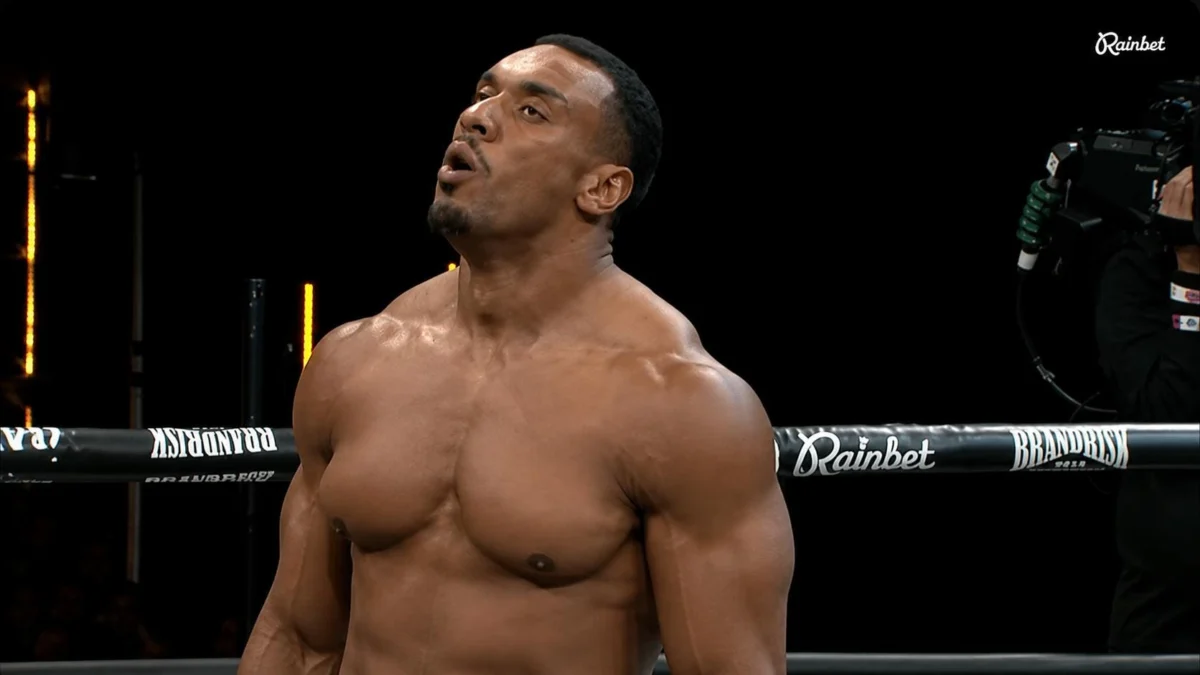
The neon-lit atmosphere of the Brand Risk Warehouse in Miami, Florida, served as the backdrop for a night that promised to further blur the lines between traditional sports and digital-age spectacle. On Saturday, August 22, 2026, the combat sports world focused its attention on Brand Risk 15, a promotion spearheaded by streaming titan Adin Ross. While the card was stacked with names from the upper echelons of the influencer and professional spheres, the co-main event featured a fascinating physiological experiment: Larry Wheels, a man synonymous with world-record powerlifting and inhuman strength, versus the seasoned prankster-turned-combatant Vitaly. However, the anticipated clash of titans was cut short not by a knockout blow, but by the catastrophic failure of a human machine.
The bout between Larry Wheels and Vitaly was positioned as a heavyweight showcase of raw power versus veteran grit. Wheels, whose career has been defined by moving massive amounts of iron, had spent months transitioning his explosive energy into the rhythmic, aerobic demands of boxing. Vitaly, on the other hand, brought a level of ring awareness that often eludes those who enter the sport later in life. As the bell rang, the tension was palpable, with many wondering if Wheels’ sheer physical force would overwhelm Vitaly’s technical defenses.
The narrative took a tragic turn in the early stages of the fight. During a high-intensity exchange, Larry Wheels suffered what appeared to be a severe rupture of his right bicep. The visual of the injury—a telltale "Popeye" deformity where the muscle belly migrates upward toward the shoulder—sent a shockwave through the commentary booth and the live-streaming audience. The fight was immediately halted and ruled a "No Contest" due to the injury. In the world of combat officiating, a No Contest is the standard ruling when a match is terminated by an accidental injury that prevents the continuation of the contest before a specific number of rounds have been completed, ensuring that neither fighter’s professional record is unfairly tarnished by an act of God.
Quinton "Rampage" Jackson, the legendary MMA pioneer providing color commentary for the event, offered a blunt assessment of the situation. Jackson, who has seen nearly every type of trauma the human body can endure in a cage or ring, noted that the severity of the bicep deformation almost certainly necessitates surgical intervention. In a moment of veteran reflection, Jackson suggested that a more seasoned fighter might have attempted to finish the round or fight "one-handed," but for an athlete like Wheels—whose entire livelihood depends on the structural integrity of his upper body—the immediate cessation of the fight was the only logical and safe course of action.
The Biomechanics of Injury: Why Strength Can Be a Liability
The injury to Larry Wheels highlights a recurring theme in the crossover between powerlifting and combat sports. While Wheels possesses a level of muscular development that few humans will ever achieve, that very mass can sometimes work against the requirements of boxing. In powerlifting, the goal is static or slow-twitch force production. In boxing, the requirement is "snap"—the ability to accelerate a limb and then rapidly decelerate it or absorb the impact of a collision.
Medical experts often point out that while muscles can be grown through hypertrophy and pharmacological assistance, tendons and ligaments do not always strengthen at the same rate. A distal bicep rupture, which is the suspected injury in this case, occurs when the tendon that attaches the bicep muscle to the radius bone in the forearm snaps under extreme tension. For a man of Wheels’ size, the torque generated by a missed hook or a punch that connects at an awkward angle can exceed the tensile strength of the connective tissue.
The recovery process for such an injury is arduous. A distal biceps repair typically involves an orthopedic surgeon reattaching the tendon to the bone using "endobuttons" or interference screws. Following surgery, the arm is usually immobilized for several weeks, followed by a gradual reintroduction of range-of-motion exercises. For a high-level strength athlete, the timeline to return to full-capacity lifting can range from six to nine months, with the psychological hurdle of trusting the limb again often taking even longer.

The Broader Impact of Brand Risk 15
Despite the somber conclusion of the co-main event, Brand Risk 15 as a whole represented a significant milestone in the evolution of influencer-led combat promotions. The main event saw Austin McBroom deliver a stunning first-round knockout against FaZe Temperrr, a result that solidified McBroom’s standing as one of the more dangerous names in this niche sector of the sport. The sheer efficiency of McBroom’s performance contrasted sharply with the injury-plagued undercard, reminding viewers that despite the "influencer" label, the stakes and the training are becoming increasingly professional.
The full card results from Miami illustrate the chaotic and unpredictable nature of these events:
- Austin McBroom def. FaZe Temperrr via KO (Round 1)
- Larry Wheels vs. Vitaly: No Contest (Injury)
- YK Osiris vs. Bob Menery: No Contest
- Supa Hot Fire def. Supreme Patty via UD (29-28 x3)
- Julian Newman def. Thiirty via UD
- Jeremy Smith def. Kodiyak Redd via TKO (Round 1)
- Yera def. Tessa via UD (29-28, 30-28, 29-28)
- No Neck Jay def. Shane Chance via KO1 (0:51)
- Gabe Silva def. Kimbo Slice Jr. via TKO2 (2:58)
- Antonio Williams def. Patrick Okine via TKO1 (2:39)
- Chibu def. B.M.A. Musa via UD (38-27 x3)
- AP The Fighter def. Anthony Taylor via UD (38-27 x3)
The victory of Gabe Silva over Kimbo Slice Jr. was particularly noteworthy, as it pitted the legacies of two combat sports icons against each other. Silva, the son of the legendary Anderson "The Spider" Silva, displayed flashes of his father’s clinical precision, securing a TKO in the second round. These matchups suggest that Adin Ross and the Brand Risk team are moving toward a model that blends viral celebrity with genuine athletic pedigree, creating a product that appeals to both the casual social media follower and the hardcore boxing fan.
The Future of the "Influencer" Boxing Paradigm
The "No Contest" result for Larry Wheels raises questions about the future of his boxing career. Wheels has been a vocal advocate for pushing the limits of the human body, but this injury serves as a stark reminder of the "Law of Diminishing Returns." As he approaches his thirties, the transition to a sport as punishing as boxing may require a fundamental shift in how he manages his physique. The boxing world will be watching closely to see if he chooses to undergo the grueling rehabilitation necessary for a return to the ring or if he will pivot back to the more controlled environment of the powerlifting platform.
For Vitaly, the evening was equally frustrating. Having prepared for a war of attrition, he was left without a definitive result. In the post-fight fallout, there has already been talk of a potential rematch once Wheels is cleared for action. However, given the length of bicep recovery, such a sequel would likely not occur until late 2027 or 2028.
As for the industry implications, Brand Risk 15 proves that there is a massive, underserved audience for these high-production-value warehouse events. By leveraging the reach of platforms like Kick and the promotional power of Adin Ross, these events are bypassing traditional pay-per-view gatekeepers. However, the frequency of injuries and "No Contest" rulings (as seen in the YK Osiris vs. Bob Menery bout as well) suggests that the sport may need more stringent medical screening and a more rigorous approach to matchmaking to ensure the longevity of its participants.
The event in Miami was a microcosm of modern entertainment: a blend of high-stakes athleticism, viral personalities, and the ever-present threat of physical catastrophe. While Larry Wheels begins his long road to recovery, the combat sports world continues to march forward, fueled by the relentless engine of digital culture and the enduring human fascination with the spectacle of the fight. The structural failure of a bicep may have halted a match, but it has only added to the complex, often dangerous narrative of the world’s strongest men testing their mettle in the squared circle.
