

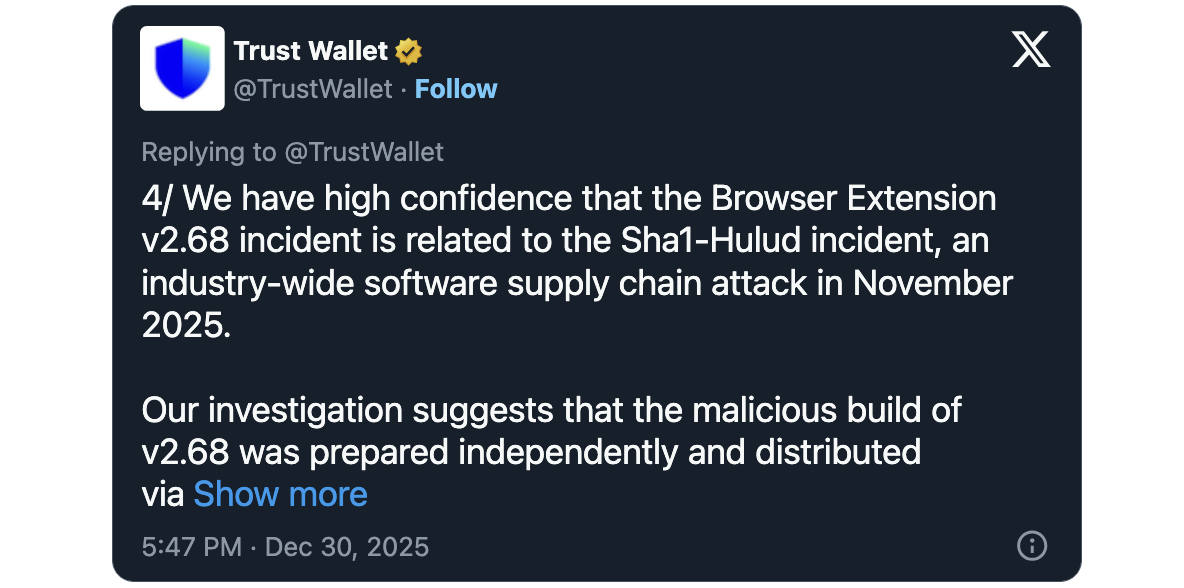
The recent security incident impacting Trust Wallet, which resulted in the unauthorized transfer of approximately $8.5 million worth of cryptocurrency from over 2,500 user wallets, is being officially linked by the firm to the pervasive and "industry-wide" threat campaign known as Shai-Hulud. This connection elevates the specific wallet breach from a localized software vulnerability to a critical data point illustrating the cascading dangers inherent in modern software supply chains, particularly those reliant on massive public repositories like npm.
Trust Wallet, a widely adopted digital asset management solution utilized by an estimated 200 million individuals, provides essential infrastructure for securing assets across major blockchains, including Bitcoin, Ethereum, and Solana, through both mobile applications and browser extensions. The attack, which crystallized on December 24th, specifically targeted the functionality embedded within the browser extension ecosystem, leading to significant financial losses for a substantial number of its user base.
The mechanism of the compromise was sophisticated and highly targeted. Threat actors successfully injected a malicious JavaScript payload into version 2.68.0 of the Trust Wallet Chrome extension. This code was engineered to exfiltrate sensitive wallet authentication data, thereby empowering the attackers to initiate and authorize unauthorized cryptocurrency transactions directly from compromised user accounts.
In a detailed post-incident analysis, Trust Wallet confirmed a direct line of ingress stemming from prior security failures: "Our Developer GitHub secrets were exposed in the attack, which gave the attacker access to our browser extension source code and the Chrome Web Store (CWS) API key." This exposure was the linchpin of the operation. The acquisition of the Chrome Web Store API key provided the adversary with a bypass mechanism, granting them the ability to push new builds directly to the store, entirely circumventing Trust Wallet’s mandatory internal approval and manual review protocols for software releases.
The exploitation followed a precise, multi-stage methodology. Following the exposure of critical development credentials, the threat actors established a camouflage infrastructure. They registered a deceptive domain, metrics-trustwallet.com, and a corresponding subdomain, api.metrics-trustwallet.com, which were then utilized to host the malicious code. This trojanized code was subsequently embedded within the Trust Wallet extension build. Crucially, because the attackers utilized source code obtained via the compromised GitHub secrets, they could integrate the malicious logic without relying on traditional, easily detectable code injection techniques.
The final delivery phase leveraged the compromised CWS API key. Version 2.68 was uploaded and published to the Chrome Web Store. Because the publishing was authorized via the legitimate, albeit compromised, API key, the version successfully passed the automated checks and was released, effectively placing the malicious software into the hands of users who believed they were installing a legitimate update.
In the immediate aftermath, Trust Wallet executed a series of defensive measures designed to contain the damage and prevent further exploitation. All active release APIs were immediately revoked to eliminate the possibility of the attackers pushing further unauthorized updates. Furthermore, the malicious domains used for command and control were reported to the NiceNIC registrar, resulting in their swift suspension and neutralizing the attacker’s ability to retrieve further data or issue new commands. The company has since initiated a reimbursement process for the victims of the exploit. Concurrently, they issued severe warnings regarding ongoing social engineering efforts, noting that threat actors are actively impersonating support staff across platforms like Telegram, attempting to solicit credentials via fake compensation forms—a common secondary tactic following high-profile breaches.
The Shadow of Shai-Hulud: An Industry-Wide Crisis
The critical element connecting this specific crypto theft to a broader systemic vulnerability is the reference to the Shai-Hulud malware campaign. Shai-Hulud, also frequently referenced in security literature as Shai-Hulud 2.0, is not a single exploit but a sustained, evolving series of highly aggressive supply chain attacks targeting the npm (Node Package Manager) registry, the world’s largest software repository, hosting over two million packages.
The initial Shai-Hulud outbreak, surfacing in early September, demonstrated a self-propagating capability. Attackers initially compromised over 180 legitimate npm packages, using malware payloads designed to autonomously seek out and steal sensitive developer secrets and API keys, often utilizing automated tools like TruffleHog for credential harvesting.
Shai-Hulud 2.0 marked a significant escalation in scope and ambition. This iteration saw the threat actors inundate the npm repository with over 27,000 newly created, malicious packages. This massive influx exponentially increased the campaign’s reach, ultimately impacting more than 800 distinct, legitimate packages through dependency confusion or direct code inclusion. The core function of these packages remained the same: to secretly collect developer and Continuous Integration/Continuous Deployment (CI/CD) secrets, often publishing this sensitive data openly across public GitHub repositories.
Security researchers have estimated the total fallout of the Shai-Hulud operation to be staggering, exposing approximately 400,000 raw secrets. This data was subsequently distributed across more than 30,000 GitHub repositories. Alarmingly, analysis conducted as late as December 1st indicated that over 60% of the stolen NPM tokens remained valid, representing an open door for persistent lateral movement across the software development landscape.

Expert Analysis: The Weaponization of Developer Trust
The Trust Wallet incident provides a textbook case study in how vulnerabilities originating in upstream, third-party dependencies can translate directly into catastrophic financial loss for end-users, even when the primary application maintains robust internal security protocols. The success of the attack hinged entirely on two critical security failures rooted in the supply chain: the compromise of GitHub secrets and the theft of the CWS API key.
From an architectural standpoint, the reliance on GitHub secrets to store deployment credentials exposes a fundamental tension in modern DevOps pipelines: speed versus security. Developers often store necessary keys within repository files (sometimes unintentionally, sometimes for convenience in automated builds) that are intended to be private. When these repositories are breached—as they were here—the attacker gains the keys to the kingdom, specifically the means to interact directly with distribution platforms like the Chrome Web Store.
The API key theft is particularly illustrative of the dangers associated with over-permissioning. A key granted broad permission to publish to the CWS without requiring secondary, out-of-band authorization (like a mandatory multi-factor check or internal validation webhook) effectively becomes a single point of failure. The attacker didn’t need to socially engineer a Trust Wallet employee to approve a fraudulent update; they simply used the digital signature granted by the stolen key to authorize it automatically.
The Shai-Hulud campaign perfected the art of credential harvesting within the software development lifecycle (SDLC). Security researchers have long warned that the npm ecosystem, due to its ubiquity and rapid iteration cycles, presents an attractive target. Shai-Hulud demonstrated an attacker capability not just to find secrets, but to harvest them at scale, validate their efficacy (checking token validity), and then leverage them against dependent services (like the Chrome Web Store or GitHub). This indicates a shift from opportunistic attacks to highly industrialized, data-driven exploitation of the software supply chain.
Industry Implications and Future Trajectories
The convergence of the Shai-Hulud infrastructure breach and the Trust Wallet exploitation sends clear signals to the broader technology and fintech sectors.
1. Decoupling Deployment from Source Control: The primary lesson is the urgent need to decouple the ability to publish software from the static credentials stored within source code repositories. CI/CD pipelines must transition toward ephemeral, short-lived tokens, often managed via secrets management vaults (like HashiCorp Vault or cloud-native key management services) that require dynamic authentication before any deployment action can occur. Storing long-lived API keys in GitHub, even private ones, is now demonstrably untenable.
2. Enhanced Platform Vetting: For platforms like the Chrome Web Store, the incident highlights the necessity of strengthening metadata verification processes. While automated scanning exists, the ability for an attacker to use a legitimate API key to bypass manual review suggests that the trust placed in the key itself is too high. Future platform security models will likely require stricter controls, perhaps mandatory multi-factor authentication tied to the publishing action itself, independent of the API token used for submission.
3. The Persistence of Harvested Credentials: Wiz security researchers noted that a significant percentage of the credentials harvested by Shai-Hulud remained active months later. This underscores a crucial reality: secrets harvested from supply chain attacks are often treated as "low-hanging fruit" and are quietly tested against various services over long periods. Companies must operate under the assumption that any credential previously exposed on GitHub or within an npm package is compromised and must be rotated immediately, regardless of perceived inactivity.
4. Expansion Beyond npm: While Shai-Hulud focused on npm, the TTPs (Tactics, Techniques, and Procedures) demonstrated—credential harvesting at scale via dependency contamination and leveraging stolen platform API keys—are directly transferable to other ecosystems, including PyPI (Python), Maven (Java), and RubyGems. Security teams across all development stacks must audit their dependency management for similar leakage vectors.
The future of digital asset security, which relies heavily on user-facing software extensions and desktop clients, must evolve beyond perimeter defense. The Trust Wallet incident confirms that the weakest link is often the development pipeline itself. As threat actors continue to perfect credential harvesting operations using the interconnected infrastructure of public registries and cloud platforms, the industry must rapidly adopt zero-trust principles within the SDLC to isolate and revoke access before stolen secrets can be converted into tangible financial losses. The continuous auditing of developer environments and the stringent isolation of deployment tokens are no longer optional best practices but existential necessities for maintaining user trust in decentralized finance infrastructure.
