

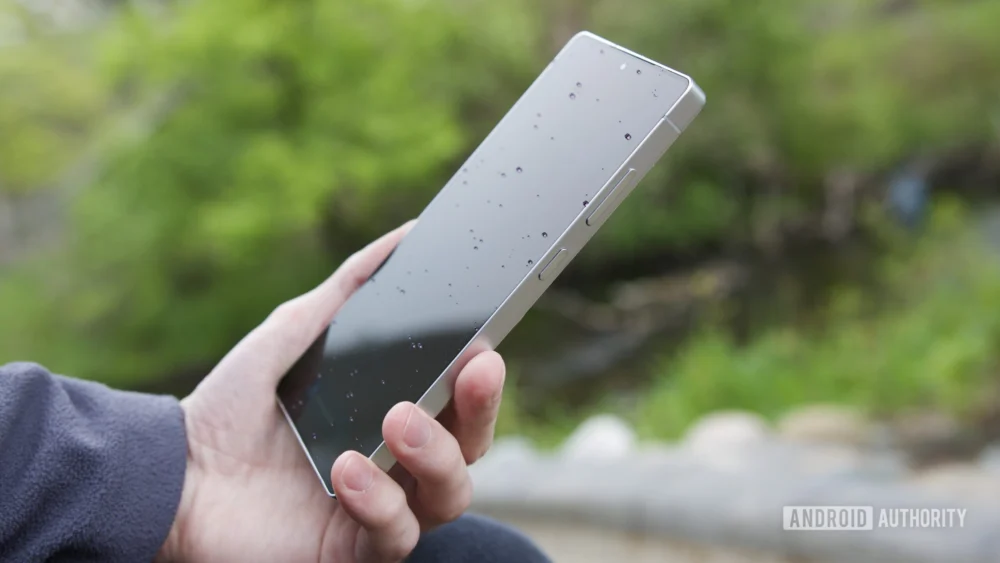
The forthcoming Samsung Galaxy S26 Ultra appears to be incorporating a sophisticated new hardware-software integration designed to bolster user privacy directly at the display level. Dubbed "Privacy Display," this feature, whose development has been tracked through software teardowns and preliminary interface leaks over the past several months, now has visual confirmation demonstrating its operational mechanism. Recent intelligence surfacing from inside Samsung’s system documentation suggests this technology aims to mitigate "shoulder surfing" by dynamically limiting the viewing angles of the screen content.
The journey toward understanding Privacy Display began in September 2025, when forensic analysis of an early build of One UI 8.5 uncovered latent code references hinting at a display-based protection system. This initial discovery, often the first breadcrumb in the lifecycle of new flagship features, suggested Samsung was actively engineering a solution beyond software encryption or conventional screen-dimming techniques. Subsequent leaks in the following month corroborated this, providing mock-ups of the anticipated user interface elements, which positioned the feature prominently within system settings. The latest development elevates this from theoretical speculation to near-certainty, thanks to the emergence of specific instructional animations retrieved from an updated iteration of Samsung’s Tips application.
These newly surfaced animations, reportedly accessed by simulating the Galaxy S26 Ultra environment within the Tips app, offer a tangible demonstration of the feature’s core function. Privacy Display operates on the principle of angular dependent visibility. When activated, the display renders content virtually opaque or heavily obscured when viewed from oblique angles—specifically the sides, top, or bottom—while maintaining clarity for the user directly facing the screen. This technique fundamentally alters the light transmission properties of the display panel based on the viewing vector, a concept that requires precise calibration between the display hardware and the processing unit.
The user experience design, as suggested by these visual aids, emphasizes accessibility and control. The feature is slated to reside within the comprehensive Display section of the main Settings application, offering users granular control over its activation state. Furthermore, the anticipated inclusion of a dedicated toggle within the Quick Settings panel suggests Samsung recognizes the need for on-the-fly adjustments. Users will likely be able to switch Privacy Display on or off instantly, bypassing deeper menu navigation when immediate privacy is required.
Crucially, the system is expected to support conditional, automatic activation. Early indicators pointed toward contextual awareness, allowing the device to infer when privacy intervention is necessary. Scenarios such as navigating crowded public transport, sitting in a busy café, or presenting in a meeting could trigger the display to automatically shift into its restricted viewing mode. This contrasts sharply with current third-party privacy screen protectors, which offer a static, fixed level of angular restriction regardless of the environment or user need.
The visual evidence provided by the Tips page animation confirms the drastic nature of the obscuration. In the illustrated sequence, a direct-view screen is sharp and vibrant. Upon shifting the simulated viewpoint to the side, the display immediately adopts a muted, almost blacked-out appearance, effectively rendering the data unreadable to the external observer. This effect, if successfully executed across the entire dynamic range of the screen, represents a significant leap in mobile device security accessibility.
Background Context: The Evolution of Mobile Privacy
The impetus for features like Privacy Display is rooted in the escalating ubiquity of personal data handled by mobile devices. Smartphones are now central repositories for banking information, corporate communications, health records, and highly personal correspondence. As screen sizes have expanded—a trend exemplified by the Ultra line—the potential surface area vulnerable to unauthorized viewing has increased proportionally.
Historically, mobile privacy solutions have been reactive or additive. Reactive solutions involve software features like secure folders or biometric authentication gates, which protect data at rest or on access but do little to prevent visual interception of actively displayed information. Additive solutions primarily rely on physical accessories, such as the ubiquitous anti-spy screen protectors that employ micro-louver technology. While effective, these physical overlays introduce several trade-offs: they often reduce overall screen brightness, introduce color distortion, necessitate installation compromises (like fingerprint sensor interference), and are not universally adaptable across different usage scenarios.
Samsung’s investment in Privacy Display suggests a strategic shift toward integrating privacy functionality directly into the core hardware stack, likely leveraging advanced display panel technology. This approach aims to deliver the benefits of physical privacy screens without the associated drawbacks of optical compromise or the friction of accessory management. For premium devices like the S Ultra series, where consumers expect cutting-edge innovation, embedding such a feature sets a new benchmark for user-centric security enhancements.
Industry Implications: A New Standard for Flagship Displays
The successful implementation of Privacy Display by Samsung could exert substantial pressure on competing manufacturers, particularly in the high-end Android segment. If this feature proves both effective and minimally disruptive to the user experience, it may quickly transition from a premium differentiator to an expected baseline capability for flagship smartphones within the next two to three years.
For display manufacturers, this development signals a renewed focus on angular performance metrics beyond traditional color gamut and refresh rates. The underlying technology required to manipulate light transmission based on viewing angle—potentially involving dynamic liquid crystal alignment or advanced polarization layers—will become a critical area of R&D investment. This could spur innovation in flexible and foldable display technologies, where maintaining visual integrity across complex surfaces is already a challenge.
Furthermore, the software integration within One UI 8.5 and the Tips application suggests Samsung is preparing a comprehensive marketing narrative around "Intelligent Security." By weaving the feature into system prompts and instructional guides, they are positioning the device as proactively safeguarding the user, moving beyond simple user responsibility. This aligns with broader industry trends where AI and context-aware computing are used not just for convenience but for enhanced digital well-being and security.
There are also notable implications for B2B use cases. Enterprises that deploy Samsung devices for employees handling sensitive client data, or those operating in environments with high levels of public interaction (e.g., field service, retail management), stand to benefit significantly. The ability to instantly secure screen visibility without relying on bulky hardware or cumbersome VPN setups offers tangible productivity and compliance advantages.
Expert-Level Analysis: The Technical Hurdles of Dynamic Obscuration
Achieving seamless, dynamic angular restriction is technically complex. True Privacy Display likely relies on one of two advanced methods, or a hybrid thereof:
-
Dynamic Pixel Orientation/Polarization: This involves integrating a layer within the display stack—perhaps an electro-optical film—that can instantaneously change its polarization properties or the alignment of its liquid crystals. When the device’s front-facing sensors (likely using machine learning models to estimate viewing angles) detect a third-party observer, the system rapidly adjusts the filter to block light rays originating from those angles. The primary challenge here is the speed and consistency of the transition. A slow or flickering transition would be more distracting than helpful.
-
Software-Assisted Rendering Masking: While less hardware-intensive, this method would involve the GPU selectively rendering a low-luminance, heavily blurred, or noise-patterned overlay specifically targeted at the pixels deemed visible to the unauthorized angle. However, for this to be truly effective against shoulder surfing, the masking must be near-perfect, which is difficult to achieve given the complex refractive nature of glass and the proximity of the unauthorized viewer. The visual confirmation suggests a more fundamental, hardware-backed change in light behavior, leaning towards the first hypothesis.
The integration with environmental context, such as automatically activating in areas where high ambient noise or movement (indicating a crowd) is detected, suggests reliance on an array of sensors beyond just the front camera for angle detection. Accelerometers, gyroscopes, and potentially even localized Bluetooth or Wi-Fi density readings could feed into the contextual engine powering the automatic activation. This multilayered sensor fusion elevates the feature beyond a simple switch.
Future Impact and Trends: The Invisible Layer of Security
The arrival of Privacy Display marks a significant step in the "invisible security" trend—features that work silently in the background to protect the user without requiring constant manual input. If this technology proves scalable and cost-effective, it could rapidly influence other display-centric applications.
Consider the future application in augmented reality (AR) and virtual reality (VR) headsets. Current AR displays often suffer from "light bleed" or visibility leakage, where overlay data can be seen by those around the wearer. A dynamic privacy filter could be crucial for commercializing AR glasses for sensitive professional tasks, ensuring that overlaid schematics or proprietary data remain visible only to the intended wearer.
Furthermore, this technology might influence the development of privacy modes for larger screens, such as laptops and external monitors. While implementing this on a 27-inch monitor presents significant engineering challenges related to power draw and uniformity, the concept of a "privacy zone" around a workstation, perhaps activated via a simple gesture or proximity sensor, becomes more viable as display panel technology evolves.
The Galaxy S26 Ultra’s Privacy Display, as previewed through these leaks, is more than just a clever gimmick; it represents Samsung’s commitment to addressing tangible, real-world vulnerabilities in personal computing. It signifies a future where the display itself acts as an active, intelligent guardian of the information it presents, blending security deeply into the fabric of the mobile experience. The market will now keenly watch the public rollout to assess the feature’s performance under real-world strain and determine its true impact on digital discretion.
