

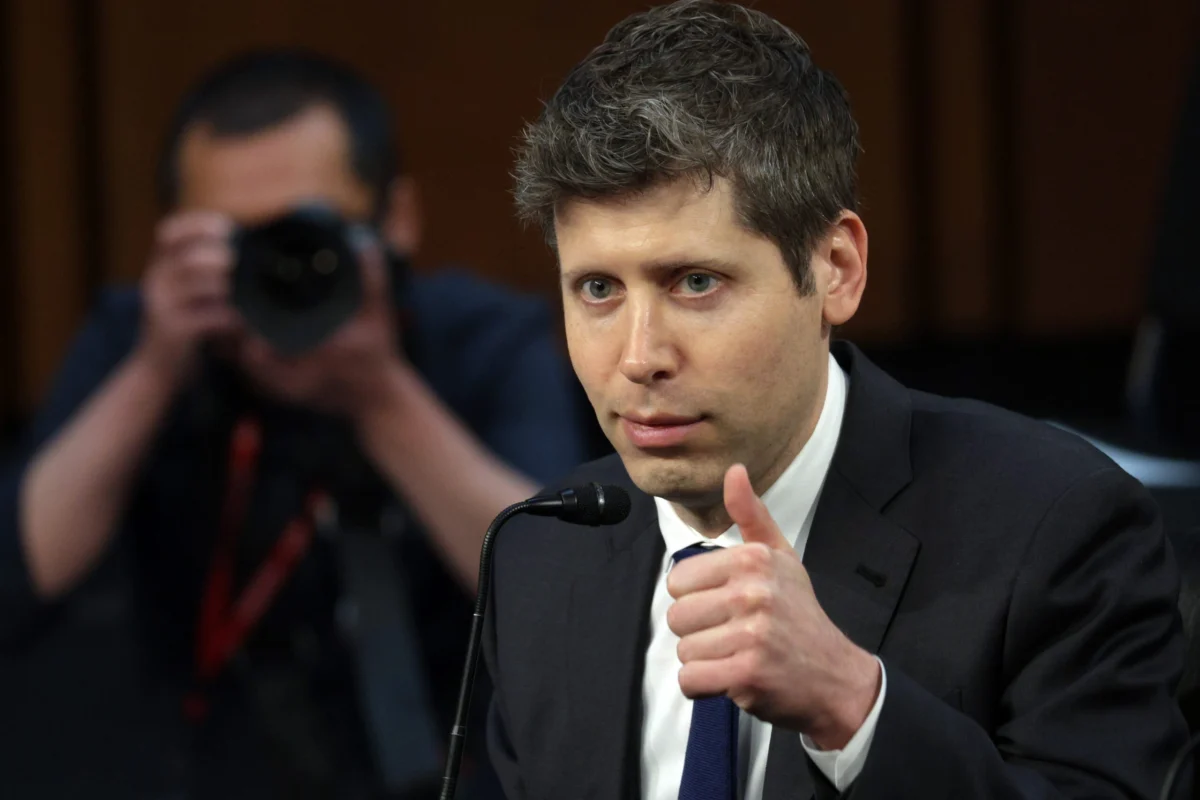
The relationship between the architects of the artificial intelligence revolution and the global community of software engineers has reached a new point of public friction. On a Tuesday in mid-March 2026, OpenAI CEO Sam Altman took to X (formerly Twitter) to express what he likely intended as a poignant tribute to the history of computer science. "I have so much gratitude to people who wrote extremely complex software character-by-character," Altman posted. "It already feels difficult to remember how much effort it really took. Thank you for getting us to this point."
While the sentiment appeared to be a nostalgic nod to the craftsmanship of traditional programming, it was met with a swift and caustic wave of backlash from the very community it sought to honor. For many developers, Altman’s words did not land as a tribute, but rather as a eulogy for their careers—delivered by the man holding the shovel. The incident highlights a deepening cultural and economic divide in the technology sector, where the efficiency gains promised by Large Language Models (LLMs) are increasingly viewed as a zero-sum game for human workers.
The timing of Altman’s post could hardly have been more sensitive. The tech industry is currently navigating a brutal period of contraction, often justified by the promise of AI-driven productivity. Recent headlines have been dominated by massive workforce reductions: Amazon recently announced the termination of 16,000 employees; Block (formerly Square) halved its workforce by cutting 4,000 roles; Atlassian reduced its headcount by 10%; and rumors continue to swirl regarding a potential 20% staff reduction at Meta. In almost every instance, corporate leadership has pointed to "increased operational efficiency" and "AI-centric restructuring" as the primary drivers behind these decisions.
To the developer who spent years mastering the nuances of C++, Python, or Rust, Altman’s phrase "getting us to this point" felt like a dismissal. It framed the act of manual coding—a skill requiring deep logic, creativity, and precision—as a relic of a primitive era, akin to hand-weaving textiles before the industrial revolution. The implication is that the "point" we have reached is one where the human element is no longer the engine of innovation, but merely the scaffolding that has been outgrown.
The irony of this transition is not lost on the coding community. The generative AI models that OpenAI and its competitors have commercialized were built using the "character-by-character" labor of millions of developers. These models were trained on massive repositories of open-source code, much of it scraped from platforms like GitHub and Stack Overflow. In essence, the software engineers of the past two decades unknowingly volunteered the training data for the very systems now being used to automate their roles. This "Digital Ouroboros"—a snake eating its own tail—has created a sense of betrayal among tech workers who feel their intellectual property was harvested to create a tool that devalues their labor.
The reaction on social media was a mixture of gallows humor and genuine vitriol. One popular response suggested a "billion-dollar app idea": an AI that scans billionaire tweets before they are posted to warn the author if they sound "incredibly out of touch." Another user compared Altman’s gratitude to the words a Mayan priest might offer a sacrificial victim right before the ceremony begins. These memes are more than just internet snark; they are a barometer of the plummeting morale within the engineering ranks of Silicon Valley and beyond.
The professional landscape for developers is indeed shifting beneath their feet. For decades, the "Computer Science Dream" was a reliable path to the middle and upper-middle class. A junior developer could expect a high starting salary and a clear trajectory toward seniority. However, the rise of AI-assisted coding tools like GitHub Copilot and OpenAI’s own specialized models has fundamentally altered the entry-level market. Companies are increasingly finding that they can replace three junior developers with one senior engineer equipped with an AI suite. This has led to a "hollowing out" of the talent pipeline, where the bridge between being a student and becoming an expert is being dismantled.
From an industry analysis perspective, we are witnessing a transition from the era of "Software Engineering" to the era of "Software Architecture and Review." In the traditional model, a developer spent a significant portion of their day writing boilerplate code, debugging syntax, and implementing standard features. Today, AI can handle those tasks in seconds. The human’s role is shifting toward high-level system design, prompt engineering, and, perhaps most importantly, security auditing. However, this shift requires a different set of skills and, crucially, requires fewer total warm bodies in the office.
There is also a growing geopolitical and open-source tension underlying the responses to Altman’s post. One commenter noted their gratitude to OpenAI for inadvertently fueling the rise of open-source models, including those coming out of China, which allow developers to bypass the "walled gardens" of American AI giants. As OpenAI moves further away from its non-profit roots and becomes a dominant commercial entity, the developer community is increasingly looking toward decentralized and open-weights models as a way to reclaim agency over their craft.
The future of the profession remains a subject of intense debate. Optimists argue that AI will "democratize" coding, allowing anyone with an idea to build complex software without needing to learn the "character-by-character" syntax that Altman referenced. They envision a world of hyper-productivity where the barrier between human intent and digital execution is erased. In this view, the current layoffs are a painful but necessary "rebalancing" as the industry moves toward a more efficient state.
However, the skeptical view—held by many of those currently facing unemployment—is that this democratization comes at the cost of deep understanding and systemic resilience. When code is generated by a black-box model rather than a human who understands the "why" behind every character, the potential for "hallucinated" bugs and security vulnerabilities increases. Furthermore, the loss of the junior developer tier means that the industry may face a catastrophic talent shortage ten years from now, as there will be no veteran engineers who learned the trade through the necessary struggle of manual implementation.
Altman’s post, whether he realized it or not, touched on the "God Complex" often attributed to the leaders of the AI movement. By framing the history of software development as a completed task, he positioned himself and his company as the final destination of a long journey. To the engineers who are still in the trenches, the journey is far from over, and the "point" Altman refers to looks less like a peak and more like a precipice.
As we look toward the latter half of the 2020s, the tech industry must grapple with a looming identity crisis. If the act of writing code is no longer the primary value proposition of a "coder," then what is? The answer likely lies in the human capacity for ethical judgment, complex problem-solving in physical environments, and the ability to understand the needs of other humans—areas where AI still struggles.
Yet, until a new economic equilibrium is reached, the friction will only intensify. The memes and sarcastic replies to Sam Altman are a form of digital protest. They are the voice of a workforce that feels it is being thanked for its service while being ushered toward the exit. The "character-by-character" effort that Altman praised was not just a means to an end; it was the foundation of the modern world. To treat it as a quaint memory of the past while the people who did the work are still in the room is a move that risks alienating the very talent OpenAI will need if it hopes to solve the even more "extremely complex" problems of the future.
Ultimately, the controversy serves as a reminder that technology is never just about code; it is about people, power, and the social contract. As AI continues to reshape the economy, the leaders of the movement would do well to remember that "gratitude" is a poor substitute for a paycheck, and that the "effort" they find so easy to forget is exactly what built the platforms they now stand upon. The memes may be funny, but the underlying anxiety is a serious warning sign for the future of the Silicon Valley consensus.
