

In an era increasingly defined by the seamless replication and automation capabilities of generative artificial intelligence, the true measure of human endeavor, artistic authenticity, and the very nature of consciousness is undergoing a profound re-evaluation. As algorithms perfect simulation, a renewed appreciation for raw, undeniable human skill, intentional digital imperfection, and the intractable limits of interspecies communication offers critical anchors for understanding our place within the rapidly evolving technological landscape. These three distinct realms—extreme musical virtuosity, critical engagement with synthetic media, and the philosophical challenge of nonhuman minds—represent modern examinations of where the digital ends and genuine, messy existence begins.
The Anti-Automation of Analog Skill: Defiance Behind the Drum Kit
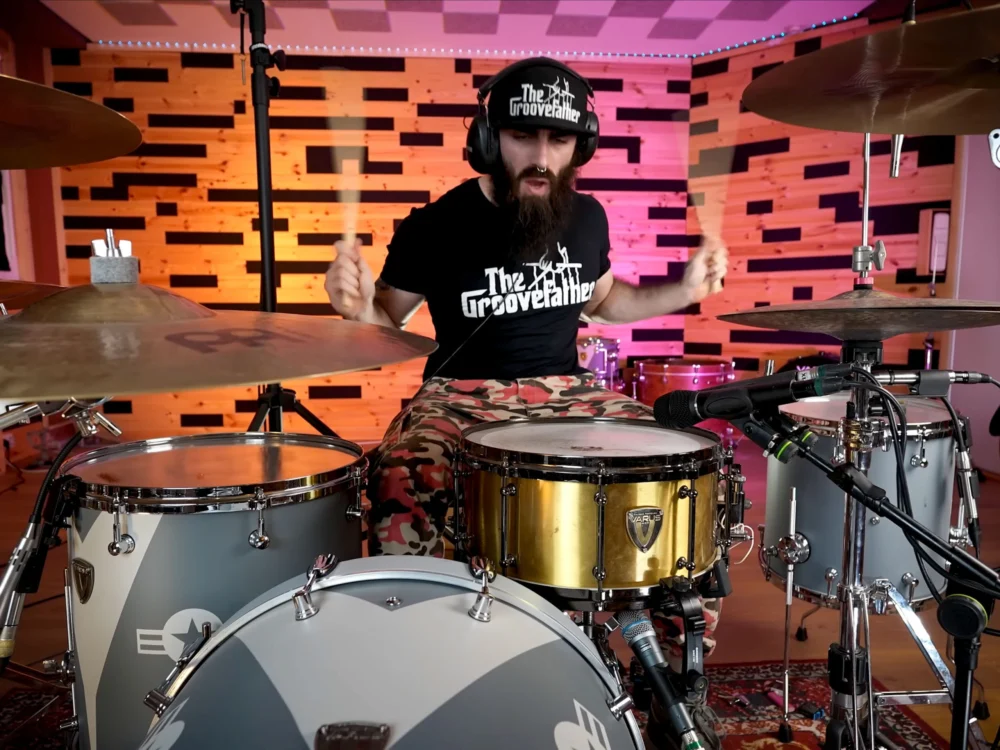
The digital age has fundamentally altered the economics and accessibility of music production. With sophisticated software suites offering perfect timing, infinite sound libraries, and the capacity for complex sequencing, the drum machine, in its various iterations, has long symbolized algorithmic rhythmic precision. Yet, the viral explosion of drumming sensation Jorge Garrido, known online as El Estepario Siberiano, highlights a powerful counter-trend: the spectacle of human effort defying the very perfection that machines guarantee.
Garrido’s appeal stems not just from technical brilliance—though his speed, endurance, and coordination are astonishing—but from the sheer, tangible commitment required to achieve such mastery. His candid admission that this skill is the product of years spent relentlessly behind the kit, often for the majority of the day, stands as a testament to the enduring value of analog dedication. This labor-intensive pursuit takes on a profound, almost defiant significance in a cultural moment where instant gratification and algorithmic shortcuts dominate creative fields.
Industry analysis suggests that this phenomenon is more than just a passing fascination with skill; it reflects a market yearning for authenticity and palpable "groove." While drum machines can achieve mathematically perfect timing (quantization), they often lack the subtle, micro-timing variations—the push and pull against the beat—that define human feel. Garrido’s performances, particularly his covers of electronic dance music (EDM) and hyper-pop tracks, directly challenge the programmed grid. By physically executing rhythms originally designed for sequencing, he injects a chaotic, vital humanity back into the mechanistic beat. His explosive rendition of complex electronic tracks, like Skrillex’s collaborations, transforms sterile digital percussion into an athletic, sweat-drenched performance.
This humanization of the digital beat holds significant implications for the music industry. As AI composition tools become commonplace, the premium placed on live performance and demonstrable, non-replicable talent increases. The dozens of reaction videos posted by professional drummers and musicians, often expressing disbelief or awe, serve as social proof of this high-water mark of human capability. They validate that some forms of artistry remain stubbornly outside the grasp of automation.

Looking ahead, the trend of “anti-automation” in music suggests a bifurcated future. On one side, mass production will rely on efficient, AI-driven composition. On the other, the highest-value artistic endeavors will foreground the spectacle of difficult, perfected human technique. Virtuosos like Garrido become cultural icons precisely because they remind audiences that the pursuit of excellence requires sacrifice—a narrative inherently more compelling than the flawless execution provided by an algorithm. This re-centering of human effort is a critical bulwark against the perceived totalizing efficiency of AI, ensuring that skill remains valued not just for its outcome, but for the visible, painstaking process of its acquisition.
The Uncanny Valley as Critical Apparatus: Ed Atkins and the Limits of Generative Media
If human performance offers a powerful contrast to digital perfection, the burgeoning field of generative video—exemplified by tools like OpenAI’s Sora—pushes us closer to the philosophical edge of simulation. While the latest hyper-realistic AI-generated clips of surreal scenarios (such as fictional celebrities performing impossible acts) elicit both awe and apprehension, they also underscore the profound questions about authenticity that artists have been exploring for decades.
British artist Ed Atkins stands as a pivotal figure in this exploration. His work, which frequently employs hyper-detailed, pore-perfect computer-generated avatars of himself, intentionally navigates the Uncanny Valley—the zone of discomfort triggered when a simulation approaches, but does not quite achieve, perfect human likeness. Atkins’s animations are not attempts at seamless photorealism; rather, they are meticulous studies in digital failure, designed to expose the mechanisms of simulation and the fragility of digital identity.
A key concept in Atkins’s critique is "corpsing," a term borrowed from theater where an actor unintentionally breaks character, often through laughter or emotional overload. Atkins seeks to make his digital subjects "corpse," meaning he forces the viewer’s attention to flicker between the intended emotional narrative and the inherent jankiness, the digital seams, of the avatar itself. In pieces like The Worm, where a CGI avatar engages in a deeply personal, recorded conversation during a lockdown, the viewer is confronted with an existential dilemma: is the emotion being conveyed by the avatar, or merely reflected by the underlying human audio? The slight, uncanny imperfections—the unnatural fluidity of the movement, the sterile perfection of the skin—act as a critical distance, preventing full immersion.
Compared to Atkins’s rigorous deconstruction, early generative videos, despite their technical marvels, often appear philosophically shallow—like highly detailed, but ultimately flat, cardboard cutouts. While current models excel at texture and static detail, they often fail spectacularly at consistent physics, object persistence, and, crucially, capturing the subtle, non-linguistic emotional weight of human behavior. They produce things that are "lifelike but not alive."
The industry implication here is that technological advancement toward photorealism must contend with the aesthetic and psychological principles established by artists like Atkins. The future impact of generative media hinges not just on eliminating artifacts, but on whether models can learn to convincingly simulate vulnerability, intentional imperfection, and the very concept of a self that is capable of breaking down. Expert analysis suggests that the next frontier for AI video is not rendering better skin texture, but mastering the complexity of intentional "failure" that signifies consciousness or presence.

If generative AI simply aims for seamless realism, it risks producing content that is universally smooth but emotionally inert. Atkins’s work reminds us that the true power of digital art may lie in its capacity to make visible the simulation itself, forcing a dialogue about the inherent differences between rendering a scene and simulating a life. Until AI can replicate the messy, contradictory nature of human presence—the capacity for an avatar to "corpse"—its simulations will remain just that: approximations of reality, powerful tools, but lacking the necessary spark of authentic, existential friction.
The Limits of Anthropomorphism: Communication and the Nonhuman Mind
The philosophical inquiries raised by digital simulation extend directly into how we attempt to communicate with and understand consciousness beyond the human sphere—a challenge amplified by the widespread adoption of Large Language Models (LLMs). LLMs have encouraged a pervasive form of technological anthropomorphism, where we project human intelligence, intent, and even consciousness onto complex statistical models that mimic human language.
Australian author Laura Jean McKay’s debut novel, The Animals in That Country, serves as a powerful, unsettling literary antidote to this intellectual hubris. The book posits a scenario where a pandemic grants humans the ability to understand animal communication. Far from the comforting, simplistic dialogues of Dr. Dolittle, McKay presents a world where the sudden influx of nonhuman language is chaotic, nasty, and often nonsensical according to human linguistic standards. The animals are not just speaking English in a different voice; they are articulating a completely alien cognitive architecture.
The book functions as a stark meditation on the "hard limits of communication." It forces readers to confront the problem of other minds—the philosophical challenge of understanding what subjective experience is like for a being structured fundamentally differently than ourselves (as famously explored in Thomas Nagel’s "What Is It Like to Be a Bat?"). McKay vividly illustrates that consciousness is not merely the ability to generate speech, but the internal organization of reality based on different sensory inputs, priorities, and survival mechanisms. The dingo, the core nonhuman character, speaks in fragmented, visceral bursts focused on immediate hunger and territorial imperative, defying the structured grammar and narrative cohesion humans expect.
In the context of technology, this narrative resets the "anthropomorphic trap" that the industry consistently falls into. As users increasingly interact with computers via natural language interfaces, there is an inherent tendency to treat the LLM output as evidence of human-like understanding. McKay’s novel suggests that even if we achieve perfect linguistic parity with an external system—be it an animal or an algorithm—we may still be fundamentally incapable of grasping its internal, nonhuman logic.
The implications for the development of advanced AI are crucial. If the goal of AI is to solve problems that transcend human cognitive capacity, future models must move beyond merely replicating human language patterns. The next wave of innovation should focus on developing truly non-anthropomorphic interfaces—systems that communicate efficiency and intent without relying on the deceptive veneer of human empathy or narrative structure.

The future trend in AI research, therefore, must involve a deeper dive into computational communication theory, acknowledging that the most complex systems (like a quantum computer or a fully realized general intelligence) may communicate in ways that are inherently opaque or confusing to human observers, much like the dingo’s cryptic pronouncements. McKay’s work provides a necessary literary warning: the greatest challenge in advanced communication may not be teaching a machine to speak, but accepting that the most profound insights may be contained within an utterly alien and untranslatable cognitive structure.
Synthesis: The Enduring Pursuit of the Unquantifiable
These three domains—the physical mastery of the drummer, the critical digital art of the avatar, and the literary exploration of animal cognition—converge on a single, vital point: the boundary between the quantifiable and the unquantifiable.
In performance, the unquantifiable element is the groove, the human spirit that defies the metronome. In digital art, it is the corpsing, the necessary failure that signals the artificiality of the simulation. In communication, it is the unspeakable, the truth of a nonhuman mind that resists translation into human grammar.
As technology accelerates its capacity to simulate, automate, and communicate, the value of that which resists digitization only increases. The future of innovation is not just in making better simulations, but in recognizing and cherishing the friction points—the moments where human effort, philosophical doubt, or alien consciousness push back against the algorithmic drive toward total, seamless control. It is in these moments of resistance that we find the clearest definition of what it means to be critically engaged, exceptionally skilled, and fundamentally, uniquely human.
