

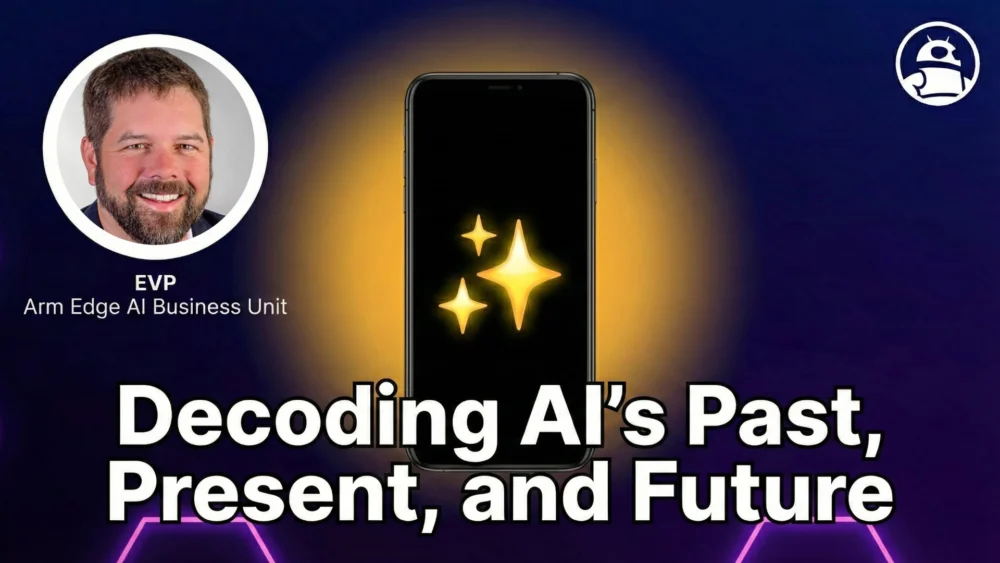
The current surge in generative artificial intelligence, dominated by cloud-based Large Language Models (LLMs), often overshadows the quiet revolution happening at the hardware level—specifically, within the mobile ecosystem. Arm, the foundational architecture powering the vast majority of smartphones, is strategically positioning itself not just as a passive supplier but as the central nervous system for this shift toward "Edge AI." To understand this imperative, we spoke with Chris Bergey, Executive Vice President of Arm’s Edge AI business unit, about the architectural necessities, developer challenges, and the long-term vision for intelligent, always-on devices.
Arm’s operational structure reflects this focus. The company recently streamlined its business units into three core pillars: Edge AI, Cloud AI, and Physical AI. Bergey’s Edge AI unit sits squarely at the intersection of consumer experience and silicon design. While many consumers only recognize Arm from a specification sheet—the CPU IP powering Android or iOS—Arm’s reach extends far deeper, into Wi-Fi controllers and myriad embedded systems. With over 400 billion Arm processors shipped to date across sectors ranging from IoT to data centers, the company’s influence is nearly ubiquitous.
This massive installed base is underpinned by an architecture forged over 35 years, rooted fundamentally in power efficiency. Bergey referenced early milestones, like the Apple Newton—an early investor in the architecture—and the Nintendo DS, underscoring Arm’s historical mandate: maximizing computational capability within stringent power envelopes. Today, AI workloads demand immense computational throughput, forcing a critical re-evaluation of this low-power heritage. The core mission now is ensuring that the power required for sophisticated AI inference does not compromise battery life, the non-negotiable feature of any modern mobile device.
Pre-LLM Foundations and Architectural Evolution
The current AI fervor, often pegged to the 2023 LLM releases, is built upon years of groundwork laid in machine learning acceleration. Bergey emphasized that complex mathematics essential for AI predated the current branding, finding homes in multimedia processing and other intensive tasks. Arm’s contribution in this pre-LLM era centered on two critical areas: the architecture itself and the development of specialized acceleration.
Arm has aggressively evolved its instruction set to handle specialized math. This includes enhancing vector acceleration capabilities and, more recently, integrating dedicated matrix engines directly into the CPU clusters. This integration is significant because CPUs, traditionally general-purpose engines, are highly accessible and programmable. By embedding matrix acceleration alongside the CPU cores, Arm allows developers to leverage a familiar programming model for AI tasks, ensuring consistency across the vast footprint of Arm-based devices.
Beyond the CPU, the ecosystem relies on specialized accelerators. Arm provides proprietary Neural Processing Units (NPUs) tailored for ultra-low-power applications. Bergey cited the Meta smart glasses as a concrete example, noting that one of Arm’s latest neural processors powers the device’s neural sensing capabilities via the accompanying wristband. This shows a deliberate, decade-long trajectory, with key AI acceleration features being introduced as early as 2017, long before the current public obsession with generative models.
Scaling from Precursors to LLMs
The early optimizations for machine learning—vector extensions and matrix engines—provide crucial advantages as the industry grapples with the exponentially larger, more demanding workloads introduced by modern LLMs.
One primary benefit derived from this foundational work is the establishment of architectural standards across the ecosystem. Arm’s protocols governing extensions to memory systems and multimedia processing create a coherent building block strategy. As AI models scale, memory management becomes paramount. The size of the model parameters and the required memory bandwidth directly influence performance and energy consumption. Arm enables its partners to design highly scalable chip architectures, capable of scaling from sub-dollar IoT devices to high-performance computing tiers, all while adhering to a unified architectural blueprint.
The second benefit stems from continuous workload feedback. Arm actively solicits input from software developers, leveraging its enormous ecosystem of over 20 million developers. This feedback loop directly inspires architectural evolution. Features like the aforementioned matrix engines are not theoretical constructs but direct responses to observed software demands. This symbiotic relationship ensures that hardware advancements are immediately relevant to the software being built, accelerating the adoption curve for new silicon capabilities.
The Rise of Ambient and Agentic AI
The current computational landscape is shifting from transient, reactive AI (like a single chatbot query) to ambient AI—a constantly running, background intelligence layer that anticipates needs and executes tasks proactively. This transition places intense, sustained pressure on device power management.
Bergey noted that Arm’s response to this demand is rooted in its decade-old concept of heterogeneous computing, exemplified by the big.LITTLE core architecture. This principle, which pairs high-performance cores for peak demand with low-power cores for background tasks, remains fundamental. Modern SoCs now extend this heterogeneity beyond the CPU to include GPUs and NPUs.
In contemporary smartphones, features like advanced computational photography already utilize the CPU, GPU, and NPU in concert, often without the user’s direct awareness of where the computation is occurring. As AI moves toward agentic systems—software entities capable of complex, multi-step reasoning—this orchestration becomes even more critical. The challenge, Bergey explained, lies in abstracting this complexity away from the software developer. Arm invests heavily in tools and abstractions, collaborating closely with operating system vendors like Google and Microsoft. By handling the complexity of routing tasks to the most efficient hardware element (CPU, NPU, or GPU) at the right time, Arm aims to deliver a seamless, "always-on" intelligent experience without draining the battery.
Navigating the Developer Fragmentation Maze
The proliferation of AI hardware presents a significant hurdle for developers: how to write code that optimizes across numerous hardware configurations, frameworks (TensorFlow, PyTorch), and specialized accelerators (NPUs, GPUs)? This fragmentation can lead to sub-optimal performance or force developers to choose between broad compatibility and peak efficiency.
Arm’s strategy here is layered abstraction. Instead of forcing developers to code directly for the underlying Register-Transfer Level (RTL) specifics of every available accelerator, Arm creates standardized libraries. A prime example is the use of Kleidi libraries, designed to interface with newer architectural extensions like SME 2 (Scalable Matrix Extension 2). A developer targeting the Kleidi library can let the library itself determine the available hardware. If the device supports SME 2, the library leverages the matrix engine; if it only supports SVE 2 (Vector Extension 2), it falls back to that.
Furthermore, Arm cooperates with OS-level vendors to integrate these capabilities higher up the stack. In the Android environment, for instance, Google’s AICore framework builds upon core Arm services, allowing developers to work at a higher level, leveraging established services like those powering Gemini integration. This tiered approach allows developers targeting mass-market applications to remain abstracted from the silicon, while those building highly specialized or custom models can descend to lower levels of optimization using Arm’s detailed documentation resources available at developer.arm.com.
The On-Device Imperative: Latency, Cost, and Privacy
A persistent debate surrounds the necessity of on-device (Edge) AI when hyperscale cloud infrastructure can offer near-limitless processing power. Skeptics argue that the most transformative features remain cloud-bound. Bergey countered this skepticism by highlighting the tangible limitations of cloud reliance for critical applications.
The foremost argument for Edge AI is latency sensitivity. While cloud interactions are acceptable for asynchronous tasks, real-time user interfaces, especially as AI integrates deeply into interaction models, demand near-zero latency. As one major handset manufacturer noted, an experience that is "good all the time" cannot be subject to cellular dead spots or network congestion. If an essential AI function fails or becomes "janky" due to network instability, users quickly abandon that feature, reverting to older interaction paradigms.
The second major driver is cost. Cloud processing is measured in tokens, a metric that, while declining in cost, remains a persistent operational expense. Bergey offered the gaming industry as an example: developers are hesitant to embed highly dynamic AI agents (like complex NPCs) whose computational load scales with player interaction, fearing unpredictable monthly bills. On-device execution eliminates this variable cost, enabling richer, more complex local experiences.
Finally, privacy remains a cornerstone argument. While not explicitly quantified in terms of token cost, the handling of highly sensitive, continuous streams of personal data (biometrics, ambient audio, contextual awareness) is significantly safer when processed locally and never transmitted to a third-party server.
Bergey posits that the future is irrevocably hybrid. Cloud infrastructure will remain essential for large-scale model training, but inference—the moment-to-moment application of the model—will increasingly reside on the edge, driven by expectations for seamless interaction that mirror a child’s innate desire to touch a screen.
The Timeline for Cloud-to-Edge Migration
The rapid architectural improvements, such as the 5x performance uplift and 3x efficiency gains seen in the latest Arm platforms (like the announced Lumina C1 Ultra), are shrinking the gap between cloud capability and local execution. Bergey projected that the migration of today’s most powerful cloud-based models to run locally on mobile devices could occur within a two-year timeframe, constrained primarily by memory capacity rather than raw computational power. This rapid shrinking is facilitated by techniques like knowledge distillation, where the essence of a massive model is transferred into a smaller, more efficient version optimized for edge hardware.
Beyond the Smartphone: XR and Wearable Renaissance
While flagship smartphones benefit first, Arm’s vision extends to constrained form factors like Augmented Reality (AR) glasses. These devices present a unique engineering challenge: minimizing weight, thermal output, and battery consumption while executing complex vision and audio processing.
Bergey acknowledged the difficulty of packing flagship performance into a discreet form factor. However, the industry is already deploying Arm-based CPUs in these devices (e.g., Meta glasses), handling initial image capture and audio processing. The path to fully standalone AR glasses necessitates continuous evolution toward lower power consumption per operation. Crucially, these devices exemplify the hybrid reality: they might offload complex, non-time-critical rendering to a tethered device or the cloud, while handling immediate contextual awareness locally.
This focus on wearables signals a broader renaissance in body-centric computing. The initial enthusiasm for smartwatches has matured, and new form factors—rings, neural bands—are re-engaging consumers with sensor-on-body interaction. Arm is positioned to supply the efficient compute necessary for these devices to move beyond simple notifications into truly impactful AI augmentation, such as real-time sensory enhancement for the hearing or visually impaired.
The Inevitable Integration: Addressing AI Fatigue
The pervasive integration of AI—often perceived by consumers as "shoehorned" features or unnecessary chatbot buttons—leads to "AI fatigue." Bergey contextualized this skepticism as a natural phase in technological adoption, comparing it to the early skepticism surrounding internet commerce. While early attempts failed due to premature timing or poor execution, the underlying concept proved transformative.
He argued that AI’s true value surfaces when it becomes personal and indispensable—when it performs a task so complex or time-consuming that its absence is noticeable. Transformative applications exist beyond chatbots, including accessibility features (augmenting sight or hearing) and massive global democratization of knowledge. Imagine deploying a sophisticated LLM like Gemini on $100 devices in underserved regions; this potential to radically alter educational trajectories is what drives the technology forward, despite the current proliferation of clumsy, visible implementations.
The distinction between visible AI (the chatbot) and invisible AI (the background systems that correctly populate a calendar or anticipate a user’s need) is key. While the visible, conversational AI often garners attention for its occasional hallucinations, the invisible, on-device AI—powered by efficient Arm architecture—will be the component that ultimately validates the long-term investment in Edge processing by becoming seamlessly integrated into the user experience.
Looking ahead to upcoming industry showcases, Bergey predicted that the most surprising headlines will likely center on these biometric and sensor-based applications, demonstrating how ambient computing, fueled by low-power Edge AI, can genuinely enhance the quality of life for individuals who rely on technological augmentation. The future of mobile computing is not just about larger models in the cloud, but about embedding subtle, powerful intelligence everywhere.
