


The nascent field of decentralized intellectual property (IP) management suffered a significant setback as Unleash Protocol, a platform dedicated to tokenizing and facilitating the monetization of IP assets, reported a substantial security breach resulting in the loss of approximately $3.9 million in various cryptocurrencies. The incident, confirmed by the protocol’s development team, was not a traditional smart contract exploit but rather a sophisticated compromise of its administrative oversight mechanism—specifically, its multi-signature (multisig) governance system.
Unleash Protocol positions itself as a crucial infrastructure layer, transforming traditional IP rights into on-chain, tokenized assets, often referred to as WIP (wrapped IP) or stIP (staked IP). These digital representations are intended to function as collateral within decentralized finance (DeFi) environments, offering novel monetization pathways and automated royalty distribution through immutable smart contract rules. The protocol’s entire value proposition rests on the security and immutability of its underlying code and governance structure.
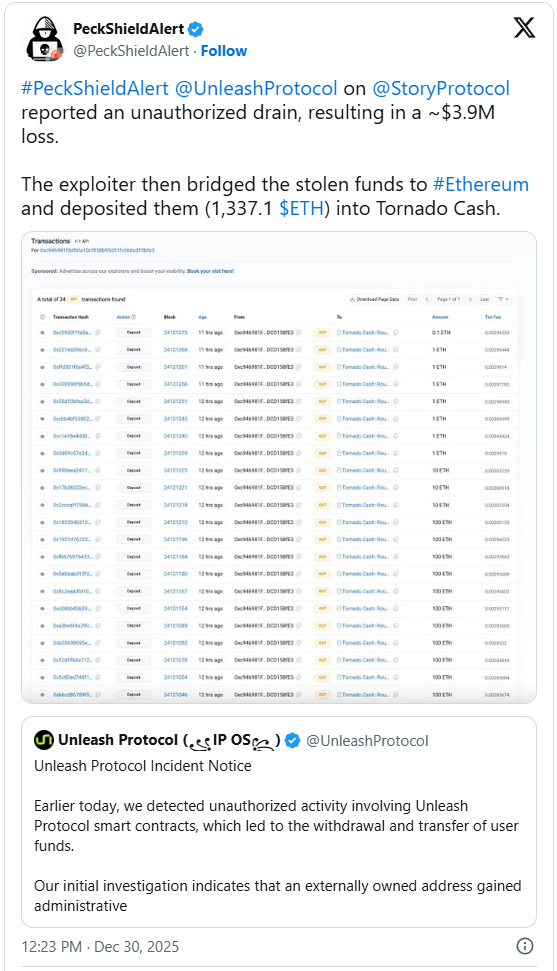
The breach commenced when an attacker managed to secure sufficient authorization within the protocol’s multisig framework. This control allowed the adversary to execute an administrative function: an unauthorized smart contract upgrade. In a public disclosure, the Unleash team articulated the gravity of the situation: "Our initial investigation indicates that an externally owned address gained administrative control via Unleash’s multisig governance and carried out an unauthorized contract upgrade." This clandestine modification fundamentally altered the contract’s operational parameters, specifically enabling withdrawal functions that had not been sanctioned by the legitimate protocol custodians. The actions were explicitly characterized as occurring "outside our intended governance and operational procedures."
The immediate consequence was the systematic draining of protocol assets. The attacker targeted a diverse portfolio of tokens held within the system, including wrapped IP (WIP), stablecoin reserves (USDC), wrapped Ether (WETH), staked IP (stIP), and voting-escrowed IP (vIP) tokens. According to on-chain monitoring services, such as PeckShieldAlert, the aggregate value of the illicitly transferred assets tallied close to the $3.9 million mark.

The Mechanics of the Attack and Obfuscation Tactics
The sophistication of this attack lies not just in compromising the multisig wallet but in leveraging that elevated privilege to deploy a malicious update. Multisig systems are designed as a security measure, requiring multiple independent key holders (signers) to approve critical transactions, mitigating the risk associated with a single point of failure or a compromised private key. For an attacker to gain administrative control sufficient to deploy a contract upgrade implies one of two scenarios: either a majority of the legitimate multisig signers were compromised (e.g., via sophisticated phishing or social engineering), or the initial setup of the multisig itself had a vulnerability that allowed a single address to accrue majority voting power through obscure means. Given the unauthorized nature of the upgrade, the former scenario—the successful compromise of multiple administrative identities—is often the most concerning implication for governance models.
Once the illicit withdrawal capability was activated, the attacker moved swiftly to launder the proceeds. The stolen cryptocurrency was immediately channeled through established bridging infrastructure, enabling movement across different blockchain networks, a common tactic to complicate forensic tracing. The final destination for a significant portion of the Ether equivalent was the notorious Tornado Cash mixing service. PeckShieldAlert confirmed the deposit of approximately 1,337 ETH into the mixer.
Tornado Cash remains one of the most scrutinized tools in the crypto landscape. Despite its original intent to enhance user privacy on public ledgers, its effectiveness in obfuscating transaction origins has made it the preferred tool for illicit actors seeking to obscure the trail of stolen funds. This platform’s history is fraught with controversy, including its sanctioning by the U.S. government in 2022 due to its use by state-sponsored hacking groups, such as those linked to North Korea. Even subsequent regulatory adjustments regarding sanctions do not erase its established reputation as a high-risk conduit for illicit capital. The use of Tornado Cash underscores the attacker’s clear intent to maximize obfuscation and delay any potential asset recovery efforts by law enforcement or security teams.
Industry Implications: The Fragility of On-Chain Governance
The incident at Unleash Protocol serves as a potent case study highlighting the inherent risks embedded within decentralized governance structures, particularly when they control access to administrative functions like contract upgrades. In the DeFi and decentralized infrastructure space, governance mechanisms—whether they are multisig wallets, on-chain voting protocols, or DAO structures—are the digital keys to the kingdom. When these keys are misused or compromised, the results can be catastrophic, often bypassing the traditional economic security safeguards that protect user funds from direct smart contract exploits.
For platforms like Unleash Protocol, which aim to bridge tangible, regulated assets (intellectual property) with the volatile, permissionless environment of blockchain, the security of the administrative layer is paramount. A successful multisig hijack erodes the fundamental trust that underpins the entire system. Users staking their IP or providing liquidity are relying on the assumption that only transparent, community-approved proposals can alter the contract logic.

This event places increased scrutiny on the implementation of multisig wallets across the decentralized ecosystem. Security auditors and developers are increasingly tasked with scrutinizing not just the operational smart contracts but also the security posture surrounding the key management for these administrative wallets. Questions arise regarding:
- Signer Diversity and Geography: Were the multisig signers sufficiently geographically and institutionally distributed to prevent a coordinated physical or digital compromise?
- Key Security Protocols: What stringent operational security (OpSec) measures—such as hardware security modules (HSMs), air-gapped signing environments, or time-locks—were enforced on the signers’ private keys?
- Emergency Response: How quickly can the remaining legitimate signers react to detect and revoke compromised credentials or pause the system once suspicious activity is noted?
The narrative shifts from "did the code have a bug?" to "did the people securing the code have a vulnerability?" This places the burden of proof on the custodians of the keys, even in a decentralized context.
Expert Analysis: The Governance Dilemma
Security experts specializing in decentralized finance often point out the paradox of governance. Decentralization is sought for censorship resistance and transparency, yet administrative control—necessary for necessary upgrades, bug fixes, and platform evolution—requires centralization of authority, even if temporary.
Dr. Anya Sharma, a blockchain security architect specializing in governance modeling, notes the inherent trade-off: "A multisig is a necessary evil in early-stage protocols. It balances the speed of development with shared accountability. However, if the process for electing or replacing a signer is weak, or if the signers themselves are susceptible to coercion or tailored phishing campaigns, the system degrades into a centralized honeypot secured only by the OpSec rigor of a few individuals."
The fact that the attacker was able to deploy a contract upgrade suggests a critical failure in the protocol’s deployment pipeline or its multisig configuration, possibly allowing a single, malicious transaction to execute without the standard delays or checks that often accompany high-stakes administrative changes. Advanced governance systems often incorporate timelocks—delays between a successful vote and the execution of the code change—to allow the community and security researchers a window to spot and halt malicious proposals. The apparent absence or circumvention of such a time-lock mechanism facilitated the immediate siphoning of funds.
Furthermore, the theft of various token types, including staked and voting tokens (stIP and vIP), suggests the attacker not only seized immediate liquidity but also potentially neutralized the governance mechanism itself by controlling the voting supply. This dual attack vector—stealing assets while simultaneously capturing voting power—is exceptionally damaging, as it cripples the protocol’s ability to mount a collective defense or recovery effort.
Path Forward: Remediation and the Future of IP Tokenization
In response to the massive outflow, Unleash Protocol has implemented an immediate and comprehensive operational freeze, halting all platform activities to prevent further potential losses and secure any remaining assets. The team has engaged third-party security specialists to conduct a thorough forensic investigation to pinpoint the exact vector that led to the administrative compromise—whether it was compromised credentials, an insider threat, or a sophisticated supply chain attack targeting one of the key holders.
The remediation phase will be complex. Beyond tracing the $3.9 million now entangled in obfuscation services, the protocol must rebuild trust. For a platform whose core mission involves securing ownership rights over valuable intellectual property, confidence in its security is non-negotiable. Any future relaunch will require radical transparency regarding the governance redesign.
This incident is likely to influence the architecture of future IP-focused blockchain projects. We anticipate a greater emphasis on:
- Decentralized Key Management: Moving away from traditional multisigs toward more robust, geographically dispersed, and technologically segregated key management solutions, potentially incorporating zero-knowledge proofs or more complex quorum requirements for upgrades.
- Immutable Governance: Designing core upgrade paths to be as immutable as possible, perhaps only allowing upgrades through mechanisms that require extremely long time-locks and broad community ratification, thus making rapid malicious contract deployment virtually impossible.
- Insurance and Bounties: Enhanced integration with decentralized insurance protocols to cover losses stemming from governance failures, and significantly increased bug bounty programs focused explicitly on governance logic flaws.
The $3.9 million loss is a harsh reminder that as decentralized finance integrates with real-world assets like intellectual property, the security standards must rise commensurately. The compromise of Unleash Protocol’s governance layer serves as a critical warning to the entire Web3 infrastructure sector: the security of the people managing the keys is just as crucial as the security of the code they deploy. The path to recovery for Unleash will be arduous, demanding not just technical fixes but a complete re-establishment of stakeholder confidence in their commitment to truly decentralized and secure asset management. Until official confirmation of safety is issued, users are strongly cautioned against any interaction with the protocol’s smart contracts.
