

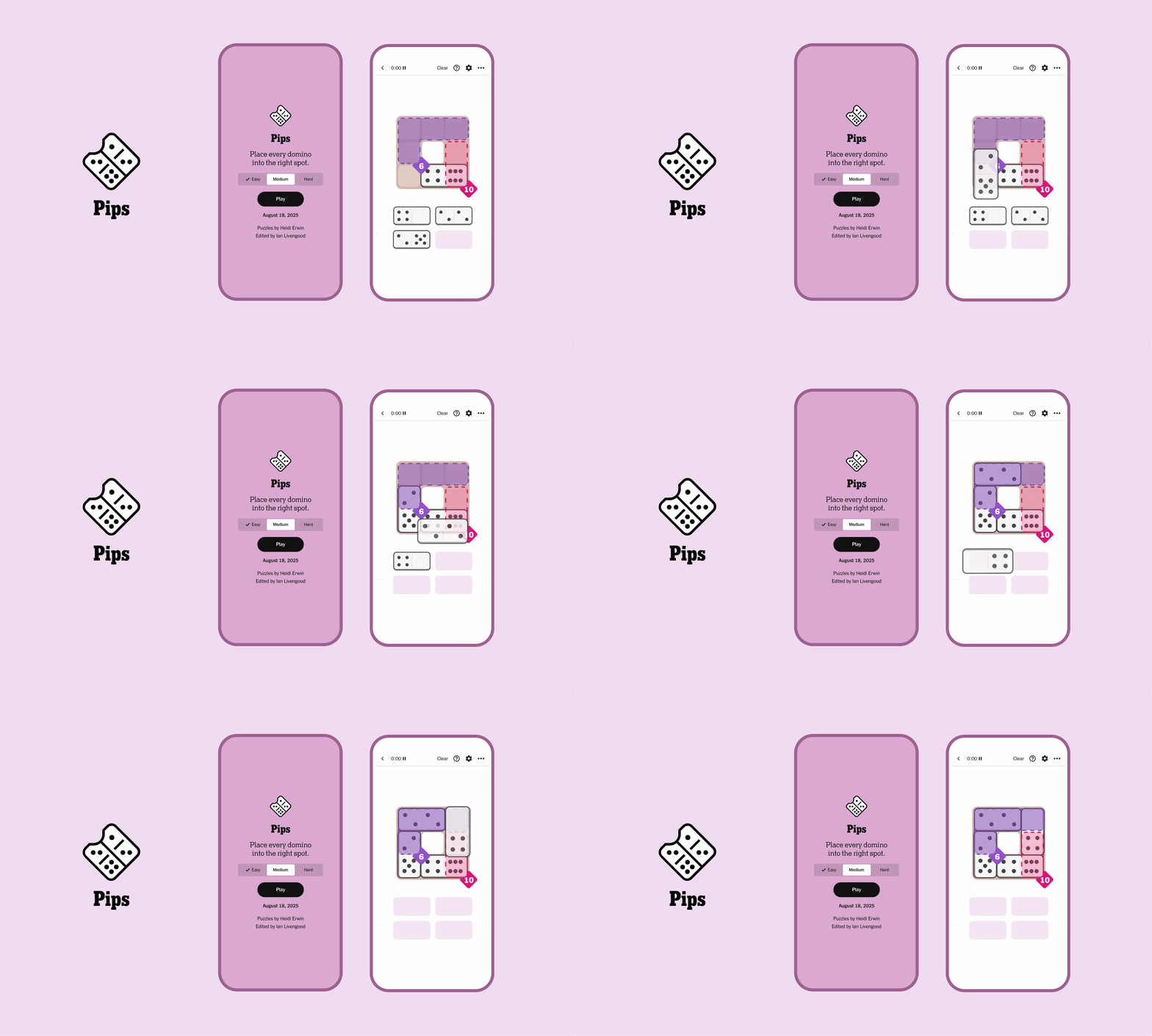
Daily digital puzzles have undergone a significant transformation over the last decade, evolving from simple diversions into a central pillar of digital media subscriptions and daily routines. As the calendar turns to the final day of 2025, the landscape of these "micro-challenges" has been dominated by a new generation of logic-based games that move beyond the linguistic focus of traditional crosswords. Among these, the game Pips has emerged as a particularly compelling synthesis of spatial reasoning, arithmetic, and domino-based strategy. This year-end analysis explores the mechanics of Pips, provides a comprehensive walkthrough of the December 31 challenges, and examines the broader industry implications of the gamification of daily news consumption.

The rise of Pips and its contemporaries marks a shift in how audiences engage with cognitive training. Unlike Wordle, which relies on vocabulary and linguistic patterns, or Connections, which tests lateral thinking and categorization, Pips demands a rigorous application of mathematical constraints and geometric placement. The game presents players with a grid of multicolored boxes, where each color corresponds to a specific logical "condition" or mathematical rule. To succeed, a player must utilize a finite set of dominoes—tiles consisting of two squares, each containing a number of "pips" (dots)—to fill the grid while satisfying every condition simultaneously.
The psychological appeal of Pips lies in its tiered difficulty system, which caters to a broad spectrum of cognitive comfort zones. The Easy, Medium, and Difficult tiers are not merely larger versions of the same puzzle; they introduce increasingly complex layers of interdependent variables. In the Easy tier, players often deal with simple equality or basic summation. As they progress to Medium and Hard, they encounter "greater than" (>) or "less than" (<) constraints, as well as "not equal to" (≠) requirements that force the player to consider the entire grid as a holistic system rather than a series of isolated math problems.

For the December 31, 2025, edition, the Pips puzzle designer opted for a thematic complexity that mirrors the reflective nature of New Year’s Eve. The grids for today require a nuanced understanding of how dominoes can be rotated to bridge disparate logic zones. In the digital puzzle industry, this is known as "constraint satisfaction," a principle also found in computer science and artificial intelligence. By solving these puzzles, users are essentially performing manual computations that mimic the logic gates of a processor.
Deciphering the December 31 Solutions
The Easy tier for Wednesday, December 31, focuses heavily on foundational equality. The grid is structured to reward players who identify the "anchor tiles" first—those squares that have the most restrictive rules. In this instance, the solution requires a careful balancing of the 2/1 and 3/6 tiles. By placing the 2/1 domino in a way that aligns with the initial sum requirements, the rest of the grid falls into place with a satisfying click of digital logic.

Moving to the Medium tier, the difficulty spikes as the grid introduces more non-linear paths. The Medium puzzle for today demands that players look at the intersections of different colored zones. The "bridging" technique becomes essential here. One must identify which dominoes can satisfy two different colored conditions at once. For example, a domino might have one half in a "sum of 10" zone and the other half in an "equality" zone. Navigating this duality is the key to the Medium solution, which ultimately utilizes the 5/4 and 6/2 tiles as the primary connectors.
The "Frog Face" Challenge: Hard Tier Walkthrough
The Hard tier Pips for the final day of 2025 has been described by the player community as having a visual layout resembling a "frog face." This architectural complexity is more than just an aesthetic choice; it creates "bottlenecks" in the logic flow. To solve the Hard Pips for Wednesday, December 31, one must adopt a systematic approach that prioritizes the most constrained areas—the "eyes" and the "mouth" of the frog.

Phase 1: The Foundation
The most logical starting point for today’s Hard puzzle is the bottom section, where single adjacent tiles offer the clearest path to entry. The strategy begins by placing the 2/1 domino into the Blue 2 and Pink 1 tiles. Simultaneously, the 3/6 domino should be slotted into the Purple 3 and the first Green 12 tile. These moves are foundational; without these specific placements, the upper "features" of the frog cannot be satisfied.
Phase 2: Bridging the Equality Groups
The middle section of the frog requires numbers that can bridge the Blue = (equality) and Pink = groups. By counting the remaining dominoes, it becomes evident that the Dark Blue = group will require 3s. This leaves the 4s and 5s to handle the heavy lifting in the Blue and Pink equality zones. The 6/5 domino should be moved from the Orange > 2 zone into the Blue = zone, followed by the 5/4 domino bridging Blue = and Pink =. To finish this phase, the 2/4 domino must be placed from the Purple > 1 zone into Pink =, allowing the 4/3 and 5/3 dominoes to be slotted vertically. This creates a cascade effect, feeding down into the Dark Blue = section.

Phase 3: The Final Integration
The final steps involve the "free tiles" and the remaining high-value dominoes. The 3/3 domino fits into the right-hand tiles of the Dark Blue = group, while the 5/0 domino moves from the Orange 5 tile into the first available free space. The 3/1 domino completes the Dark Blue = group and occupies the second free tile. Finally, the 6/2 domino is placed from the Green 12 zone into the third and final free tile. This completion marks the end of the 2025 Pips cycle, a year that has seen the game grow from a niche offering into a daily ritual for millions.
Expert Analysis and Industry Implications
The success of Pips is indicative of a broader trend in the tech and media industry: the "Games-as-a-Service" (GaaS) model applied to traditional journalism. Media conglomerates have realized that while news is often a "one-and-done" consumption item, puzzles create high-retention habits. A user who visits a site daily to solve Pips is significantly more likely to maintain a long-term subscription than one who only visits for breaking news.

From a design perspective, Pips represents a masterclass in UX (User Experience). The ability to click and rotate dominoes provides a tactile feel that bridges the gap between physical board games and digital interfaces. Furthermore, the use of color-coded logic zones taps into visual processing centers of the brain, making the math feel more like a visual puzzle than a schoolbook exercise.
Expert-level analysis of the December 31 puzzle reveals a shift toward "multi-solution" potential. While many Pips puzzles have a singular, rigid solution, the end-of-year Hard tier shows signs of "soft constraints," where multiple domino combinations could theoretically work in certain zones, provided the player manages the "overflow" of numbers correctly. This increases the game’s replayability and fosters a community of "Pipsqueaks" who share and compare alternative solutions on social media platforms.

Future Impact and Trends for 2026
As we look toward 2026, the trajectory of digital puzzles suggests several emerging trends. First, we are likely to see increased integration of AI-driven procedural generation. While the December 31 Pips puzzle was clearly hand-curated to provide a specific end-of-year experience, many games are moving toward algorithms that can generate infinite variations of difficulty. The challenge for developers will be maintaining the "human touch"—that feeling of a "fair" challenge that only a human designer can currently provide.
Secondly, the competitive aspect of these games is set to expand. We can expect to see more robust leaderboards, time-trial modes, and "social solving" features where users can collaborate on "Mega-Pips" grids in real-time. This transforms a solitary cognitive exercise into a social event, further embedding the game into the cultural fabric.

Finally, the cognitive health benefits of games like Pips will likely become a major marketing point. As the global population ages, "brain training" games are being scrutinized by researchers for their ability to maintain neuroplasticity. Pips, with its combination of arithmetic and spatial rotation, is ideally positioned to be at the forefront of this "wellness-tech" intersection.
The final puzzle of 2025 is more than just a game; it is a testament to the enduring human desire to find order in chaos. Whether one sees a frog face in the grid or merely a series of mathematical hurdles, the act of placing that final 6/2 domino provides a sense of closure. As we transition into 2026, the digital puzzle will continue to serve as a vital tool for mental sharpening, a source of community, and a cornerstone of the modern media economy.
