


The European Space Agency (ESA), a pivotal organization coordinating the space endeavors of 23 member states, has publicly acknowledged a recent cybersecurity incident involving infrastructure situated outside its primary corporate perimeter. This confirmation arrived following assertions made by a recognized threat actor on the BreachForums platform, suggesting unauthorized access to ESA’s systems. The agency, headquartered in Paris and boasting a workforce of approximately 3,000 professionals, managed a substantial budget of €7.68 billion (roughly $9 billion) in the 2025 fiscal year, underscoring its strategic significance in global scientific and technological advancement.
ESA’s official statement, issued on Tuesday, characterized the incident as involving servers supporting "unclassified collaborative engineering activities within the scientific community." Crucially, the agency emphasized that a forensic security analysis is underway, and immediate mitigation measures have been enacted to isolate and secure potentially compromised devices. Initial internal assessments suggest that the impact is confined to "only a very small number of external servers." Despite this minimizing assessment, the ramifications of any intrusion into the operational technology (OT) and development environments of a major space agency warrant intensive scrutiny.
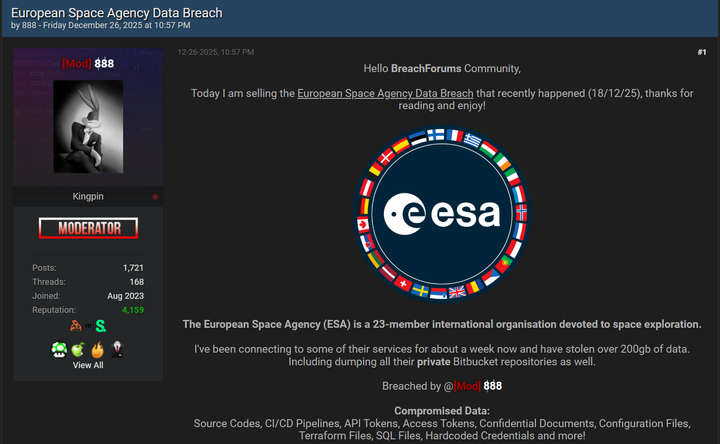
The context surrounding this breach is amplified by the claims made by the adversary. The threat actor not only provided visual evidence, specifically screenshots demonstrating access to ESA’s JIRA and Bitbucket servers over a span of a full week, but also alleged the exfiltration of a substantial volume of data—reportedly exceeding 200 gigabytes. The reported contents of this stolen cache are particularly concerning for an entity involved in sensitive, high-technology research and development. Allegations include the theft of proprietary source code, configurations for Continuous Integration/Continuous Deployment (CI/CD) pipelines, various access tokens (API and general access), sensitive documentation, infrastructure-as-code definitions such as Terraform files, database schemas in SQL format, and, critically, hardcoded credentials embedded within configuration files.

The mention of compromised private Bitbucket repositories is a significant detail. Bitbucket, a widely used platform for version control, houses the iterative history and intellectual property underpinning complex engineering projects. For a space agency, source code relates not merely to software but often to flight control systems, mission planning algorithms, data processing routines, and ground support infrastructure. While ESA stresses the data is "unclassified," the theft of source code, deployment logic, and embedded credentials represents a significant intelligence coup for any sophisticated adversary, potentially leading to supply chain compromises or detailed reconnaissance for future, more targeted attacks.
Historical Context and Escalating Threat Landscape
This incident is not an isolated event in ESA’s recent cybersecurity history, lending credence to the theory that the agency remains a persistent, high-value target. Approximately one year prior, the agency experienced a separate security failure when its official web shop was compromised. That attack involved injecting malicious JavaScript code—a form of digital skimming—to intercept and steal customer payment card data during e-commerce transactions. While distinct from the current engineering server breach, the pattern suggests systemic vulnerabilities either in the management of external-facing digital assets or a persistent failure to secure third-party integrations essential for operations.
The distinction between the previous e-commerce breach and the current engineering data theft is vital. The former targeted transactional data and customer PII/PCI data, impacting public trust and financial security. The latter targets the core intellectual and operational foundation of the agency’s technical capabilities. In the realm of national security and strategic technology, the compromise of source code and deployment artifacts is often viewed as far more damaging in the long term than the theft of credit card numbers.
Industry Implications: The Security Perimeter Dissolves
The ESA’s acknowledgment of a breach on "servers located outside the ESA corporate network" highlights a contemporary challenge facing large, collaborative scientific and governmental organizations: the erosion of the traditional security perimeter. Modern engineering, especially in fields like aerospace, relies heavily on distributed collaboration, cloud services, and third-party toolchains (like JIRA and Bitbucket). These external environments, often managed under different security protocols than the core internal network, become attractive vectors for adversaries.

For the broader aerospace and defense (A&D) sector, this event serves as a stark reminder that the risk exposure extends beyond the firewall. Security leadership must now treat any system connected to the development lifecycle—from code repositories to artifact managers and build servers—as potentially mission-critical, regardless of its hosting location or classification level. The successful exfiltration of CI/CD pipeline definitions is particularly worrying; an attacker gaining insight into deployment mechanics can craft highly effective, stealthy malware specifically tailored to bypass ESA’s operational deployment checks, effectively turning the agency’s own trusted automation against itself.
Expert analysis suggests that the adversary likely leveraged vulnerabilities within the authentication or authorization mechanisms of the external servers, possibly through credential stuffing, exploiting unpatched software, or leveraging compromised credentials from phishing campaigns targeting ESA personnel. The week-long period of unauthorized access indicated by the threat actor suggests a slow, methodical approach aimed at reconnaissance and data staging, indicative of a sophisticated, state-sponsored actor or a highly organized cybercriminal group targeting intellectual property.
Deep Dive into the Alleged Data Theft
The specific types of data allegedly stolen provide a roadmap of the potential damage:
- Source Code and CI/CD Pipelines: This is the crown jewel. Understanding the source code allows an adversary to discover zero-day vulnerabilities in ESA systems or to reverse-engineer proprietary algorithms used in mission control or satellite telemetry processing. CI/CD definitions reveal how software is built, tested, and deployed—essential knowledge for staging a software supply chain attack.
- API and Access Tokens: These tokens grant programmatic access to other systems, potentially extending the breach laterally into cloud environments (like AWS, Azure, or Google Cloud where mission data might be stored) or internal network segments that the initial external servers could access.
- Hardcoded Credentials and Configuration Files: The presence of hardcoded secrets indicates potential oversights in secure coding practices or secret management policies. These credentials, even if only for lower-privileged external services, can often be reused across interconnected systems, leading to privilege escalation.
- Terraform Files: These files define the desired state of infrastructure using Infrastructure as Code (IaC). Their compromise allows an attacker to understand the architecture of ESA’s cloud or virtualized environments and potentially issue commands to modify or dismantle infrastructure during a future attack phase.
The ESA’s classification of the affected data as "unclassified" must be viewed skeptically in the context of this specific haul. While mission-critical flight data might be classified, the source code for a new generation of scientific instrument software, or the access keys to the development environment for the next Copernicus satellite, possesses immense strategic value, even if it lacks the formal security label of "Secret." This data enables technological espionage, allowing competitors or hostile nations to leapfrog years of expensive R&D.
Forensic Analysis and Stakeholder Notification
ESA’s commitment to a forensic analysis is standard procedure, but the speed and depth of this investigation will be crucial. Key forensic priorities will include: determining the initial point of entry (patient zero), identifying the persistence mechanisms established by the attackers, mapping the full extent of data exfiltration, and auditing all tokens and credentials believed to have been exposed.
The notification of "all relevant stakeholders" is a complex administrative and diplomatic task for an intergovernmental body like ESA. Stakeholders include the national space agencies of the 23 member states, major industrial partners (e.g., Airbus, Thales Alenia Space), academic collaborators, and potentially international partners like NASA or JAXA, depending on the specific engineering projects supported by the compromised servers. A unified, transparent communication strategy is essential to manage political fallout and coordinate defensive actions across the entire ecosystem.
Future Trends and Hardening Strategy
This incident underscores several critical trends in securing high-value scientific infrastructure:
- The Necessity of Zero Trust Architecture (ZTA): The failure to contain the breach within the "external servers" suggests a flat or poorly segmented network architecture where an initial foothold granted too much lateral access. Implementing ZTA—where no user or service is trusted by default, regardless of location—is paramount. Access to JIRA or Bitbucket should be strictly limited based on the principle of least privilege, requiring multi-factor authentication (MFA) even for automated service accounts.
- Secrets Management Over Hardcoding: The alleged presence of hardcoded credentials mandates an immediate, organization-wide audit of development pipelines. Modern security dictates that secrets must be injected at runtime via dedicated secrets management vaults (e.g., HashiCorp Vault, cloud-native KMS services) rather than being stored statically in source code or configuration files.
- Securing the Software Supply Chain: Given the theft of CI/CD data, ESA must adopt rigorous Software Bill of Materials (SBOM) generation and vulnerability scanning tools integrated directly into their build processes. Furthermore, adopting cryptographic signing of all artifacts before deployment can ensure that only code verified by ESA’s internal systems can ever reach operational status, mitigating the risk posed by compromised source code.
- Continuous Monitoring of Collaborative Tools: Tools like JIRA and Bitbucket, while essential for agile development, represent an often-overlooked attack surface. These platforms must be subjected to the same high-level monitoring and intrusion detection scrutiny as core network assets, looking for anomalous access patterns, excessive data downloads, or unusual command execution within integrated development environments.
In conclusion, while the European Space Agency is actively investigating and addressing the immediate threat posed by the breach of its external engineering servers, the incident reveals systemic challenges common to organizations managing vast, distributed technological assets. The alleged theft of source code, deployment logic, and access tokens elevates this from a simple data leak to a potential strategic intelligence compromise, demanding a comprehensive re-evaluation of perimeter security and development lifecycle hygiene across the entire European space sector. The coming weeks will be critical as ESA transitions from containment to remediation, determining the true depth of the exposed intellectual capital.
