

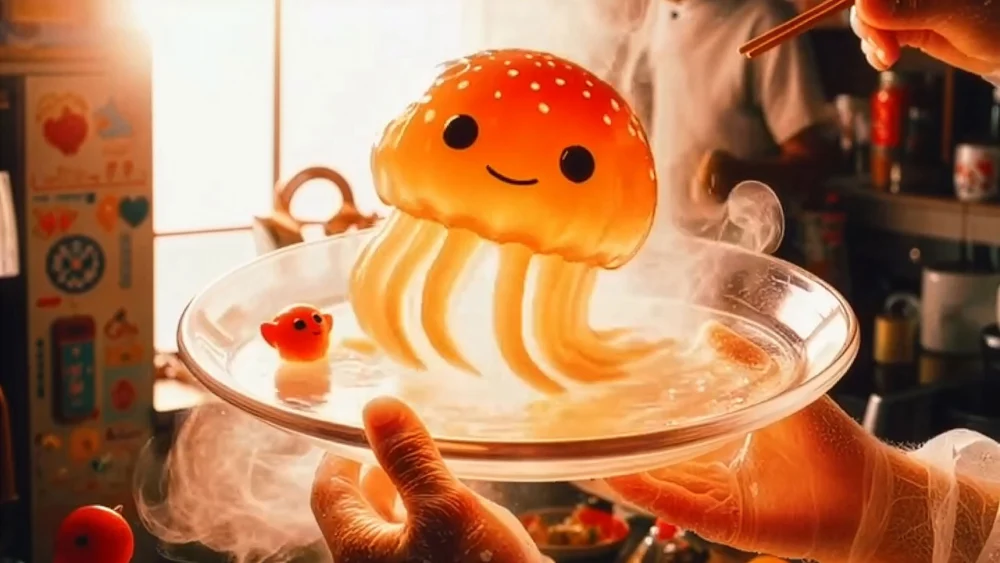
A distinct, unsettling aesthetic has saturated the digital landscape: the uncanny, fish-eyed perspective of a low-resolution surveillance camera. This visual signature—a grainy, wide shot capturing a mundane domestic scene or an empty parking lot—sets the stage for the fundamentally impossible. A politician appears on a suburban doorstep wearing a ludicrous costume; a vehicle spontaneously folds itself into a geometric origami shape before rolling away; or a disparate collection of animals, such as a capybara, a cat, and a bear, suddenly cohabit in a bizarre, pastoral scene. This style of hyper-surreal, low-fidelity motion clip has become the defining characteristic of what the digitally native now label "AI slop."
For anyone navigating the short-form video ecosystems of platforms like TikTok and Instagram Reels, this stream of repetitive, often incoherent AI-generated content is inescapable. This sudden ubiquity is a direct consequence of the widespread accessibility of advanced generative models, including OpenAI’s Sora, Google’s Veo series, and sophisticated tools developed by Runway. These systems have effectively demolished the technical barriers to entry, enabling virtually anyone with a smartphone to produce complex video narratives with nothing more than a few keystrokes.
The tipping point for the mainstream recognition of this phenomenon occurred recently when a short, deceptively simple video of rabbits rhythmically bouncing on a trampoline went globally viral. For many experienced users, this clip represented a moment of genuine confusion; it was among the first instances where an AI-generated video successfully mimicked reality, only to be revealed as synthetic upon closer inspection. The immediate response was an explosive wave of imitative content, with users generating endless variations—different animals, objects, and characters—all replicating the same bizarre trampoline scenario.
Initially, the prevailing sentiment across critical commentary and industry discourse was overwhelmingly negative. The proliferation of this content was frequently cited as evidence of the internet’s decline, feeding into theories of "enshittification"—the degradation of online platforms as they prioritize profit and mass-produced content over quality and user experience. My own initial reaction mirrored this critique; I instinctively scrolled past these clips, a futile protest against the algorithm’s push toward manufactured mediocrity. Yet, as compellingly strange and occasionally brilliant clips began circulating among private networks and group chats, it became clear that a blanket rejection of "AI slop" meant dismissing a nascent form of digital expression—a new kind of creativity taking shape in real time.
The Technological Acceleration of the Absurd
The term "AI slop" is broad, encompassing text, audio, and static imagery, but its true cultural breakthrough has been in the realm of video generation. These clips are typically created by inputting a descriptive written prompt into a large-scale AI model. Functionally, these models operate similarly to large language models (LLMs) but are significantly more demanding in terms of computational resources. They are trained on vast datasets of video and visual information, allowing them to predict the content, texture, and motion of every subsequent frame in a sequence.
The evolution of this technology has been breathtakingly fast. Early text-to-video systems, prevalent between 2022 and 2023, struggled with basic continuity. Outputs were often limited to short, blurry bursts of motion, plagued by visual artifacts—objects warping, characters teleporting, and the infamous "melting face" or "mangled hand" visual cues that immediately betrayed the synthetic origin. Over the past two years, advanced iterations such as Sora 2, Veo 3.1, and Runway’s Gen-4.5 have delivered dramatic improvements. These newer models produce realistic, seamless video segments lasting up to a minute, often incorporating ambient soundscapes and rudimentary dialogue, resulting in output that is increasingly difficult to distinguish from real footage.
The major AI development companies initially positioned these models as the future of professional cinema. Their promotional materials focused on widescreen aesthetics, dramatic camera movements, and applications for filmmakers, studios, and high-end storytellers. OpenAI marketed Sora as a "world simulator," actively engaging Hollywood executives with promises of feature-film quality shorts. Similarly, Google introduced Veo as a tool for generating storyboards and longer scenes, integrating directly into established film production workflows.
This initial vision hinged on the assumption that users desired hyperrealistic, high-fidelity video. However, the reality of deployment has been far more peculiar and decentralized. The true battleground for AI video is not the cinema screen but the six-inch mobile device. The democratization of these tools means that adoption is not limited to professional "creators" or film students. An Adobe report indicated that over 85% of professional creators utilize generative AI, but the tools are equally popular among average social media users who simply possess a phone and a fleeting idea.
Industry Implications and the Frictionless Trend
This democratization explains the prevalence of bizarre, algorithmically favored content: the Indian prime minister dancing with Mahatma Gandhi, an impossible close-up of a crystal dissolving into butter, or a famous fantasy series re-imagined as regional Chinese opera. While social platforms like TikTok and Reels were already built on rapid-fire, micro-trends, AI has acted as an accelerant. The cost of iteration has plummeted to zero; copying a viral concept no longer requires coordinating costumes, location scouting, or complex editing. It requires merely tweaking a prompt, hitting ‘Generate,’ and sharing the result.
This frictionless creative environment has prompted platforms to adapt aggressively. The Sora application now facilitates the insertion of AI versions of users into generated scenes, effectively turning the user base into actors within their own generative narratives. Meta’s experimental apps aim to transform entire personalized feeds into seamless streams of AI clips, recognizing the addictive, hypnotic quality of the format.
However, the ease of creation that fosters harmless novelty also facilitates malicious activity, posing significant industry and ethical challenges. The generative capacity has been quickly co-opted for creating harmful deepfakes, resulting in the need for companies to implement complex content moderation blocks, such as the restrictions imposed by the Martin Luther King Jr. estate regarding racist deepfakes. Furthermore, platforms like TikTok and X have struggled to contain the bulk circulation of violent and abusive clips, often featuring Sora watermarks, posted by dedicated malicious accounts. Most concerning is the rise of "nazislop," a nickname for AI videos that repackage fascist and hateful ideologies into slick, algorithm-optimized content aimed at young, impressionable audiences.
Despite the severe issues of misuse, the momentum of short-form AI video as a medium remains unchecked. New dedicated apps, specialized Discord communities, and advanced tutorial channels multiply weekly. Crucially, the creative community is increasingly moving away from attempting to achieve perfect photorealism. Instead, the focus is shifting toward embracing and exploiting the inherent strangeness and occasional glitches of the AI models.
The New Creative Directorship
Conversations with early adopters reveal a shared commitment to pushing the boundaries of the absurd. Wenhui Lim, an architect-turned-full-time AI artist, notes a competitive spirit among creators: "There is definitely a competition of ‘How weird we can push this?’ among AI video creators." The models excel at violating the laws of physics and challenging conventional optics, making them ideal vehicles for satire, body horror, experimental art, and absurdist comedy.
Drake Garibay, a software developer, exemplified this shift when he began experimenting with generative media tools like ComfyUI, drawn by the viral body-horror clips circulating in early 2025. His creations, such as the viral video depicting a human face emerging from a boiling pot of dough, achieve widespread attention precisely because they leverage the technology’s capacity for the morbid and the surreal. Garibay, who describes himself as having an artistic background, felt an immediate draw: "When I saw what AI video tools can do, I was blown away."
Daryl Anselmo, a digital artist and former creative director, has been chronicling the technological progression since 2021 through a daily AI-generated video project, ironically titled AI Slop. Anselmo uses a wide palette of tools—Kling, Luma, Midjourney—constantly iterating. For him, the experimentation is the core value. "I would like to think there are impossible things that you could not do before that are still yet to be discovered. That is exciting to me," he explains. His work, exhibited in prestigious venues, often presents art-house vignettes, shifting from landscapes to darker subjects like the hyperrealistic bot peeling open its own skull in feel the agi.
These systems also enable creators to build consistent, recurring characters and spaces that function as informal franchises, a crucial element for algorithmic success. Lim’s popular account, Niceaunties, draws on Singaporean "auntie culture"—a stereotype of elderly, often meddlesome women—and reimagines them in playful, surreal scenarios. Her viral piece, Auntlantis, casts silver-haired aunties as industrial mermaids in an underwater trash-processing plant, subverting cultural expectations through generative fantasy.
Similarly, the creators behind Granny Spills, Eric Suerez and Adam Vaserstein, have built a successful daily content channel around a glamorous, sassy old lady who dispenses life advice in street interviews. Their entire workflow—from scriptwriting to scene construction—is AI-powered. Their primary function, they argue, is creative direction and brand management. This model proves highly scalable, allowing them to rapidly expand their fictional universe by creating culturally specific counterparts (Black granny, Asian granny) who engage in crossover videos, maximizing audience reach and platform traffic.
The Semiotics of Slop and Algorithmic Anxiety
The derogatory term "slop" has a long history, tracing back to the early 2010s within niche internet forums. Internet linguist Adam Aleksic notes that the term has evolved from an insular in-joke to a widespread pejorative for any low-quality, mass-produced content aimed at an unsuspecting public. Despite its broadened application to everything from manufactured news articles to subpar work reports, its primary association remains AI-generated output. This perception is rapidly being cemented by cultural institutions; the Cambridge Dictionary, for example, now defines the relevant sense of "slop" as "content on the internet that is of very low quality, especially when it is created by AI."
This charged label is a source of friction among AI creators. While some, like Anselmo, embrace the term semi-ironically—seeing their work as an "experimental sketchbook" that pushes the limits of the model—others actively reject it. Suerez and Vaserstein view the term as disrespectful of their artistic and directorial input, emphasizing that while they don’t manually draw or film, they make continuous, legitimate creative choices.
For most dedicated creators, generative output is far from a one-click process. Achieving a desired aesthetic requires significant skill in prompt engineering, iteration, trial and error, and a strong sense of visual taste. Lim notes that a single minute of video can require days of refinement. The implication of "ease of creation" inherent in the term "slop" deeply frustrates those who spend hours mastering complex generative workflows.
Aleksic frames the public reaction to slop as a complex emotional blend: "There’s a feeling of guilt on the user end for enjoying something that you know to be lowbrow. There’s a feeling of anger toward the creator… and all the meantime, there’s a pervasive algorithmic anxiety hanging over us." This anxiety predates generative AI; it is the low-grade dread of being constantly manipulated by platform algorithms, having personal taste engineered, and attention herded. AI simply provides the newest, most visible target for this long-simmering resentment against digital infrastructure.
This negative association has tangible economic consequences. A Brookings Institution study examining a major freelance marketplace found that following the widespread launch of generative AI tools in 2022, freelancers in exposed occupations experienced a measurable decline: approximately a 2% reduction in contracts and a 5% drop in earnings.
Mindy Seu, a researcher and associate professor of digital arts at UCLA, highlights the core conflict: the term "AI slop" implies a lack of artistic labor, which clashes with traditional concepts of contemporary art. The resistance to AI mirrors historical stigmas associated with previous technological advances in creative fields. Just as digital art and internet art struggled for institutional recognition decades ago, AI now forces a critical re-evaluation. "Every big advance in technology yields the question, ‘What is the role of the artist?’" Seu observes.
The Future of Authorship and Creative Resistance
The rise of AI video forces a shift in the definition of authorship. The rare, specialized skill of craftsmanship is being replaced by a skill set closer to creative direction: the ability to articulate precise linguistic commands and contextual references that the model can understand. Discernment and critique—knowing what to ask for, and how to refine the output—become central to the process. Coco Mao, cofounder of OpenArt, suggests that mastering generative tools will soon be as essential for content creators as learning Photoshop was for previous generations of graphic designers.
Yet, this shift is not purely mechanical. Lim emphasizes that true creativity lies in consistency and human intent: "It’s very easy to copy the style… but they [imitators] don’t understand why I’m doing it." The idea, the underlying human concept, remains the essential ingredient. Zach Lieberman, a professor at the MIT Media Lab, agrees that mathematical logic is not incompatible with beauty, but he notes the trade-off: reliance on black-box AI models inevitably means artists sacrifice some degree of direct control over the final output.
For critics, AI slop embodies the worst tendencies of the internet: noise, ugliness, and the crowding out of genuine human work. It represents content engineered to be mathematically average, scraped from existing culture and blended into a "formulaic derivativeness" designed for maximum algorithmic engagement.
But within this noise, a new form of collaborative culture is emerging. The "Italian brainrot" phenomenon, popular among Gen Z and Gen Alpha, serves as a prime example. This trend, centered around human-animal-object hybrids with pseudo-Italian names, started with simple viral sounds and quickly expanded into a massive, decentralized lore-building exercise. Denim Mazuki, a content creator, describes the appeal: "It was the collective lore-building that made it wonderful. Everyone added a piece. The characters were not owned by a studio or a single creator—they were made by the chronically online users." Tools like OpenArt, which offer frame-by-frame narrative control, are specifically enabling this shift toward communal storytelling.
Ultimately, the act of consuming AI slop is an admission that the cultural infrastructure is now opportunistic and extractive. The algorithm reigns supreme. Yet, human agency, rather than disappearing, is simply finding new outlets. We are now watching content generation happen on an unimaginable scale, and our collective response—the memes, the remixes, the parodies—immediately feeds back into the loop.
This cycle suggests that AI slop, born of submission to algorithmic logic, is not merely mediocre; it is so aggressively, inhumanly banal that it achieves a surreal, compelling quality. To accept this content is to recognize the brokenness of the modern internet, but it is also to recognize the resilient human urge to play, to laugh, and to create meaning even within the wreckage.
This phenomenon reached a meta-critical peak when a Chinese creator, Mu Tianran, began producing live-action skits that deliberately mimicked the stilted, uncanny quality of AI slop. In one widely shared clip, he plays a street interviewer asking actors, "Do you know you are AI generated?" The actors’ responses—eyes fixed slightly off-camera, laughter delayed, movements subtly wrong—are uncanny because they perfectly parody the visual flaws of the AI models. Watching this human imitation of synthetic failure, it becomes clear that AI is not extinguishing human creativity; it is simply handing humanity a new style, a new texture, and a new set of flaws to inhabit, mock, and ultimately, transcend. The urge to remix and joke remains stubbornly human, a force that technology cannot automate away.
