

For nearly a decade, the promise of a silent, lightning-fast, and emissions-free semi-truck has been the crown jewel of Elon Musk’s vision for a sustainable energy future. When the Tesla Semi was first unveiled in late 2017, the atmosphere was one of revolutionary fervor. Musk promised a vehicle that would not only outperform its diesel counterparts in speed and safety but would fundamentally break the back of the trucking industry’s operating costs. However, as the Semi finally moves toward meaningful production in the first half of 2026, the world it is entering looks radically different from the one for which it was designed. The intersection of shifting federal policy, a volatile energy market, and the immense power demands of the artificial intelligence boom has created a perfect storm of headwinds for the electric heavy-duty sector.
In recent months, Tesla’s corporate narrative has pivoted sharply. During the company’s most recent earnings discussions, the focus was almost entirely on the transition from an automotive manufacturer to an "AI and robotics powerhouse." Musk’s rhetoric now centers on the "Cybercab"—a steering-wheel-less autonomous taxi—and the "Optimus" humanoid robot. Even the storied Model S and Model X, the vehicles that established Tesla’s luxury credentials, have been framed as legacy products making way for a new era. Yet, largely absent from this high-level visionary talk was the Tesla Semi, a Class-8 beast that represents the company’s most significant engineering challenge to date.
The timing of the Semi’s rollout is particularly fraught. While the passenger electric vehicle (EV) market continues to grow, albeit at a decelerating pace, the heavy-duty commercial sector is facing a much steeper climb. Industry analysts, including those at ACT Research, suggest that demand for electric Class-8 trucks will remain a niche segment for the foreseeable future. Projections for 2026 suggest total volumes might hover just under 1,400 units nationwide—a staggering drop from the mass-market aspirations once touted by Tesla. This cooling of interest is not merely a matter of technological skepticism; it is a direct reflection of a changing political and economic landscape.
The most immediate hurdle is the dramatic shift in federal support. Under the current administration, the aggressive subsidies and green-energy incentives that once made the transition to electric fleets financially viable have been significantly curtailed or eliminated entirely. For a fleet manager, the "green" image of an electric truck is a luxury that must eventually be reconciled with the bottom line. Without federal tax credits or state-level grants to offset the high initial purchase price—which often reaches $400,000 for competing models from Volvo or Navistar—the math for the average shipping company simply does not add up.

Beyond the political climate, the fundamental "fuel" economics that Musk used to sell the Semi in 2017 have been turned upside down. At the vehicle’s debut, Tesla estimated that electricity would cost roughly 7 cents per kilowatt-hour (kWh), while diesel prices remained high. This allowed Musk to claim that a Tesla Semi would be 20% cheaper to operate per mile than a traditional diesel rig. Today, that calculation has collapsed. According to data from the Federal Reserve, the national average for electricity has climbed to nearly 19 cents per kWh, with prices in logistics hubs like California soaring as high as 33 cents. Conversely, diesel prices have stabilized and, in many regions, decreased, narrowing or eliminating the operational savings that were supposed to justify the Semi’s premium price tag.
Ironically, part of the reason for this surge in electricity costs is Musk’s other ventures. The insatiable demand for power from massive data centers—driven by the AI revolution and companies like Musk’s own xAI—is putting unprecedented strain on the American electrical grid. As these data centers compete for the same power supply that would charge a fleet of Semis, the cost of "refueling" an electric truck is being pushed higher, further eroding the competitive advantage of battery-powered freight.
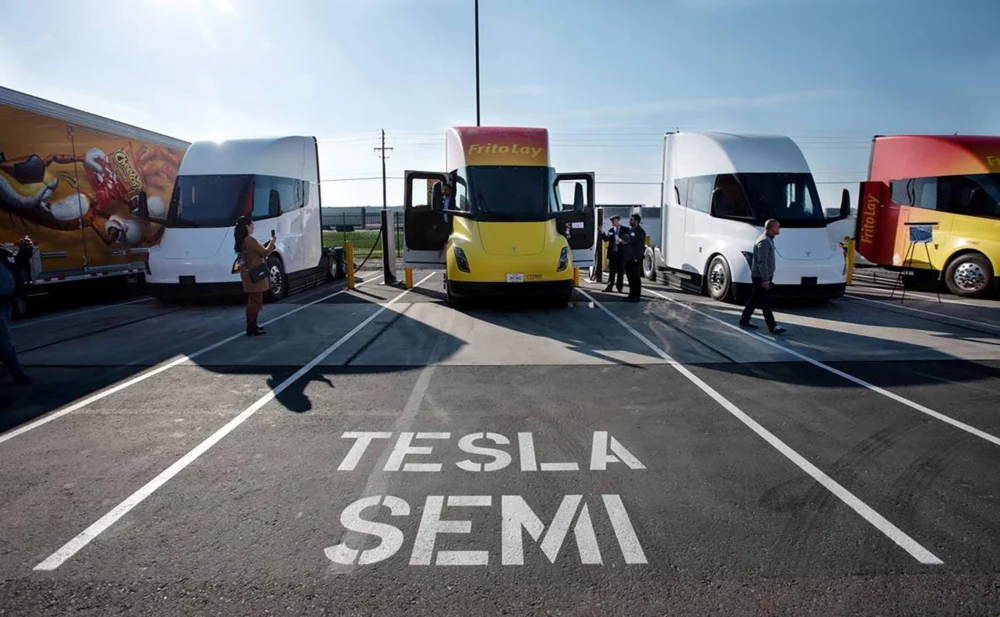
Despite these challenges, a handful of corporate giants remain committed to the experiment. DHL and PepsiCo (specifically its Frito-Lay division) have been early adopters, integrating a limited number of Semis into their California operations. For these companies, the motivation is often rooted in long-term corporate ESG (Environmental, Social, and Governance) goals. DHL, for instance, has stated its intention to electrify 30% of its fleet by 2030. However, even these enthusiasts are pragmatic about the truck’s current limitations. Most are deploying the Semi for short-to-medium haul routes rather than the 500-mile long-haul treks Musk originally envisioned.
The physics of heavy-duty hauling also remains a point of contention. There is a reason the phrase "it’s smarter to transport potato chips" has become a mantra among industry skeptics. A Class-8 truck hauling light, airy cargo like Frito-Lay snacks can maximize its range because the battery isn’t fighting the immense weight of the payload. However, when the cargo is something dense and heavy, like crates of soda or liquid chemicals, the energy required to move the vehicle increases exponentially, draining the massive 990 kWh battery pack and shortening the distance between "Megacharger" stops.
Tesla’s infrastructure plans are equally ambitious and uncertain. The company has mapped out a network of Megacharger stations across the U.S. for 2026, designed specifically to handle the high-voltage requirements of the Semi. Yet, building this infrastructure requires more than just installing plugs; it requires massive upgrades to the local power grids at every station. For many rural truck stops, providing the megawatts of power needed to charge multiple Tesla Semis simultaneously is equivalent to powering a small town—a logistical and financial hurdle that utilities are not always prepared to meet.

The competitive landscape has also thinned out, serving as a cautionary tale for the industry. Nikola, once seen as Tesla’s primary rival in the zero-emissions trucking space, faced a spectacular fall from grace, ultimately filing for bankruptcy after a series of leadership scandals and a depletion of cash reserves. While established players like Volvo and Navistar continue to offer electric options, they are doing so with a level of caution that suggests they see the market as a slow-burn evolution rather than a rapid revolution.
Perhaps the most telling sign of Tesla’s internal recalibration is the mystery surrounding its production capacity. For years, Tesla’s quarterly reports listed the production line at its Nevada Gigafactory as having an annual capacity of 50,000 Semis. It was a bold figure, representing nearly 20% of the entire U.S. Class-8 market. However, in the most recent fourth-quarter update, that capacity figure was conspicuously left blank. This omission suggests that Tesla is quietly tempering expectations, moving away from the "mass production" narrative toward a more measured, low-volume rollout as it gauges the reality of the 2026 market.
As the first production-line Semis begin to roll out of Nevada, they will enter an industry that is currently more focused on survival and efficiency than experimental technology. For the Tesla Semi to truly transform trucking, it will need to prove its worth not just on a flashy stage in Hawthorne, but on the grueling, cost-sensitive highways of the American heartland. It must overcome a world where electricity is expensive, diesel is resilient, and government support is vanishing.
The next two years will be the ultimate stress test for Tesla’s heavy-duty vision. If the company can drive down the cost of the vehicle and the Megacharger network can expand despite the grid’s limitations, the Semi may yet become the "game-changer" Musk promised. But for now, the biggest truck in Tesla’s history is facing its biggest obstacle: a market reality that refuses to follow the script written nine years ago. The road ahead for the Tesla Semi is finally open, but it is steeper, narrower, and more expensive than anyone anticipated.
