

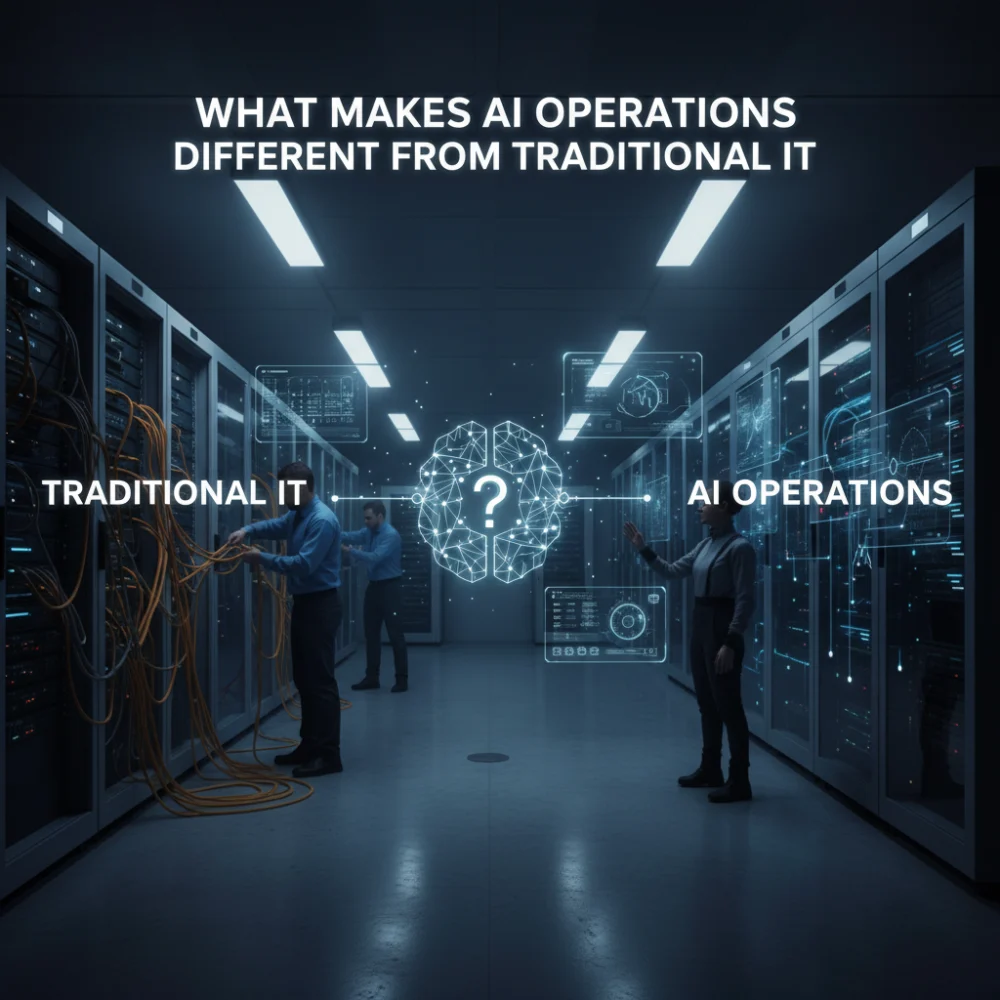
Introduction: The Evolving Landscape of IT Operations
In today’s rapidly evolving technological landscape, the way we manage and operate IT infrastructure has undergone a significant transformation. Traditional IT operations, characterized by manual processes and reactive problem-solving, are gradually giving way to AI Operations (AIOps), a modern approach that leverages artificial intelligence and machine learning to automate and optimize IT processes. Understanding the distinctions between these two paradigms is crucial for organizations seeking to enhance efficiency, reduce costs, and improve overall IT performance.
Defining Traditional IT Operations
Traditional IT operations typically involve a set of manual and often siloed processes for managing IT infrastructure, applications, and services. This approach relies heavily on human expertise and intervention, with IT professionals manually monitoring systems, identifying issues, and implementing solutions. Key characteristics of traditional IT operations include:
- Manual Processes: Repetitive tasks such as monitoring, patching, and configuration are performed manually.
- Reactive Problem-Solving: Issues are typically addressed after they occur, leading to downtime and service disruptions.
- Siloed Teams: Different IT teams (e.g., networking, security, applications) operate independently, hindering collaboration and communication.
- Limited Automation: Automation is often limited to basic scripting and scheduled tasks.
- Data Silos: Data is fragmented across different systems and tools, making it difficult to gain a holistic view of IT performance.
Introducing AI Operations (AIOps)
AIOps represents a paradigm shift in IT operations, leveraging artificial intelligence (AI) and machine learning (ML) to automate and enhance various IT processes. By analyzing vast amounts of data from diverse sources, AIOps platforms can identify patterns, predict anomalies, and automate responses to IT issues. Key features of AIOps include:
- Automated Incident Management: AI algorithms can automatically detect, diagnose, and resolve IT incidents, reducing downtime and improving service availability.
- Predictive Analytics: ML models can predict potential issues before they occur, allowing IT teams to proactively address them.
- Root Cause Analysis: AIOps platforms can quickly identify the root cause of IT problems, eliminating the need for manual troubleshooting.
- Intelligent Automation: AI-powered automation can streamline repetitive tasks, freeing up IT staff to focus on more strategic initiatives.
- Unified Data Platform: AIOps platforms aggregate data from various sources into a unified platform, providing a comprehensive view of IT performance.
Key Differences: Automation and Orchestration
One of the most significant differences between AIOps and traditional IT lies in the level of automation. Traditional IT relies on manual processes and limited scripting, while AIOps leverages AI and ML to automate a wide range of tasks, including incident management, problem resolution, and performance optimization. AIOps takes automation a step further with orchestration, which involves coordinating and automating complex workflows across multiple systems and teams. This enables IT organizations to respond quickly and efficiently to changing business needs.
Data-Driven Decision Making
Traditional IT often relies on gut feelings and limited data when making decisions. AIOps, on the other hand, is driven by data. AIOps platforms collect and analyze vast amounts of data from various sources, including logs, metrics, and alerts. This data is then used to identify patterns, predict anomalies, and make informed decisions about IT operations. By leveraging data-driven insights, IT organizations can optimize performance, reduce costs, and improve overall efficiency.
Proactive vs. Reactive Problem-Solving
Traditional IT is often reactive, meaning that issues are addressed after they occur. This can lead to downtime, service disruptions, and frustrated users. AIOps, on the other hand, is proactive. By leveraging AI and ML, AIOps platforms can predict potential issues before they occur, allowing IT teams to address them proactively. This can prevent downtime, improve service availability, and enhance the user experience.
Enhanced Visibility and Insights
Traditional IT often suffers from a lack of visibility into IT performance. Data is fragmented across different systems and tools, making it difficult to gain a holistic view of IT operations. AIOps platforms provide enhanced visibility by aggregating data from various sources into a unified platform. This provides IT teams with a comprehensive view of IT performance, allowing them to identify and address issues more quickly and effectively. AIOps provides actionable insights by analyzing the data and presenting it in an easy-to-understand format.
Improved Collaboration and Communication
Traditional IT often involves siloed teams that operate independently. This can hinder collaboration and communication, leading to inefficiencies and delays. AIOps promotes collaboration and communication by providing a shared platform for IT teams to work together. AIOps platforms can automate communication workflows, ensuring that the right people are notified of issues in a timely manner.
Reduced Costs and Increased Efficiency
By automating tasks, predicting issues, and optimizing performance, AIOps can help organizations reduce costs and increase efficiency. AIOps can reduce the need for manual labor, freeing up IT staff to focus on more strategic initiatives. AIOps can also help organizations avoid downtime, which can be costly in terms of lost productivity and revenue. Overall, AIOps can help organizations get more value from their IT investments.
Scalability and Flexibility
Traditional IT can be difficult to scale and adapt to changing business needs. AIOps platforms are designed to be scalable and flexible, allowing organizations to easily adapt to changing demands. AIOps can automatically provision resources, optimize performance, and ensure that IT infrastructure is always available and responsive.
The Role of Machine Learning in AIOps
Machine learning (ML) is a core component of AIOps. ML algorithms are used to analyze vast amounts of data, identify patterns, predict anomalies, and automate responses to IT issues. ML models can be trained to identify specific types of issues, such as security threats, performance bottlenecks, and capacity constraints. As ML models learn from data, they become more accurate and effective over time.
Implementing AIOps: Key Considerations
Implementing AIOps requires careful planning and execution. Organizations should start by identifying their specific needs and goals. They should then select an AIOps platform that meets their requirements. It is important to integrate the AIOps platform with existing IT systems and tools. Organizations should also train their IT staff on how to use the AIOps platform. Finally, organizations should continuously monitor and optimize their AIOps implementation to ensure that it is delivering the desired results.
Challenges and Considerations for AIOps Adoption
While AIOps offers numerous benefits, organizations may encounter challenges during adoption. Data quality is crucial; inaccurate or incomplete data can lead to flawed insights. Cultural resistance to change can also hinder progress, as IT teams may be hesitant to relinquish control to automated systems. Security concerns must be addressed by implementing robust access controls and data encryption. Careful planning and addressing these challenges are essential for successful AIOps implementation.
The Future of IT Operations: AIOps as the New Normal
As AI and ML technologies continue to advance, AIOps is poised to become the new normal for IT operations. Organizations that embrace AIOps will be better positioned to manage the complexity of modern IT environments, reduce costs, improve efficiency, and enhance the user experience. AIOps will enable IT organizations to move from being reactive to proactive, from being cost centers to value drivers.
Conclusion: Embracing the AIOps Advantage
The transition from traditional IT operations to AIOps represents a fundamental shift in how organizations manage their IT infrastructure. By embracing automation, data-driven decision-making, and proactive problem-solving, AIOps empowers IT teams to optimize performance, reduce costs, and improve overall efficiency. As the complexity of IT environments continues to grow, AIOps will become increasingly essential for organizations seeking to stay ahead of the curve and deliver exceptional digital experiences.
