

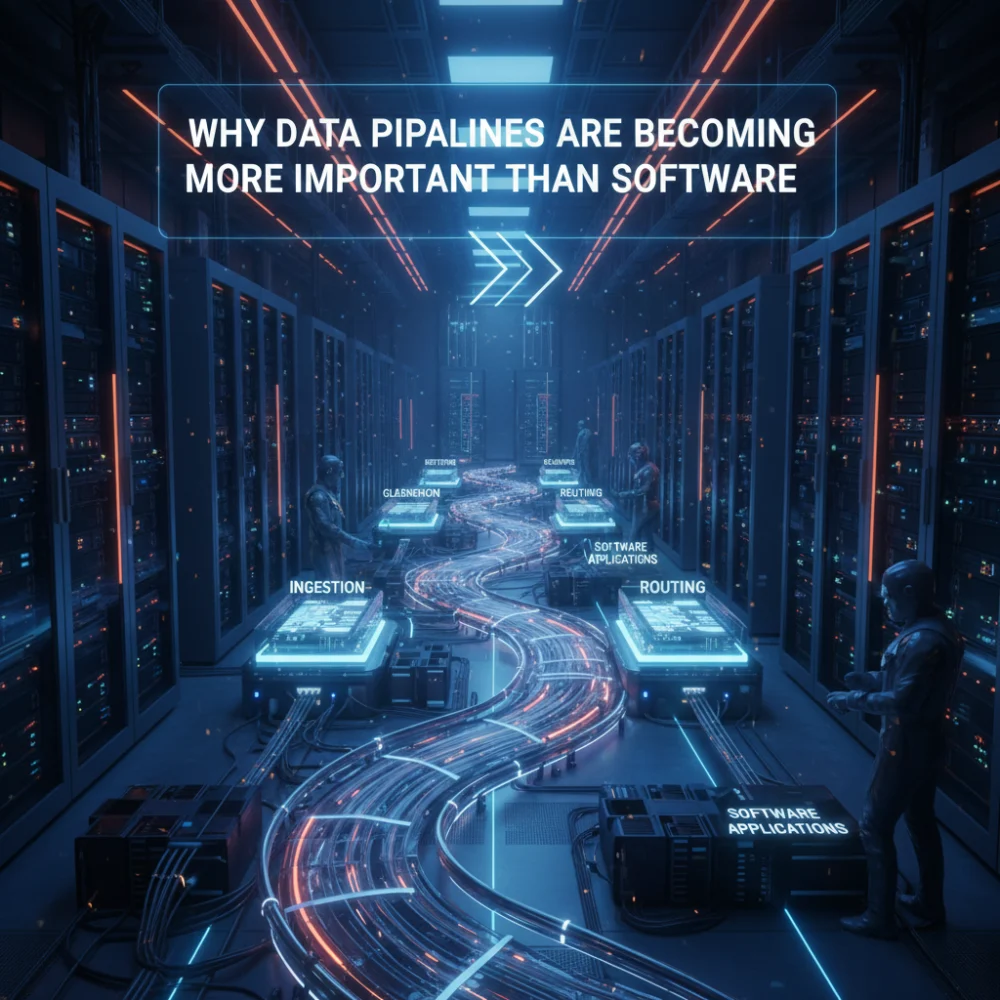
The historical focus of technology investment has overwhelmingly centered on building applications: the user interfaces, the business logic, and the core software that runs daily operations. However, a significant, often invisible shift is occurring. Data pipelines, the automated systems designed to ingest, process, transform, and deliver data reliably, are increasingly becoming the critical differentiator and the true source of competitive advantage, often outweighing the importance of the applications they feed.
The Primacy of Data in the Modern Enterprise
In the era of Big Data and machine learning, data is frequently cited as the ‘new oil.’ But raw data, much like crude oil, is useless until it is refined. Data pipelines are the refineries. Without robust, scalable, and trustworthy pipelines, even the most sophisticated AI models or business intelligence dashboards remain theoretical constructs, starved of the fuel they need to operate effectively.
Traditional software development focuses on features and functionality for direct user interaction. Data pipelines, conversely, focus on fidelity, latency, and volume for machine consumption and analytical insight. This subtle difference in focus dictates their strategic value in a data-driven world.
The Fragility of Data Flow Versus Application Stability
An application might crash due to a bug in its presentation layer, causing temporary user frustration. A failure in a critical data pipeline, however, can silently corrupt the foundational truth of the business. Imagine inventory systems receiving delayed stock updates, fraud detection models being trained on stale transaction records, or financial reports based on incomplete ledger entries. These pipeline failures lead to systemic, high-impact business errors that are often harder to trace and rectify than application bugs.
Key Differences in Required Robustness:
- Idempotency: Pipelines must handle reprocessing data without creating duplicates or side effects, a concept less critical in stateless front-end applications.
- Schema Evolution: Data sources constantly change their formats. Pipelines must gracefully manage schema drift, a constant battle absent in tightly controlled application environments.
- Backpressure Management: They must absorb massive fluctuations in incoming data volume without overwhelming downstream systems or losing data.
The AI/ML Imperative: Pipelines as the True Engine
The ascendancy of Artificial Intelligence and Machine Learning has cemented the importance of pipelines. Machine learning models are only as good as the data they consume, leading to the maxim: ‘Garbage In, Garbage Out’ (GIGO). Data scientists spend an inordinate amount of time preparing data—the MLOps pipeline is essentially a complex data pipeline focused on feature engineering and validation.
The software that runs the model (the inference engine) is often simple; the pipeline that ensures the model is continuously fed fresh, clean, relevant training data is the complex, high-value component. This realization is shifting engineering resources away from optimizing the serving layer to perfecting the training and validation pipelines.
Shifting Engineering Talent and Investment
Historically, top engineering talent gravitated towards building customer-facing products. Today, many of the highest-paid and most sought-after roles are focused on Data Engineering, specifically designing, building, and maintaining these complex data flows. This migration of talent signals where the market perceives the highest leverage point for business value lies.
Companies are now investing heavily in specialized tools—stream processing frameworks, orchestration engines like Airflow or Dagster, and real-time data warehouses—tools fundamentally dedicated to pipeline infrastructure, rather than just application frameworks.
