

The arrival of the second-generation Apple AirTag marks a pivotal moment in the evolution of the Find My ecosystem, representing an iterative yet profound refinement of a product that has become a staple of modern personal logistics. When Apple first entered the tracking market in 2021, the original AirTag was met with a mixture of acclaim for its seamless integration and scrutiny regarding its privacy implications. Years later, the successor has emerged, not as a radical departure in aesthetics, but as a significant technological leap in performance, reliability, and accessory sustainability. This second iteration addresses the nuanced pain points of the original while doubling down on the proprietary silicon that gives Apple a distinct advantage over competitors like Tile and Samsung.
At the heart of the new AirTag is the second-generation Ultra Wideband (UWB) chip, the same sophisticated silicon found in the iPhone 17 series. This hardware upgrade is the primary driver behind the device’s most touted feature: a 50% increase in the range for Precision Finding. In practical terms, this means the "hot and cold" directional interface on a user’s iPhone can engage at a much greater distance, reducing the time spent wandering through a home or office before the signal locks on. For users in sprawling environments or those trying to locate an item in a crowded outdoor space, this expanded radius fundamentally changes the utility of the device. It transforms the AirTag from a "last-meter" solution into a "last-room" solution, providing a smoother handoff between the broad geographical location provided by the global Find My network and the localized precision of UWB.
The auditory experience of the AirTag has also undergone a sophisticated overhaul. While the original model was often criticized for being difficult to hear when muffled by couch cushions or thick luggage, the second-generation unit boasts a significantly louder internal speaker. However, the change is not merely one of decibels. The chime itself has been redesigned, shifting from a fundamental F note to a G. This higher pitch is more than a musical choice; it is an acoustic strategy. Higher frequencies are often perceived as more piercing and are easier for the human ear to localize in environments with significant ambient low-frequency noise. By optimizing the sound profile, Apple has ensured that the "Play Sound" feature is more effective in real-world scenarios, such as finding keys in a noisy coat closet or a backpack buried in a car trunk.
One of the most significant, albeit less publicized, improvements involves the device’s power source. The original AirTag had a documented conflict with certain CR2032 coin cell batteries, specifically those treated with a bitterant coating. These coatings, designed to prevent accidental ingestion by children, often interfered with the AirTag’s contact points, leading to inconsistent power or a total failure to operate. In response to consumer feedback and safety regulations, the second-generation AirTag features a redesigned internal battery housing and contact mechanism. Apple has worked to ensure compatibility with a wider array of battery manufacturers, allowing users to prioritize child safety without sacrificing the functionality of their tracker. This change reflects a maturing product line that is increasingly attentive to the intersection of hardware design and household safety standards.
From a design perspective, Apple has maintained the iconic "polished pebble" form factor, a decision that ensures backward compatibility with the vast ecosystem of third-party mounts, loops, and cases already on the market. While some enthusiasts had hoped for a built-in lanyard hole—a feature found on some competitor products—Apple’s commitment to the accessory market remains firm. The new model is marginally heavier, a byproduct of the denser internal components and the more robust speaker assembly, though the difference is virtually imperceptible in daily use. The external casing remains a canvas for personalization, though long-term users of the original model will note that the new version’s longevity is better protected by the same IP67 water and dust resistance rating that defined its predecessor.

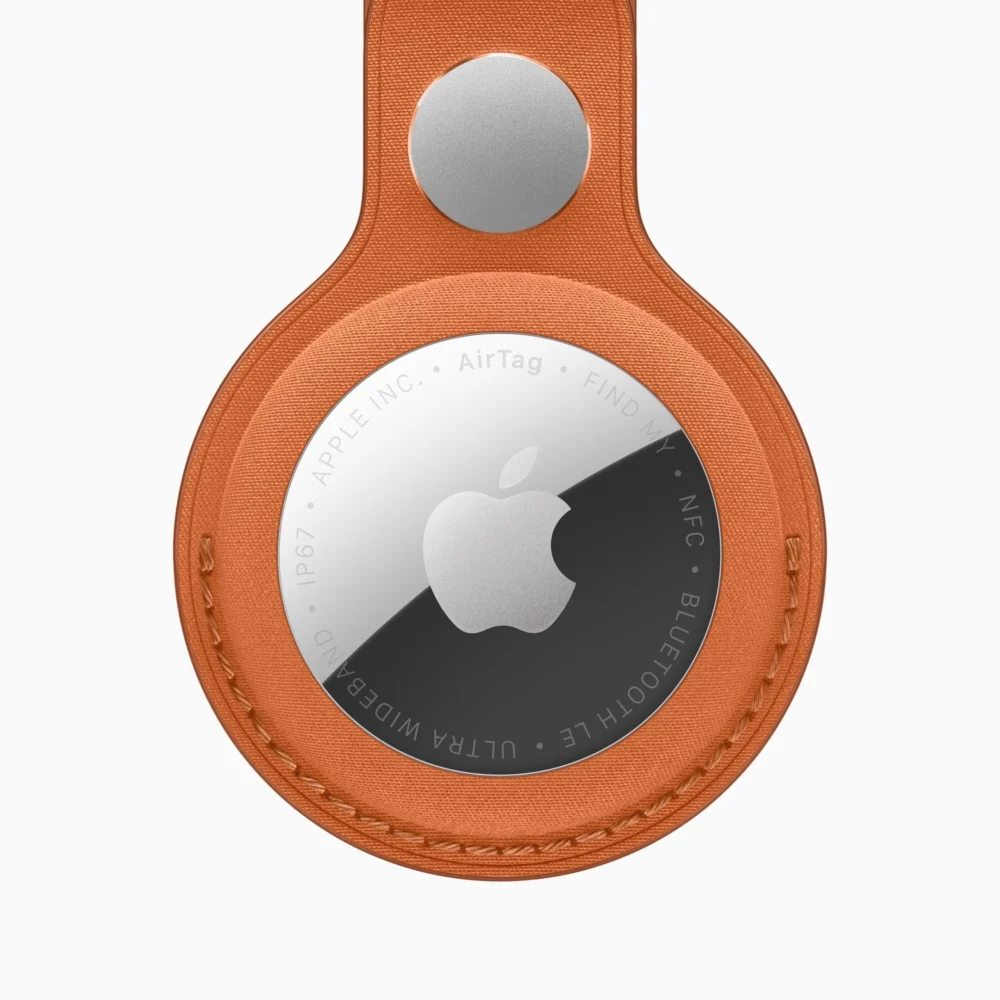
The shift in Apple’s environmental philosophy is perhaps most visible in the official accessories launched alongside the new AirTag. The transition from leather to FineWoven materials is now complete across the AirTag line. The new FineWoven key rings, available in a palette that includes Black, Moss, Navy, Midnight Purple, and Fox Orange, represent a move toward a lower carbon footprint. These accessories also feature a subtle but noteworthy design change: the metal ring is now engraved with "Designed by Apple in California. Assembled in Thailand." This marks a shift in Apple’s supply chain geography, moving away from the concentrated manufacturing hubs of previous years toward a more diversified production strategy in Southeast Asia. The choice of Fox Orange, in particular, serves a dual purpose; it is a vibrant fashion statement, but it also provides high visual contrast, making the physical key ring easier to spot even without the aid of digital tracking.
The integration of the second-generation AirTag with the Apple Watch represents a significant leap in wearable utility. Users with an Apple Watch Series 9 or later, or an Apple Watch Ultra 2 or later, can now utilize Precision Finding directly from their wrist. This eliminates the need to reach for a phone when navigating through a house to find a misplaced wallet. The haptic feedback provided by the watch—subtle vibrations that intensify as the user approaches the object—creates an intuitive, eyes-free search experience. This synergy between the AirTag and the Apple Watch underscores Apple’s "ecosystem-first" approach, where the value of each individual device is multiplied when used in conjunction with others in the portfolio.
Privacy remains a cornerstone of the AirTag’s value proposition, particularly as the industry grapples with the potential for misuse of tracking technology. The second-generation AirTag benefits from the robust anti-stalking measures that Apple has refined over the past several years. These include proactive alerts that notify users if an unknown AirTag is moving with them, as well as the industry-standard "Detecting Unwanted Location Trackers" (DULT) protocol. This cross-platform collaboration with Google ensures that Android users receive similar protections, a move that was essential for the long-term viability of the product category. By maintaining these standards while improving the core tracking hardware, Apple is attempting to balance the convenience of a global search network with the ethical necessity of user privacy.
Looking toward the future, the implications of the second-generation AirTag extend into the realms of augmented reality (AR) and enterprise logistics. As Apple continues to push into the spatial computing space with the Vision Pro, the high-precision data provided by the AirTag’s UWB chip could eventually be used to overlay digital markers on a physical environment with millimeter accuracy. In a corporate or industrial setting, the improved range and battery compatibility of the new AirTag make it a more viable solution for asset tracking on a larger scale. While primarily a consumer-facing product, the reliability of the second-generation hardware suggests that we may see the Find My network increasingly utilized for small-business inventory management and high-value equipment monitoring.
The competitive landscape of the tracking market has forced Apple to innovate not just on hardware, but on the sheer density of its network. The Find My network leverages hundreds of millions of Apple devices worldwide to act as a crowdsourced mesh network. When an AirTag is marked as lost, it sends out a secure Bluetooth signal that can be detected by nearby devices in the network. These devices then report the location of the AirTag back to the owner, all in an encrypted, anonymous fashion. The second-generation AirTag, with its improved signal efficiency, is designed to be a more "visible" node in this network, ensuring faster updates and more accurate location reporting even in areas with lower device density.
Ultimately, the second-generation AirTag is a testament to the power of incremental improvement. It does not seek to reinvent the wheel but rather to ensure that the wheel is perfectly balanced, highly audible, and compatible with the safest components available. For the millions of users who rely on these devices to safeguard their most important belongings, the improvements in range, sound, and wearable integration represent a tangible upgrade in peace of mind. As personal technology becomes increasingly invisible and integrated into our daily routines, the AirTag stands as a silent, reliable guardian of the physical objects that populate our lives, now refined for a new era of precision and connectivity.
