

The abyss has long been regarded as the final frontier of terrestrial exploration, a realm where light fades into an oppressive velvet blue and the laws of physics demand specialized equipment for even a momentary glimpse. Yet, as the results of the latest Ocean Art Underwater Photography Competition demonstrate, the boundary between the terrestrial and the aquatic is becoming increasingly transparent. This year’s winners, selected from thousands of entries spanning 90 countries, do more than just showcase technical prowess; they represent a sophisticated intersection of biological documentation, artistic patience, and the rapid evolution of optical technology. From the crystalline waters of the Philippines to the frigid depths of Lake Huron, these images serve as a vital medium for understanding an environment that is simultaneously essential to human survival and profoundly alien to the human experience.
The competition, organized by the Underwater Photography Guide, highlights a diverse array of categories—14 in total—ranging from wide-angle vistas to the specialized realm of "blackwater" photography. This year’s Best in Show honors went to Steven Kovacs for his remarkable capture of a monkfish in the waters off Kumejima, Japan. Titled "Tired Fish," the image depicts the creature in the middle of what appears to be a gargantuan yawn. While the visual is undeniably whimsical, the backstory reflects the grueling reality of professional underwater imaging. Kovacs spent nearly two weeks of nightly dives in the deep open ocean searching for this specific subject. The monkfish, a member of the order Lophiiformes, is a master of camouflage and typically resides in deep, dark environments. To capture it facing the camera with its maw wide open required not just luck, but an intimate understanding of the animal’s behavior and the persistence to remain in the water until the "decisive moment" occurred.
This level of dedication is a recurring theme among the elite tier of underwater photographers. Nirupam Nigam, the editor-in-chief of the Underwater Photography Guide, noted that these images are the culmination of "obsession, patience, and exploration." For many practitioners, the pursuit of a single frame can span years. This obsession is driven by the fact that many of the behaviors captured—such as a sea snake shedding its skin or a seahorse giving birth—are rarely witnessed by human eyes, let alone documented with high-resolution clarity.
The Physics of Light and the Snorkeler’s Advantage
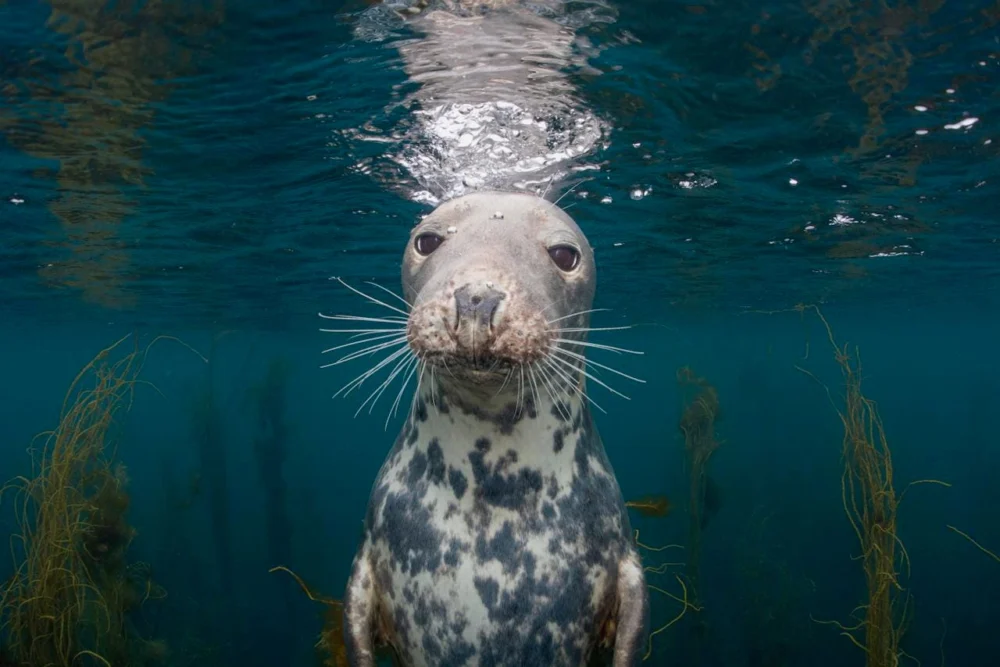
While deep-sea scuba diving often garners the most attention, some of the most impactful images from this year’s competition were captured just beneath the surface. Simon Temple, who received an honorable mention in the Cold Water category for his portrait "Grey Seal Contact," argues that the first few meters of the water column offer a unique aesthetic advantage. Off the coast of southwestern England, Temple captured a grey seal surfacing for air, its whiskers fanned out and eyes locked onto the lens.
From a technical standpoint, Temple’s preference for the surface is rooted in the physics of light. As light enters the water, it is absorbed and scattered; red and orange wavelengths disappear within the first few meters, leaving deeper images with a monochromatic blue or green cast. By working in the "top couple of meters," photographers can utilize the full spectrum of sunlight, resulting in higher contrast and more vibrant color saturation. Furthermore, the interaction between the water’s surface and the sky creates a shimmering, light-speckled canopy that adds a layer of ethereal texture to the composition. This "snorkeler’s zone" is a masterclass in utilizing natural ambient light to create intimacy with subjects that are often seen as distant or inaccessible.
The Rise of Blackwater and Macro Specialties
One of the most significant trends in modern underwater photography is the explosion of interest in "blackwater" diving. Unlike traditional reef diving, blackwater involves suspending a light string in the open ocean over deep water at night. This attracts the larval stages of deep-sea creatures and pelagic organisms that migrate toward the surface under the cover of darkness. The resulting images often feature translucent, alien-looking subjects set against a stark, void-like background.
Kovacs’ winning monkfish is a prime example of this genre’s evolution. The technical challenges of blackwater photography are immense: the subjects are often no larger than a fingernail, they are constantly moving in the current, and the photographer has no fixed point of reference in the dark water. Achieving sharp focus requires advanced autofocus systems and a mastery of strobe positioning to avoid "backscatter"—the illumination of tiny particles in the water that can ruin an otherwise perfect shot.
Similarly, the Macro category continues to push the boundaries of what is visible to the naked eye. Daniel Sly’s first-place macro shot of a pughead pipefish in Indonesia’s Lembeh Strait demonstrates the incredible camouflage these creatures employ. Tucked within coral polyps, the pipefish is nearly indistinguishable from its environment. Capturing such a subject requires lenses with high magnification ratios and a level of buoyancy control that allows the photographer to remain perfectly still in a three-dimensional environment.

Technological Implications and Industry Trends
The quality of the entries in this year’s competition also reflects a broader shift in the photography industry. The transition from DSLR to mirrorless camera systems has been a boon for underwater shooters. Mirrorless cameras offer superior eye-tracking autofocus, which is critical when trying to focus on the eye of a moving fish through a glass dome port. Additionally, the improved high-ISO performance of modern sensors allows photographers to capture images in lower light conditions without excessive digital noise, a factor that has directly contributed to the success of categories like "Cold Water" and "Blackwater."
The equipment market has responded to this demand with increasingly sophisticated underwater housings, specialized "wet lenses" that can be changed underwater, and powerful strobe lights that mimic the color temperature of the sun. The prizes for this year’s contest, valued at over $60,000, included high-end gear and dive expeditions, highlighting the lucrative nature of this niche industry. As technology becomes more accessible, we are seeing a "democratization" of the abyss, where even compact camera users—represented in the "Compact Wide Angle" category won by Haemi Cho—can produce world-class imagery.
The Digital Frontier: Artistry vs. Documentation
A notable inclusion in the competition is the "Underwater Digital Art" category, which allows for more extensive post-processing and creative manipulation. Michal Štros took top honors here with an abstract fractal of a pufferfish’s head. This category acknowledges that underwater photography is not merely a tool for scientific record-keeping but also a medium for fine art. By using tools like Photoshop and specialized plug-ins, artists can emphasize the geometric patterns and surreal qualities of marine life, creating a bridge between the natural world and human imagination.
However, this also sparks a debate within the industry regarding the ethics of editing. While the "Digital Art" category encourages manipulation, the "Marine Life Behavior" and "Portrait" categories maintain strict standards to ensure the images remain faithful representations of nature. This balance is crucial for maintaining the credibility of photography as a tool for conservation.
Future Impact: Photography as a Conservation Catalyst
Beyond the trophies and gear, the Ocean Art Underwater Photography Competition serves a vital ecological purpose. We are living in an era of unprecedented marine crisis, from coral bleaching and overfishing to plastic pollution and climate-driven migration of species. Many of the subjects featured in this year’s winning gallery are currently facing existential threats.
By capturing the "Beautiful Birth" of a seahorse (as seen in Jeon Min Seok’s winning shot) or the "Last Light" hitting silky sharks in a Cuban marine park (captured by Byron Conroy), photographers are creating an emotional connection between the public and the ocean. It is a psychological truism that people are more likely to protect what they can see and admire. These images transform "the ocean" from an abstract concept into a collection of individuals: a yawning fish, a curious seal, a mother seahorse.
Looking forward, the trend of "citizen science" through photography is expected to grow. High-quality images of rare behaviors or species in new locations provide invaluable data to marine biologists. As underwater cameras become more integrated with GPS and AI-tagging software, the line between the professional artist and the field researcher will continue to blur.
In conclusion, the winners of the Ocean Art Underwater Photography Competition represent the pinnacle of a demanding and dangerous craft. Their work is a testament to the fact that while the ocean may be vast and unforgiving, it is also a place of profound beauty and surprising intimacy. As long as there are individuals willing to brave the depths with a lens and a light, the mysteries of the blue planet will continue to be brought to the surface, one frame at a time.
