

For years, the primary critique leveled against the Apple Watch by hardcore endurance athletes and wilderness explorers was its reliance on a persistent data connection or a tethered iPhone for sophisticated navigation. While the hardware—particularly the ruggedized Apple Watch Ultra—has long been capable of handling grueling environments, the software ecosystem often felt like it was trailing behind the robust, offline-first mapping capabilities of dedicated sportswatches from the likes of Garmin or Coros. That paradigm is shifting rapidly. Two of the most influential names in the fitness tracking space, Strava and Komoot, have recently rolled out substantial updates that bring high-fidelity, offline route guidance to the wrist, signaling a new era of independence for the watchOS platform.
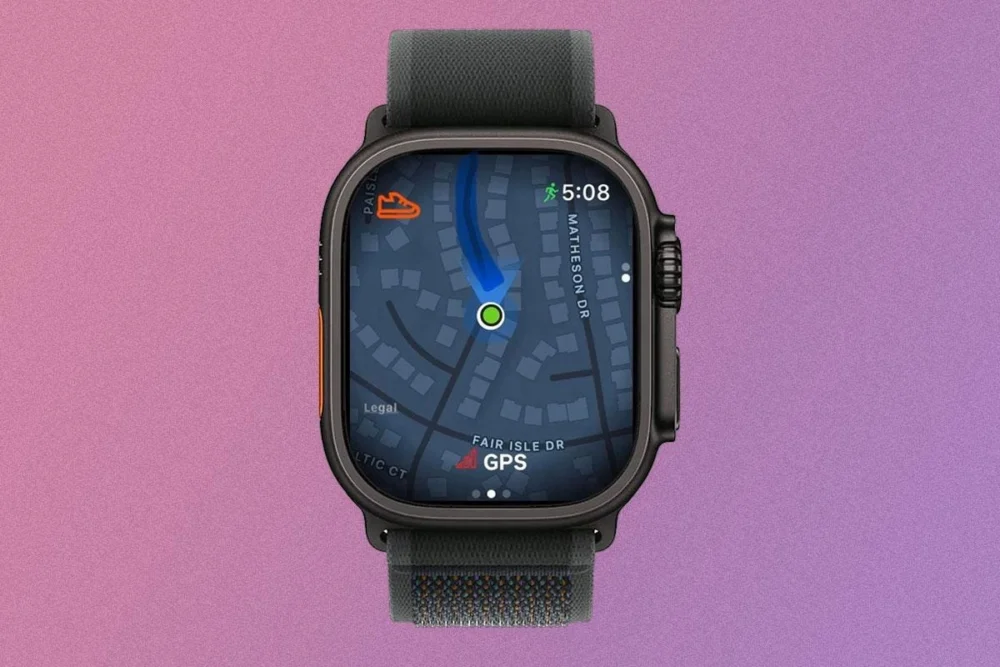
The arrival of offline mapping on Strava’s Apple Watch application represents a significant milestone for a platform that has historically prioritized social connectivity and post-activity analysis over real-time navigation. For a long time, Strava users on Apple Watch were limited to basic metric tracking or, at best, a rudimentary "breadcrumb" trail that offered little context of the surrounding terrain. The latest update, currently circulating among users and appearing in beta-like deployments even for those not officially enrolled in testing programs, changes the equation entirely. Users can now sync pre-planned routes directly to the watch, allowing for a localized, visual map interface that functions without a cellular signal.
Technical teardowns and user reports indicate that this isn’t merely a static image of a path. The interface features a subtle but detailed map view that sits beneath the active route, providing the geographical context necessary for making split-second decisions at trail forks or urban intersections. This move follows Strava’s aggressive expansion strategy, which included the acquisition of the marathon training platform Runna and the introduction of "Instant Workouts." By integrating offline navigation, Strava is positioning itself not just as a digital trophy case for athletes, but as a critical utility for the duration of the activity itself.
Simultaneously, Komoot, a platform revered by the hiking and bikepacking communities for its granular topographic data, has upped the ante with its own offline implementation. Unlike some basic implementations that only show a line on a screen, Komoot’s update provides full turn-by-turn guidance directly on the watch hardware. This is a game-changer for cyclists and hikers who need to keep their hands free and their phones safely stowed in a backpack to preserve battery life.
What makes Komoot’s approach particularly sophisticated is its data-caching strategy. The app downloads a "corridor" of map data extending approximately 1.5 kilometers on either side of the planned route. This buffer is essential for real-world adventuring; it allows the user to pan and zoom to see nearby landmarks or find alternative paths if a trail is blocked, all without needing to reconnect to a server. This level of technical foresight reflects a deep understanding of the "off-grid" user experience, where a 1:1 route line is rarely sufficient when things go sideways.
The timing of these updates is no coincidence. It is a direct response to the evolving capabilities of watchOS. While Apple introduced its own version of offline maps with watchOS 10 and refined it in watchOS 11, the native experience remains somewhat generalist. Apple Maps is excellent for finding a coffee shop in a new city or navigating a subway system, but it lacks the specialized topographic layers, trail-specific heatmaps, and community-sourced data that make Strava and Komoot indispensable to the fitness community. By leveraging the more powerful processors and expanded storage of modern Apple Watches, these third-party developers are proving that the hardware can indeed compete in the "pro-sumer" sports category.

From an industry perspective, this shift highlights the intensifying battle for the "wrist-space" of the premium consumer. For years, Garmin dominated the high-end fitness market because its devices were "tools," whereas the Apple Watch was a "gadget." However, as third-party apps bridge the utility gap, the distinction is blurring. If an Apple Watch Ultra can provide the same offline navigational security as a Garmin Fenix, while also offering superior integration with a user’s digital life (mobile payments, communication, and a vibrant app ecosystem), the value proposition for dedicated sports watches begins to narrow to battery life alone.
Furthermore, the business logic behind these updates is worth analyzing. Interestingly, both Strava and Komoot have made these features available—at least for the time being—without strictly locking them behind their respective premium paywalls. This suggests a strategic play for user retention and platform stickiness. In the "Attention Economy," the app that an athlete looks at during their four-hour Sunday ride is the app they are most likely to subscribe to eventually. By providing high-value navigation for free, these platforms are ensuring they remain the primary interface for the user, effectively sidelining Apple’s native Workout and Maps apps.
Looking ahead to the remainder of 2025 and into 2026, the roadmap for wearable navigation is becoming even more ambitious. Komoot has already signaled that it is working on live auto-rerouting—a feature that traditionally requires significant on-device processing power to recalculate paths without a cloud connection. When this arrives, the Apple Watch will essentially function as a standalone outdoor GPS unit. We are also seeing the early stages of location-sharing features being integrated into these offline modes, allowing hikers to broadcast their coordinates via the watch’s own satellite capabilities (on supported hardware) or cellular pings, enhancing safety in remote areas.
The implications for battery management are also profound. Historically, running a GPS-heavy mapping app was a death sentence for the Apple Watch’s battery life. However, optimizations in how watchOS handles background tasks, combined with the more efficient dual-frequency GPS chips in the Ultra series, have made these features viable for all but the longest ultra-marathons. Developers are now utilizing vector-based map tiles rather than data-heavy raster images, allowing for smoother zooming and panning with minimal power draw.
Expert analysis suggests that we are witnessing a "de-tethering" trend across the entire wearable industry. The goal is no longer to make the watch a better remote control for the phone, but to make the phone redundant during the most active parts of a user’s day. For the runner in the woods or the cyclist on a mountain pass, the phone is a liability—it’s heavy, fragile, and distracting. The ability to leave it behind, or at least leave it turned off in a bag, while still having access to world-class navigation, transforms the Apple Watch from a luxury accessory into a legitimate piece of safety equipment.
As we move forward, expect to see even more specialized integrations. We may soon see augmented reality (AR) overlays on the watch screen, using the device’s compass and accelerometer to point toward waypoints in real-time. We might also see deeper integration with biometric sensors, where the map route dynamically adjusts based on the user’s fatigue levels or heart rate zones—suggesting a flatter route home if the athlete is over-exerting.
In conclusion, the updates from Strava and Komoot are more than just incremental feature additions; they are a declaration of intent. They prove that the Apple Watch’s software ecosystem is maturing to meet the demands of the most rigorous users. By providing offline autonomy, these apps are removing the final barriers for athletes who previously hesitated to trust a smartwatch with their wilderness navigation. The "better for fitness" narrative is no longer just about counting steps or calories; it is about providing the confidence to explore the world, untethered and informed. For the millions of Apple Watch users who view their device as a partner in adventure, the horizon just got a lot clearer.
