


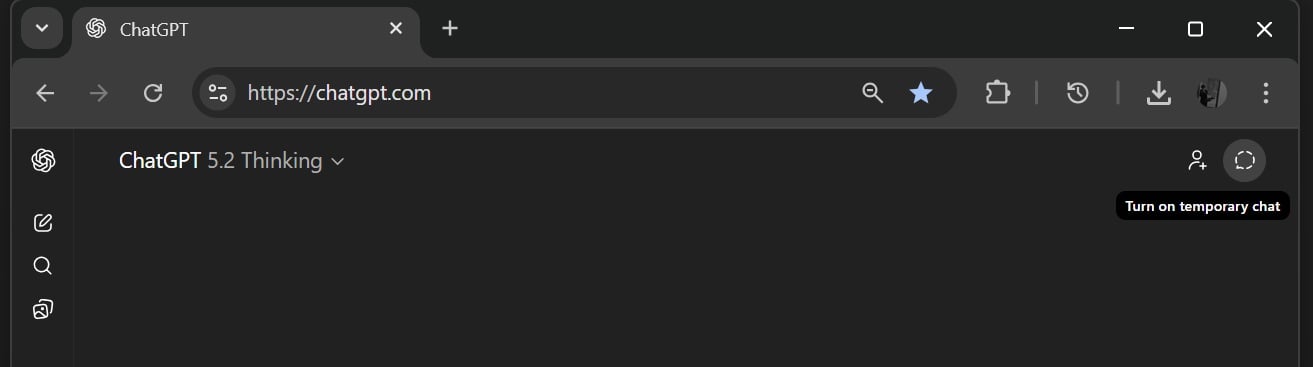
The landscape of generative artificial intelligence, particularly within highly accessible platforms like OpenAI’s ChatGPT, is an ongoing negotiation between utility maximization and user privacy expectations. A recent, subtle yet significant evolution observed within the platform pertains to its "Temporary Chat" functionality. This mode, initially designed as a truly stateless interaction environment, is undergoing a crucial adjustment that seeks to bridge the gap between complete conversational amnesia and the growing user desire for a consistent, personalized AI experience. The core of this emerging update is the ability for Temporary Chats to leverage, and selectively apply, established user personalization parameters without those interactions permanently contaminating the broader user profile or model training data.
Deconstructing the Original Intent of Temporary Chat
To appreciate the magnitude of this refinement, one must first recall the fundamental architecture of the initial Temporary Chat feature. Launched as a direct response to growing concerns about data retention and the persistent memory capabilities of large language models (LLMs), Temporary Chat was positioned as the digital equivalent of starting over with a blank slate.
In its original iteration, engaging this mode meant the model actively disregarded all prior conversational context stored under the user’s account. This included historical chat logs, any learned "memories" established through ongoing interaction, and stylistic preferences the user might have painstakingly configured over weeks or months. The model essentially operated under an immediate, hard-coded directive: "Forget everything that came before this session."
Crucially, the original design ensured a strict separation of concerns. Interactions within a Temporary Chat session were neither used to refine the underlying foundational models—a critical concern for proprietary data exposure—nor were they saved to the user’s persistent chat history accessible via the sidebar. This offered users a vital sandbox for sensitive queries, testing potentially problematic prompts, or engaging in short-term tasks where the output quality needed to be high but the input history needed to be zero. The only element that typically persisted, even in this ephemeral mode, were the globally defined Custom Instructions. These instructions, often set outside the main chat window, dictate fundamental behavioral traits (e.g., "Always respond in a formal tone," or "Format all code blocks using Python 3.11"). Even these, however, represented a slight compromise to absolute amnesia.
The New Equilibrium: Personalization Without Permanence
The emerging modification fundamentally alters this strict dichotomy. Initial reports suggest that the updated Temporary Chat functionality will now incorporate a user’s personalization profile—including established tone, preferred response style, and perhaps even rudimentary learned context related to the Custom Instructions—while strictly maintaining the promise of non-persistence regarding the content of the conversation.
This represents a significant UX enhancement. Users often invest considerable effort configuring ChatGPT to behave exactly as desired. Forcing users to restart with a purely default configuration every time they needed a private session was a usability friction point. Now, the model can respect the user’s established "persona" or preferred interaction matrix (the learned style) without retaining the specific facts, details, or sensitive inputs of that particular session.

The mechanism appears to be a toggleable state. The conversation remains fundamentally temporary—it will not appear in the chat history, nor will its content feed back into the generalized model training pipeline. However, the session now has authorized, temporary access to the user’s stored preferences. This creates a powerful hybrid state: ephemeral interaction governed by persistent style.
From a practical standpoint, this means a user can switch to Temporary Chat to discuss a confidential project draft, benefit from the model knowing their preferred level of technical detail, yet still ensure that the draft content itself vanishes from record (save for the mandated safety retention period).
Industry Implications: Navigating the Data Trade-Off
This iteration by OpenAI is more than a mere feature tweak; it signals a mature understanding of enterprise and privacy-conscious user needs within the AI ecosystem.
1. Enhanced Enterprise Adoption: Corporate users are often hesitant to use public-facing LLMs for anything that borders on proprietary information due to data leakage risks. While dedicated enterprise agreements (like those offered through Azure OpenAI Services) provide stronger contractual guarantees, a more robust, user-facing privacy feature like this lowers the barrier to entry for sensitive internal work performed by individual contributors. If users can trust that a session will not accidentally be used for future training or stored indefinitely, adoption for brainstorming or summarizing internal documents increases.
2. The Evolving Definition of "Memory": This update forces a necessary differentiation in how we define AI "memory." There is the content memory (what was said) and the style memory (how the AI should behave). OpenAI is signaling that content memory is strictly optional and controllable, whereas style memory is treated more like a user setting—a preference that can be selectively applied or overridden based on the session type. This modular approach to context management is likely to become a standard feature across competing LLM interfaces.
3. Competition and Feature Parity: As rivals like Google Gemini and Anthropic’s Claude iterate rapidly, features that offer granular control over data lifecycle management become competitive differentiators. Users are becoming increasingly educated about the implications of model training data. Platforms that offer clear, accessible controls over what data is retained, used for training, or saved to history will hold a significant advantage in user trust metrics.
Expert Analysis: The Technical Nuance of Safety Retention
A critical aspect that warrants deeper scrutiny is OpenAI’s caveat: "For safety reasons, OpenAI may still keep a copy of the chat for up to 30 days."
This retention policy is a non-negotiable feature tied to Responsible AI governance. Even if a user deletes a chat, or if the session is designated as temporary, the provider must retain records to investigate potential misuse, adherence to content policies (e.g., illegal activity, generation of harmful content), and to debug systemic issues.
Technical Analysis of the 30-Day Window:
- Model Training Exclusion: The key is how this retained data is segregated. The data retained for safety review is typically isolated from the data pipelines used for iterative model fine-tuning and improvement. This suggests a separate, audited storage and access layer reserved solely for compliance and security teams.
- User Control vs. Platform Liability: This demonstrates the limits of user control when interacting with a platform governed by external legal and ethical standards. The user forfeits absolute deletion in favor of platform accountability checks. For users handling highly classified or legally restricted information, even a 30-day retention period remains a significant risk factor, reinforcing the need for on-premise or strictly siloed enterprise solutions for the most sensitive tasks.
Broader Context: The Interplay with Age Prediction Models
The discussion around session control cannot be divorced from OpenAI’s recent introduction of the ChatGPT Age Prediction model. This concurrent development highlights the platform’s increasing sophistication in user segmentation and dynamic policy enforcement based on inferred user demographics.
The Age Prediction model dynamically assesses user input patterns to classify users as potentially underage, leading to content restrictions on topics deemed inappropriate for younger audiences (e.g., violence, gore, high-risk challenges).
The Interaction Point:
When a user initiates a Temporary Chat, they are seeking control over context. When the Age Prediction model is active, the system is attempting to control content exposure based on inferred identity. These two mechanisms must operate harmoniously:
- If a user with known adult status uses Temporary Chat, they benefit from personalized style while ensuring the content does not train the model.
- If the Age Prediction model flags a user during a Temporary Chat session, the system must enforce content restrictions regardless of the temporary nature of the chat, because the platform’s liability regarding exposure to harmful content supersedes the user’s desire for an unrestricted ephemeral session.
The potential for error in the age prediction model—mistaking adults for minors or vice versa—creates a secondary layer of friction. An adult restricted erroneously in a Temporary Chat environment will be frustrated by the lack of desired personalization (because the system defaults to a restrictive state) coupled with the inability to immediately verify their age within that ephemeral session, potentially requiring them to switch back to a standard, logged session to initiate verification.
Future Trajectories in Context Management
This pivot toward customizable ephemeral states suggests several key trends shaping the future of LLM interaction:
1. Granular Context Windows: Future iterations will likely move beyond simple "on/off" toggles for memory. We might see controls allowing users to specify which previous conversations (e.g., "Allow context from Project Alpha threads only") or which custom instructions (e.g., "Use my technical writing style but ignore my preference for using emojis") are active for a given session.
2. Context Inheritance Profiles: Imagine "Session Templates." A user could create a "Debug Mode" template that loads specific debugging tools and environments but retains no personal context, or a "Creative Writing Mode" that inherits only stylistic elements from their main profile. This allows for rapid context switching without deep configuration dives.
3. Zero-Knowledge Proof Integration (Long-Term): While technically complex for current public APIs, the ultimate goal for highly sensitive data is to enable interactions where the model provides an output derived from input data, but without the platform ever storing or training on that input data—a true zero-knowledge interaction. The updated Temporary Chat is a step toward this ideal by strictly segmenting input data from training data, even if it retains preference data.
The integration of personalization into Temporary Chat is a necessary evolution, acknowledging that users want the efficiency derived from their history without sacrificing the security boundaries afforded by an isolated session. It refines the user contract with the AI, making the platform feel more intuitive and adaptable, while OpenAI concurrently invests in internal mechanisms (like age prediction and safety retention) to manage the platform’s external responsibilities. This delicate balancing act defines the maturity curve of consumer-facing generative AI tools.
