

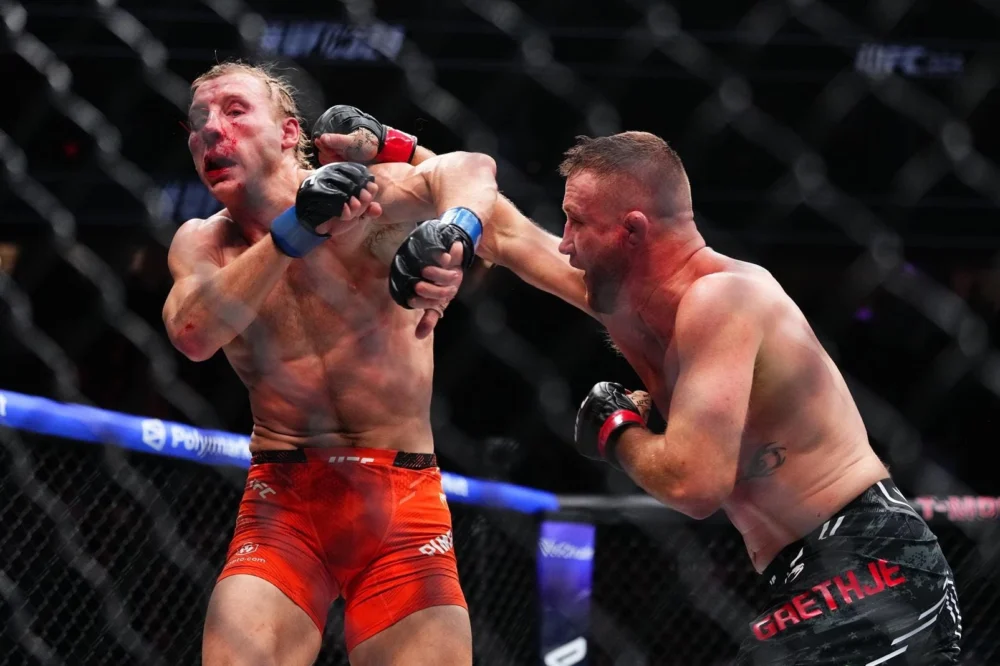
The landscape of professional mixed martial arts underwent a seismic shift on January 24, 2026, as UFC 324 descended upon the T-Mobile Arena in Las Vegas. While the evening was ostensibly a celebration of the promotion’s inaugural venture into the "Paramount era"—a new multi-year domestic media rights agreement that promises to redefine how combat sports are consumed globally—the action inside the Octagon provided a complex narrative of tactical subversion and championship resilience. The event, headlined by a high-stakes interim lightweight title bout between Justin Gaethje and Paddy Pimblett, served as a poignant reminder that in the world of elite fighting, the gap between a fighter’s perceived potential and their strategic execution can often be the difference between legendary status and a missed opportunity.
The Lightweight Paradox: Gaethje’s Durability vs. Pimblett’s Tactical Inertia
The main event of UFC 324 was a contest defined by its contradictions. Justin Gaethje, the perennial "human highlight reel," secured the interim UFC lightweight championship via a unanimous decision, yet the victory was overshadowed by the perplexing performance of his opponent, Paddy "The Baddy" Pimblett. Entering the bout, the stylistic clash was clearly defined: Pimblett, a grappling specialist with a submission-heavy arsenal, was expected to test Gaethje’s improved but historically vulnerable defensive wrestling. Conversely, Gaethje’s path to victory lay in his devastating leg kicks and high-volume, high-impact striking.
However, as the 25-minute war unfolded, Pimblett appeared to abandon his primary advantage. Despite being an expert grappler, the Liverpool native made zero concerted efforts to bring the fight to the canvas. Instead, Pimblett chose to engage in a prolonged striking battle with perhaps the most dangerous power-puncher in the history of the 155-pound division. This decision-making process was described by many analysts as "peculiar" at best and "self-sabotaging" at worst.
Gaethje, for his part, fought with the measured violence that has characterized the latter half of his career. No longer the reckless brawler who prioritized entertainment over safety, the Trevor Wittman-trained veteran utilized a disciplined jab and punishing low kicks to systematically dismantle Pimblett’s mobility. While Pimblett showed incredible chin and heart, absorbing shots that would have finished lesser athletes, he was essentially a target for 25 minutes. The lack of tactical adjustments from Pimblett’s corner was equally striking; the commentary team’s silence regarding his refusal to grapple added a layer of surrealism to a fight that was high on action but low on strategic variety.
Gaethje’s win sets up a definitive unification bout with the undisputed champion, Islam Makhachev. For Gaethje, this interim strap is a testament to his longevity and his ability to evolve. For Pimblett, the loss is a harsh lesson in the limitations of "fighting the opponent’s fight." At the elite level of the UFC, charisma and toughness cannot compensate for a failure to utilize one’s core competencies.
The Bantamweight Renaissance: Sean O’Malley’s Calculated Comeback
In the co-main event, former bantamweight champion Sean O’Malley reminded the MMA world why he remains one of the sport’s biggest draws. After a two-year hiatus from the winner’s circle—a period marked by injury and a loss of momentum—O’Malley faced a stern test in China’s Song Yadong. The bout was a microcosm of O’Malley’s career: a blend of high-level technical striking, moments of vulnerability, and a final-round surge that solidified his status as a top-tier contender.
Song Yadong, known for his explosive power and technical boxing, pushed O’Malley to the limit in the opening ten minutes. The first round was a razor-thin affair, with both men trading heavy leather in the center of the Octagon. However, it was in the third frame that O’Malley’s conditioning and superior reach management became the deciding factors. He dominated the final five minutes, showcasing the "Suga" Sean of old—a sniper who finds openings with surgical precision.

The post-fight narrative quickly shifted to O’Malley’s future. His call-out of reigning champion Petr Yan for a rematch of their 2022 classic is a move geared toward legacy and high-pay-per-view numbers. However, the internal logic of the bantamweight division suggests a different path. Umar Nurmagomedov, who also secured a victory on the UFC 324 card, represents the next generation of Dagestani dominance. A matchup between O’Malley’s elite striking and Nurmagomedov’s suffocating wrestling is arguably the most intriguing fight that can be made in the 135-pound weight class today.
Industry Implications: The Paramount Era and the Tech of the Broadcast
UFC 324 marked the beginning of a new chapter for the organization’s broadcasting infrastructure. The move to Paramount reflects a broader trend in the sports media industry: the shift toward hybrid distribution models that prioritize both traditional linear television and direct-to-consumer streaming.
The production value of UFC 324 saw a noticeable uptick, with enhanced biometric data integration and real-time striking analytics providing viewers with a deeper understanding of the damage being inflicted. This technological evolution is part of the UFC’s broader strategy to gamify the viewing experience, catering to a younger, tech-savvy demographic that demands more than just a two-dimensional broadcast.
Furthermore, the "Paramount era" signifies the UFC’s continued global expansion. By aligning with a media giant that possesses a massive international footprint, the UFC is positioning itself as a cornerstone of global sports entertainment, rivaling the reach of the NBA or the Premier League. The success of UFC 324, despite the tactical oddities of its main event, proves that the brand’s momentum is resilient to individual fight outcomes.
Bonus Structures and the Financial Evolution of the Athlete
The UFC also utilized the 324 platform to showcase its evolving bonus structure. While the "Fight of the Night" honors predictably went to Gaethje and Pimblett for their 25-minute slugfest, the promotion also awarded $100,000 "Performance of the Night" bonuses to Ty Miller and Josh Hokit.
The decision to grant a $25,000 bonus to every fighter who achieved a knockout or submission—provided they didn’t receive the $100,000 top-tier award—is a strategic move aimed at addressing long-standing criticisms regarding fighter pay. By incentivizing finishes, the UFC ensures that its product remains high-octane, while simultaneously providing a financial safety net for rising prospects who may be fighting on lower-guaranteed contracts. This "finisher’s dividend" is likely to become a standard feature of the Paramount era, as the promotion looks to encourage aggressive, fan-friendly styles.
Future Outlook: A Logjam at the Top
As the dust settles on UFC 324, several key storylines have emerged that will dominate the MMA news cycle for the remainder of 2026.
- The Lightweight Unification: Justin Gaethje is now the clear #1 contender. However, the "interim" nature of his title means he is on a collision course with Islam Makhachev. The tactical question remains: Can Gaethje’s improved sprawl-and-brawl style withstand the relentless pressure of the Sambo-based grappling that defines the Dagestani camp?
- Pimblett’s Rebuild: Paddy Pimblett’s star power remains intact, but his competitive ceiling is now under scrutiny. To remain a viable title contender, he must address the disconnect between his grappling pedigree and his in-cage execution. A return to his roots in a high-profile matchup against a ranked opponent like Renato Moicano or Beneil Dariush seems necessary.
- Bantamweight Chaos: The 135-pound division is currently the deepest in the sport. With O’Malley back in the mix, Petr Yan holding the gold, and Umar Nurmagomedov looming as the "boogeyman" of the division, the matchmaking over the next six months will be critical in determining the long-term hierarchy of the weight class.
UFC 324 was more than just a collection of fights; it was a statement of intent for an organization entering its most ambitious phase yet. Between the grit of Justin Gaethje, the return of Sean O’Malley, and the technological leap of the Paramount broadcast, the event solidified the UFC’s position at the apex of the sports world. While the main event left fans scratching their heads at Pimblett’s strategy, the overarching narrative was one of growth, evolution, and the relentless pursuit of excellence in the most unpredictable arena on earth.
