

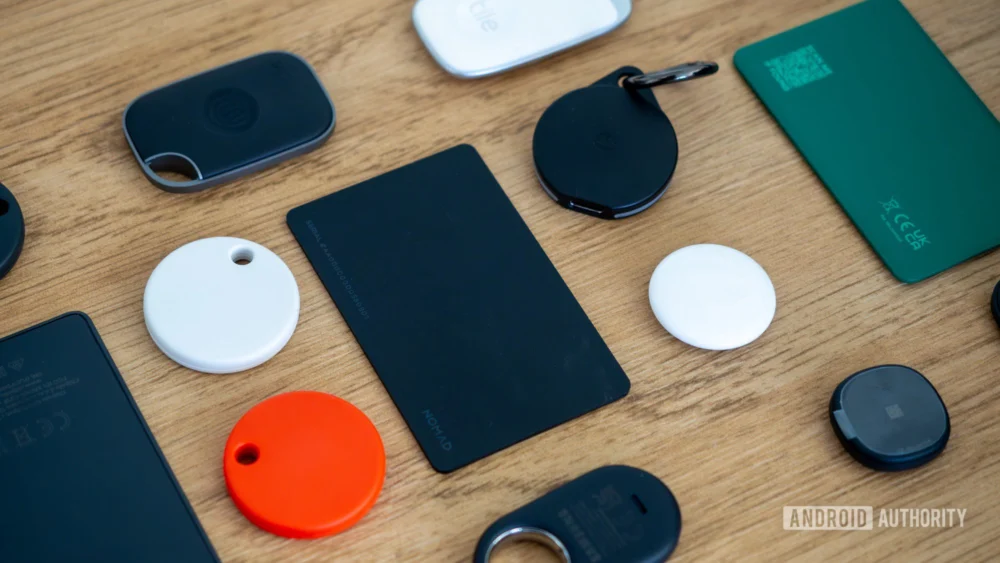
The landscape of personal item tracking, long dominated by proprietary ecosystems, is undergoing a significant inflection point, evidenced by the imminent entry of Xiaomi into the dedicated hardware space. For years, the utility of Bluetooth Low Energy (BLE) trackers, popularized by incumbent players like Tile and dramatically scaled by Apple’s AirTag, has been hampered on the Android side by fragmentation and a lack of cohesive, deep-OS integration. While Samsung has made significant strides with its Galaxy SmartTag series, leveraging its own SmartThings Find network, the broader Android market remains ripe for mass adoption. The recent revelation, stemming from deep dives into the firmware of Xiaomi’s latest HyperOS builds, suggests that the Chinese technology behemoth is preparing to launch its own branded item tracker, tentatively named the "Xiaomi Tag." This development is not merely another accessory release; it is a critical indicator of the increasing maturity and standardization occurring within the Android location services infrastructure.
The foundation for these modern trackers rests on two core technologies: standard Bluetooth connectivity for general proximity detection and the much more advanced Ultra-Wideband (UWB) radio for precise, centimeter-level spatial awareness. The leaked intelligence, attributed to expert analysis of HyperOS code strings, indicates that Xiaomi is planning a dual-pronged approach, potentially offering both a standard BLE-only model and a premium version incorporating UWB technology. This bifurcation is a strategic move mirroring the industry’s segmentation: the standard version targets affordability and broad compatibility, while the UWB variant caters to users demanding pinpoint accuracy for finding keys, wallets, or luggage within immediate proximity.
The significance of UWB cannot be overstated in this context. While Bluetooth excels at alerting a user that a lost item is "somewhere nearby" using crowdsourced network triangulation (where nearby phones anonymously report the tag’s location), UWB enables features akin to Apple’s Precision Finding. This involves directional antennas that can calculate the distance and angle to the tag, guiding the user with visual and haptic feedback—a feature that fundamentally changes the user experience from a simple "find it" alert to an active, guided search. The inclusion of UWB in a Xiaomi device signals that the company is investing in the hardware necessary to fully exploit forthcoming Android location standards.
The Infrastructure Imperative: Building the Android Find Network
The effectiveness of any item tracker is directly proportional to the density and responsiveness of the network available to locate it when it is out of immediate Bluetooth range. Apple’s dominance with the AirTag is largely attributable to the sheer ubiquity of iPhones worldwide, forming the "Find My" network—a massive, secure, and encrypted mesh of location reporters. For Android manufacturers, the challenge has been creating a similar, unified infrastructure across the fragmented device base.
Google has been working diligently to establish the "Find My Device" network, which leverages the billions of active Android devices globally. This initiative aims to standardize how third-party trackers communicate with the network, much like how Apple set the standard with AirTags and the Find My ecosystem. Samsung’s SmartTag relies primarily on its SmartThings network, which is robust within the Samsung user base but less expansive across other OEMs.
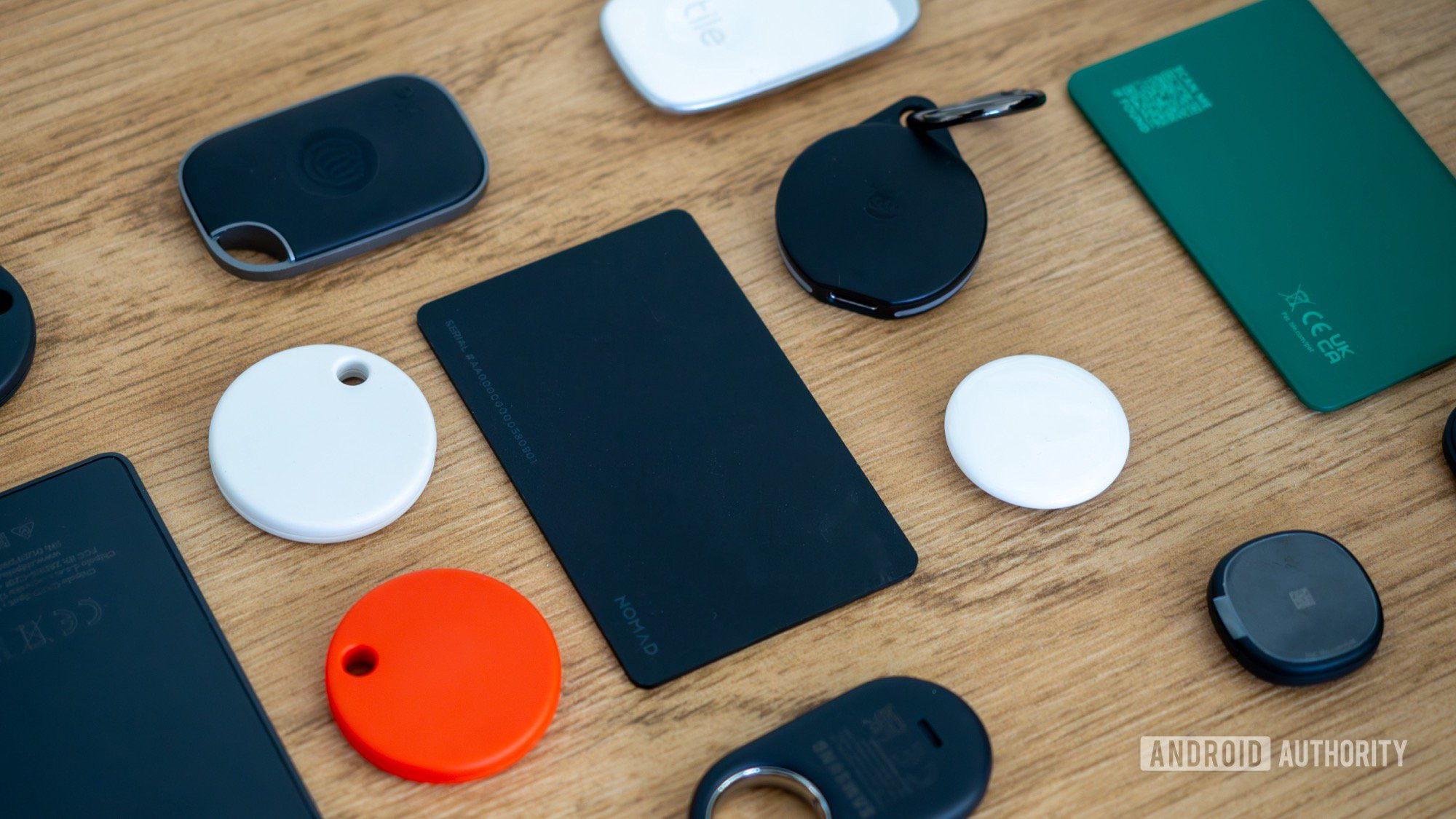
Xiaomi’s entry is a pivotal moment for the broader "Find My Device" network. As one of the world’s largest smartphone vendors, any proprietary tracker Xiaomi releases will inherently integrate deeply into its massive user base, particularly across Asia and Europe. If Xiaomi chooses to align its new tracker primarily with Google’s universal Find My Device network—a strong possibility given the HyperOS context hinting at system-level integration—it provides a massive injection of new reporting nodes into the collective Android location infrastructure. This move forces the issue of ecosystem unification, pushing the Android tracking ecosystem closer to the seamless experience offered by Apple.
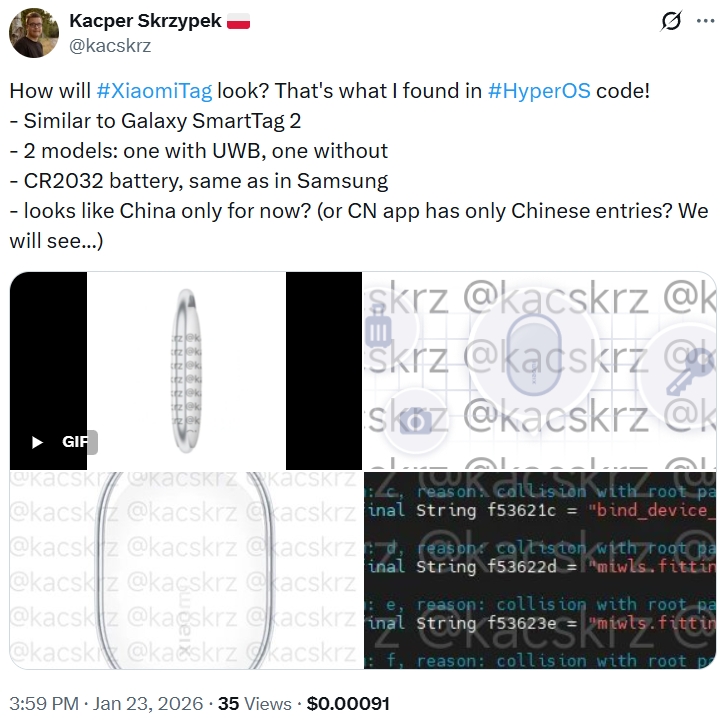
The technical details extracted from the code snippets further underscore this commitment to integration. References to "finddevice_iot_discover_xiaomi_tag" and prompts instructing users to "Turn on ‘Find this device’ to add your Xiaomi Tag" explicitly map the device’s functionality directly onto Google’s standardized framework for finding lost items. This contrasts with earlier, more siloed attempts by various Android accessory makers.
Design Philosophy and User Experience Under Scrutiny
The hardware specifications hinted at—namely, the reliance on the widely available CR2032 coin cell battery—suggest a commitment to long battery life and user serviceability. The CR2032 standard is crucial for cost control and convenience, allowing users to replace the power source easily, contrasting with proprietary rechargeable or sealed battery designs that often lead to premature product obsolescence.
Furthermore, the onboarding process, described as peeling a protective label to activate the battery contact and then using Near Field Communication (NFC) or close-range Bluetooth pairing ("hold it close to your phone"), reflects industry best practices established by both Apple and Samsung. Simplicity in setup is paramount for mass consumer adoption of tracking accessories.
Crucially, the inclusion of "trust" mechanisms within the reported strings points toward addressing a critical privacy and usability concern: the issue of "unwanted tracking." Both Apple and Google have implemented sophisticated, cross-platform systems to detect if an unknown tracker is traveling with a user, designed to prevent malicious stalking. Xiaomi’s implementation of a "Trust this Xiaomi Tag" string suggests they are building this necessary layer of user consent and privacy control directly into the firmware and software stack, ensuring that their device adheres to modern expectations for anti-stalking measures within the broader Android ecosystem. This indicates a proactive stance on regulatory and ethical concerns surrounding tracking technology.
Industry Implications and Competitive Dynamics
The arrival of the Xiaomi Tag fundamentally alters the competitive matrix. Samsung, which has invested heavily in its SmartThings Find ecosystem, now faces a direct challenge from another major OEM leveraging the presumed Google network. If Xiaomi’s tracker is priced aggressively—a hallmark of the brand’s market strategy—it could undercut existing third-party manufacturers like Tile and Chipolo, forcing them to rely heavily on superior niche features or deeper integration with specific niche platforms.
For the consumer electronics market, this signifies the full commoditization of item tracking hardware. Once a feature transitions from a premium accessory to a standard offering from major OEMs, the focus shifts entirely to ecosystem strength and pricing parity. Xiaomi’s participation validates the market segment Apple carved out and signals that item tracking is now considered an essential, rather than optional, peripheral for modern connected lifestyles.
The implications for Google are perhaps the most profound. Every major OEM that commits its hardware to the "Find My Device" network strengthens Google’s competitive standing against Apple’s vertically integrated solution. A robust, multi-vendor Android network is essential for Google to offer a truly equivalent, and potentially superior, crowdsourced tracking capability. Xiaomi’s large install base, especially in high-density urban environments where tracking devices are most frequently misplaced or lost, provides an immediate and significant boost to the network’s reporting density.
Future Trends: Beyond Simple Location Pinpointing
Looking forward, the integration of UWB hardware suggests that Xiaomi’s roadmap extends beyond simple "find my keys" functionality. UWB technology is the backbone for future spatial computing applications, enabling highly accurate indoor navigation, digital key functionality for vehicles and smart locks, and enhanced augmented reality interactions. A Xiaomi Tag equipped with UWB could potentially serve as a baseline reference point for these emerging technologies within the Xiaomi device ecosystem.
Furthermore, the discussion around an initial China-only release warrants careful observation. While initial market testing often begins domestically, Xiaomi’s global ambitions suggest a worldwide rollout is highly probable. The success of this launch, particularly outside of China, will depend heavily on how smoothly the integration works with the global "Find My Device" framework, as opposed to relying solely on a domestic network solution. If the device is designed for global Find My Device compatibility, it simplifies the proposition for international consumers who might own a mix of Xiaomi phones, Google Pixel devices, and other Android hardware.
The long-term trend points toward integration into the core operating system experience. We can anticipate that future versions of Android will feature increasingly sophisticated, battery-optimized background services dedicated to managing these tags, potentially incorporating machine learning to differentiate between genuine loss events and routine movement patterns. The Xiaomi Tag, by leveraging the CR2032 battery, offers a practical counterpoint to devices that require frequent charging, ensuring that tracking remains active for extended periods, which is the fundamental promise of this technology category.
In conclusion, the impending arrival of the Xiaomi Tag represents more than just a new product launch. It is a significant indicator of the maturation of the Android ecosystem, the increasing alignment among major hardware manufacturers on critical infrastructure standards like Ultra-Wideband and standardized location networks, and the cementing of item tracking as a mainstream consumer expectation. The competitive pressure exerted by this entry will likely accelerate innovation and drive down costs across the entire segment, ultimately benefiting the end-user with broader choice and more reliable tracking solutions across the vast Android landscape. The race to build the most comprehensive crowdsourced tracking network is heating up, and Xiaomi’s participation guarantees increased investment and feature parity in the near future.
