

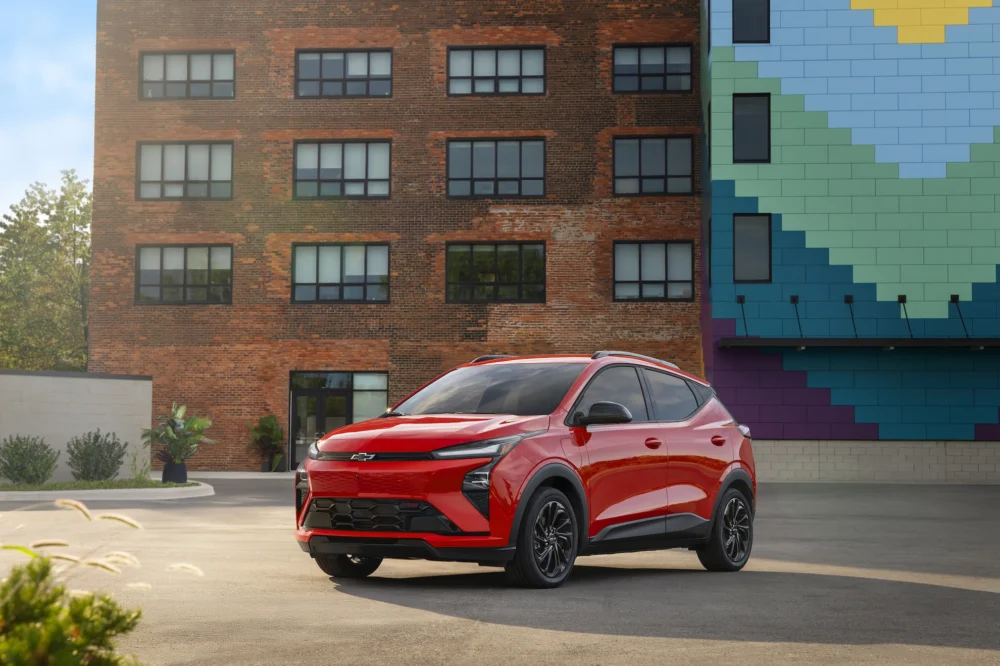
General Motors is executing a sweeping, strategic overhaul of its North American manufacturing footprint, a move precipitated by evolving geopolitical pressures and shifting economic incentives designed to favor domestic production. This significant realignment involves consolidating production lines in the United States, specifically at the Fairfax Assembly Plant in Kansas, a change that will necessitate the cessation of the newly rebooted Chevrolet Bolt EV production within the next eighteen months. The decision underscores Detroit’s intensifying effort to de-risk its supply chain exposure to China and Mexico while maximizing eligibility for domestic content requirements embedded in contemporary U.S. industrial policy.
The Fairfax Assembly Plant, currently dedicated solely to the manufacture of the resurrected 2027 Chevrolet Bolt EV, will undergo a complete transformation. As confirmed by GM, the plant is slated to pivot its operations to accommodate two high-volume crossover utility vehicles (CUVs): the internal combustion engine (ICE) version of the Chevrolet Equinox, which will be transferred from its current assembly location in San Luis Potosí, Mexico, starting in mid-2027, and the next-generation Buick Envision, which will be repatriated from its existing production base in China, beginning in 2028. This complex maneuver represents not merely a change in assembly location, but a fundamental strategic shift prioritizing manufacturing resilience over maximizing initial cost efficiency via international sourcing.
The Bolt’s Brief, Budget-Conscious Return
The fate of the Chevrolet Bolt is particularly poignant for advocates of mainstream EV adoption. The original Bolt, introduced in 2016, was an early pioneer in the mass-market EV space before its reputation was severely damaged by widespread battery fire recalls. General Motors had high hopes for the 2027 reboot, which entered dealerships just this month. Crucially, the refreshed Bolt was positioned as one of the most competitively priced new electric vehicles available to American consumers, starting at an accessible $29,990, including the destination fee. This affordability was vital in filling a market gap increasingly abandoned by competitors who are shifting focus toward high-margin luxury EVs.
However, despite the warm reception for its price point, the Bolt’s lifespan was predetermined to be limited. A spokesperson for GM reiterated that the 2027 model was always conceived as a "limited run model" when it was initially unveiled. This short operational window suggests the vehicle was primarily intended as a stopgap measure, designed to maintain a presence in the affordable EV segment and utilize existing platform technology while the company fully transitions its core portfolio to the proprietary Ultium battery and platform architecture. The imminent end of production, scheduled for approximately a year and a half after its launch, effectively terminates GM’s commitment to the sub-$30,000 EV market for the immediate future, leaving the company to rely on higher-priced, though more technologically advanced, models like the electric Chevrolet Equinox and Blazer, which utilize the dedicated Ultium technology.
The Geopolitical Engine of Reshoring
The decision to cease the Bolt’s production and concurrently relocate two major CUV lines—one from China and one from Mexico—to Kansas is a direct consequence of escalating economic protectionism and the evolution of global trade policy. This strategic shuffling is fundamentally driven by two interrelated factors: U.S. tariff policy and the increasingly stringent requirements governing federal clean energy incentives.
The initial impetus for decoupling production from China traces back to the tariffs imposed by the previous administration, specifically Section 301 tariffs, which placed significant duties on goods imported from China, including finished vehicles like the Buick Envision. While the Envision is a popular model in the U.S. market, the tariff burden substantially eroded its profitability when imported. By moving production to Fairfax, GM eliminates this significant operational headwind, making the vehicle more economically viable for the American sales channel. This move signals a broader acknowledgment across the automotive industry that the era of frictionless, lowest-cost global sourcing, especially from China for the U.S. market, is rapidly receding.
Furthermore, the cessation of the federal EV tax credit, which once provided up to $7,500 off qualifying electric vehicles, profoundly impacted the Bolt’s market viability. While the original phase-out was tied to sales volume, the subsequent Inflation Reduction Act (IRA) introduced strict sourcing requirements for critical battery minerals and components, heavily penalizing EVs that rely on Chinese or other non-free-trade-agreement-country content. Although the rebooted Bolt might have qualified under certain conditions, the long-term strategic advantage lies in producing vehicles domestically to meet future incentive structures and avoid the unpredictable volatility of international trade disputes. The shift to bringing ICE vehicles and a key Buick model home to the U.S. maximizes plant utilization and hedges against future protectionist legislation that could penalize imports from Mexico, despite the existence of the USMCA (United States–Mexico–Canada Agreement), which itself is subject to periodic review and political pressure regarding labor and content rules.
Operational Complexities and the Fairfax Rework
The "factory musical chairs" GM is orchestrating at Fairfax is a complex feat of operational engineering. The plant currently handles the Bolt EV, which operates on an older, dedicated electric vehicle platform. Switching this facility, after only a short run of the 2027 Bolt, to accommodate the gasoline-powered Chevrolet Equinox and the next-generation Buick Envision—both of which likely ride on more traditional ICE architectures or flexible platforms—requires massive retooling, re-calibration of supply chains, and significant capital investment.
The gas-powered Equinox, migrating from Mexico, is a cornerstone of GM’s domestic sales volume. Placing it in a U.S. facility guarantees that this high-volume model is protected from potential tariffs or political trade disruptions targeting Mexican-made goods. More critically, the repatriation of the Buick Envision, a premium CUV, to U.S. soil marks a decisive commitment to insulating a key brand from Chinese geopolitical risk. This move solidifies the Buick brand’s standing in the U.S. market, where domestic manufacturing often carries a strong consumer preference and can be leveraged in marketing campaigns.
For the UAW and American labor, this shift is a significant victory, ensuring the continued viability and employment base of the Fairfax plant, albeit through a temporary transition away from EVs and toward traditional ICE and hybrid models in the immediate term (2027-2028). The investment demonstrates GM’s long-term strategy of prioritizing U.S. manufacturing jobs as a hedge against labor actions and political backlash.
Industry Implications and the Affordable EV Gap
General Motors’ decision to sunset the affordable Bolt highlights a crucial inflection point in the electric vehicle transition: the ongoing struggle between advanced technology deployment and achieving price parity for the average consumer.
The Tech Transition: The Bolt’s demise confirms GM’s accelerated pivot toward its highly publicized Ultium architecture. While the Ultium platform offers superior scalability, faster charging, and modularity across a wide range of vehicle segments (from the GMC Hummer EV to the electric Equinox), the initial cost of deployment remains high, making it difficult to produce vehicles below the $35,000 threshold profitably. The Bolt, which utilized older battery technology and a non-Ultium platform, was a technological outlier in GM’s future vision, making its elimination a necessary step toward platform standardization and operational efficiency.
The Affordability Crisis: By withdrawing the $29,990 Bolt, GM leaves a gaping hole in the budget EV segment. This vacuum may soon be exploited by foreign competitors, particularly Chinese manufacturers like BYD, who are rapidly expanding their global reach with highly cost-optimized EVs. However, given the current U.S. political climate, which is highly protectionist against Chinese automotive imports, this gap is unlikely to be filled by overseas rivals immediately. Instead, American consumers seeking an affordable new EV will face extremely limited choices, potentially forcing them into the used EV market or delaying their transition to electrification entirely. This temporary retreat from affordability by a major domestic automaker could slow the overall pace of EV adoption, contradicting the stated goals of the Biden administration’s clean energy push.
Expert analysts suggest that GM is making a calculated trade-off: sacrificing immediate market share in the budget segment to secure long-term profitability and geopolitical stability in its high-volume crossover segments. The financial certainty gained by avoiding tariffs on the Buick Envision and ensuring the Equinox’s tariff-free status outweighs the short-term sales boost offered by the limited-run Bolt.
Future Outlook: The Promise of Next-Generation Affordable EVs
Despite the unceremonious exit of the Bolt, General Motors has provided assurances regarding the future role of the Fairfax facility in its electrification roadmap. The company has promised substantial future investments in the Fairfax Assembly Plant to prepare it for its "next generation of affordable EVs."
This promise is critical and implies that the shift to ICE and repatriated CUV production between 2027 and 2028 is a transitional phase. The period between 2027 and 2029 will likely be used to retool Fairfax not just for the immediate ICE/Buick needs, but also to prepare the infrastructure for a future wave of Ultium-based compact EVs.
For this next generation of affordable EVs to materialize, two technological hurdles must be cleared:
- Battery Cost Reduction: GM must achieve significant economies of scale and technological breakthroughs in battery manufacturing—likely through its Ultium joint ventures—to drive down the cost per kilowatt-hour substantially. Only when the underlying component costs drop dramatically can an Ultium-based vehicle profitably compete at the $30,000 price point.
- Platform Optimization: The promised affordable Ultium EVs will likely be smaller, utilizing standardized battery packs and simplified manufacturing processes compared to the larger electric trucks and SUVs currently prioritized. This strategic move aligns with industry expectations that true mass-market adoption requires compact, affordable city cars built on highly flexible global platforms.
While the Bolt EV offered immediate affordability, its abrupt cancellation confirms that GM is prioritizing a unified technological architecture and geopolitical insulation over maintaining a short-term, sub-$30,000 price point. The Kansas facility, therefore, becomes a microcosm of Detroit’s broader pivot: a temporary retreat into profitable, protected ICE and repatriated CUV production, serving as a staging ground for a much larger, more integrated, and domestically sourced electric future that is still several years away from delivering true mass-market accessibility. The market now watches closely to see if GM can deliver on its promise of the "next generation" before competitors permanently capture the entry-level EV buyer.
