

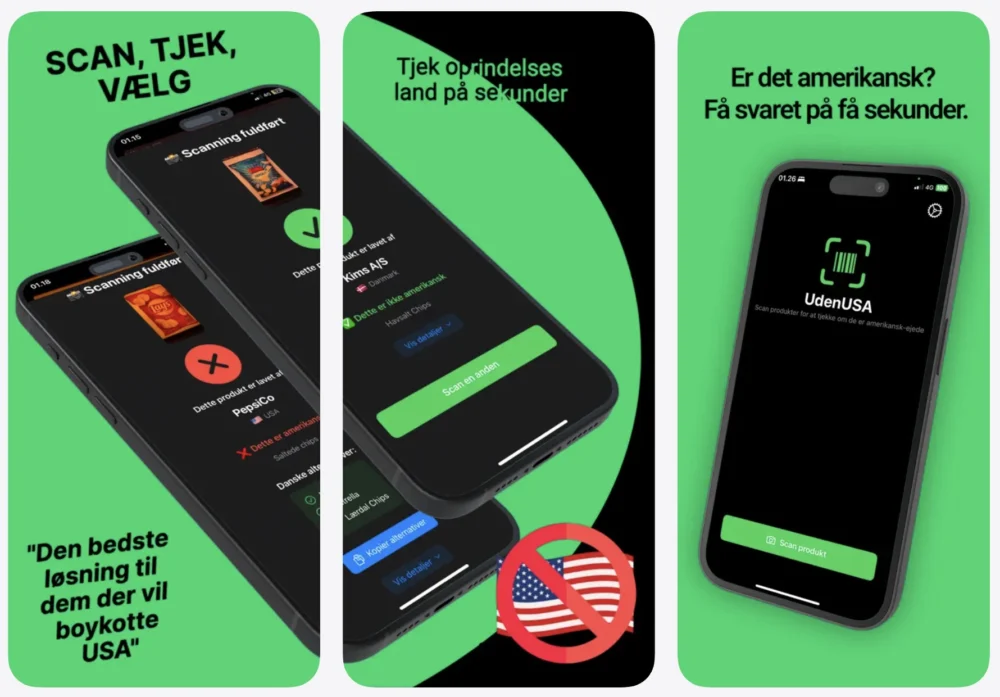
The intersection of geopolitical friction and consumer technology has manifested in a dramatic, quantifiable shift in digital behavior across Nordic markets. Following a high-profile diplomatic dispute concerning the territorial status of Greenland, Danish consumers have mobilized a grassroots economic counter-response, leveraging mobile applications to meticulously curate their purchasing decisions. Data reveals that two distinct utility applications, specifically designed to identify and circumvent American-made products, have experienced an explosive surge in downloads, catapulting them to the zenith of the Danish App Store charts. This unprecedented shift demonstrates the potency of mobile platforms as conduits for immediate political and economic activism.
Analysis provided by market intelligence firms indicates that two key players, NonUSA and Made O’Meter, have dominated the download rankings across both iOS and Android ecosystems this month. The combined average daily downloads for these applications across all platforms—specifically NonUSA for iOS, and Made O’Meter for both iOS and Google Play—registered a staggering 867% increase over the preceding seven-day period. This near ten-fold acceleration in adoption underscores a rapid and widespread public commitment to consumer sovereignty and economic protest.
The Geopolitical Catalyst: From Diplomacy to Digital Boycott
The sudden acceleration in app usage is directly traceable to the diplomatic fallout ignited by previous United States administration threats regarding the potential acquisition or control of Greenland, a sovereign territory under the Kingdom of Denmark. For many Danes, this proposition represented a profound breach of diplomatic protocol and an affront to national sovereignty, prompting a powerful, non-governmental reaction. While diplomatic channels managed the official response, the public channelled its frustration into tangible economic action.
The boycott movement, initially organic and decentralized, quickly expanded beyond mere rhetoric. Reports indicate that Danish consumers began cancelling reservations for planned U.S. vacations, and, perhaps more significantly in the digital realm, terminated subscriptions to major U.S.-based streaming services and content providers, notably Netflix. This move confirms that the protest extended beyond physical goods to encompass the digital services that permeate daily life.
The technological solution arose to facilitate this complex, multi-layered boycott. Traditional boycotts often struggle with friction; identifying the origin of every item purchased requires significant time and effort, leading to quick dissipation of momentum. Mobile technology drastically lowers this barrier. NonUSA, which briefly secured the No. 1 spot in the Danish App Store rankings, epitomizes this new era of friction-free activism. On a specific Wednesday, the app climbed to the top position, continuing a rapid ascent from No. 6 the previous day, and a massive jump from its rank of No. 441 just weeks prior.
The primary function of NonUSA is utility-driven and highly effective: users utilize their smartphone camera to scan product barcodes (EAN or UPC codes). The app instantly accesses a database to determine the product’s country of origin. Crucially, it moves beyond mere identification by providing actionable recommendations—suggesting locally produced, Danish alternatives, thereby reinforcing domestic economic activity while maintaining the political protest.
The Dynamics of Techno-Nationalism in Nordic Markets
The adoption pattern reveals a fascinating trend beyond Danish borders. The top five markets for NonUSA currently include Denmark, Norway, Sweden, and Iceland. This distribution highlights a rapid spread of digital solidarity across the broader Nordic region, suggesting a coordinated, digitalized expression of regional alignment and shared cultural or political values in response to external diplomatic pressure. This phenomenon can be categorized as a form of techno-nationalism, where digital tools are employed to preserve national or regional identity and economic independence.

While NonUSA led the charge, the cross-platform application Made O’Meter also saw substantial uptake, climbing to the No. 5 position in the App Store rankings. The collective performance of these applications—achieving an 867% increase in downloads—demonstrates that consumers are actively seeking and utilizing technology to enforce their political choices in the marketplace.
It is important to contextualize this download surge within the specific parameters of the Danish mobile ecosystem. Compared to gargantuan markets like the United States, the Danish App Store is relatively modest in scale, observing approximately 200,000 total downloads across all applications daily. Achieving a top ranking in this smaller, high-engagement market requires only a few thousand downloads in a single day, unlike the hundreds of thousands required in major economies. However, the sheer volatility and speed of the rank climb—from outside the top 400 to number one in days—provides statistically compelling evidence of a coordinated, powerful, and politically motivated consumer mobilization, rather than simple organic growth or successful marketing.
Industry Implications: The Challenge to Global Supply Chains
The rise of politically charged utility apps presents significant implications for multinational corporations (MNCs) and the complexity of global supply chains. For decades, supply chain optimization has prioritized efficiency, cost reduction, and timely delivery, often obscuring the product’s country of origin (COO) from the end-user. These apps fundamentally reverse that dynamic, making COO the primary filter for consumer decision-making.
The challenge for U.S. companies operating in markets influenced by such boycotts is manifold. First, corporate structure often makes country-of-origin identification ambiguous. A product manufactured in Ireland by a subsidiary of a U.S.-headquartered company, using raw materials sourced from Asia, complicates the definition of "American-made." Boycott apps must rely on standardized identifiers, such as the initial digits of the EAN or UPC code, which denote the country of the numbering authority, often leading to potential inaccuracies regarding the true location of manufacture or the ultimate ownership of the brand.
Second, this trend forces MNCs to re-evaluate their branding and marketing strategies in politically sensitive regions. If consumers are actively using technology to filter out a nation’s goods, brands must choose between emphasizing their local operational footprint (e.g., "Produced and packaged in Denmark by a global company") or absorbing the economic cost of the boycott. The effectiveness of these apps places measurable pressure on sales volumes, turning consumer choice into a potent, market-driven diplomatic tool.
Furthermore, the surge highlights a crucial technology industry implication: the shift of utility apps into the realm of political advocacy. Historically, barcode scanners and comparison shopping tools were purely commercial utilities. Now, they are being weaponized for social and political ends. This raises questions for app store operators (Apple and Google) regarding content policy and the policing of apps that facilitate politically motivated economic action, especially when such actions target specific nation-states or industries.
Expert Analysis: Behavioral Economics and Digital Nudging
From a perspective of behavioral economics and digital activism, the success of NonUSA and Made O’Meter is rooted in the concept of "digital nudging" and minimizing the "cost of participation."
Traditional boycotts carry a high participation cost. They require conscious effort, research, and often necessitate foregoing preferred or convenient products. The mobile app removes this cost. Instead of requiring the consumer to memorize lists of banned brands or spend time researching alternatives, the app offers instant data and instant solutions at the exact point of purchase—the supermarket aisle. This is an example of just-in-time activism.

Dr. Elara Jensen, a specialist in digital consumer behavior at a leading European think tank, notes that "the barcode scanning app transforms a complex political action into a low-friction, almost gamified task. It turns the consumer’s smartphone, already an extension of their decision-making process, into a political compass. This ease of use ensures longevity for the protest where traditional methods would quickly fade."
Moreover, the collective nature of the app’s use reinforces social cohesion. When consumers observe these apps topping the download charts, it validates their individual commitment, reinforcing the perception that the boycott is widespread and effective—a digital manifestation of collective efficacy. This communal validation is essential for sustaining long-term, decentralized movements.
Future Trajectories: The Regulatory and Technological Landscape
The incident in Denmark serves as a crucial case study for future trends in trade disputes and consumer engagement. As global supply chains become more transparent—driven partly by consumer demand for ethical sourcing and partly by regulatory pressures—the data these boycott apps rely on will become richer and more accurate. Future iterations of these applications may integrate advanced features, such as deep supply chain mapping, allowing users to filter products not just by the final country of assembly, but by the nationality of the company’s ownership, its labor practices, or its environmental record.
The regulatory environment around these tools is also ripe for evolution. If similar political disputes escalate elsewhere, leading to widespread adoption of nationalistic filtering apps, governments and trade organizations may attempt to regulate the display of origin data or impose standards on how product information is presented via mobile platforms. Furthermore, trade agreements might begin to include clauses addressing digital tools that specifically encourage discriminatory purchasing based on national origin, viewing them as non-tariff barriers to trade.
For tech developers, the trend opens a new niche: politically or ethically driven utility tools. We may see an increase in apps focusing on specific values, such as identifying products from companies with poor human rights records, high carbon footprints, or those linked to specific political ideologies. The ability to instantly transform passive consumption into active, values-aligned purchasing is a powerful new capability offered by mobile technology.
In conclusion, the meteoric rise of NonUSA and Made O’Meter in the Danish App Store is far more than a fleeting download spike; it is a profound signal regarding the digital future of international relations and commerce. It illustrates how readily consumers will weaponize widely available technology—the ubiquitous smartphone and the simple barcode scanner—to express deep political dissatisfaction and enforce economic consequences. This micro-market trend in a key Nordic nation highlights a macro-political reality: in the age of digital transparency, consumer sovereignty is now instantly executable, making the digital marketplace a powerful, immediate arena for geopolitical negotiation and protest. The resulting 867% surge is a testament to the fact that, increasingly, foreign policy debates are being settled not just in diplomatic halls, but through millions of individual taps on a mobile screen.
