

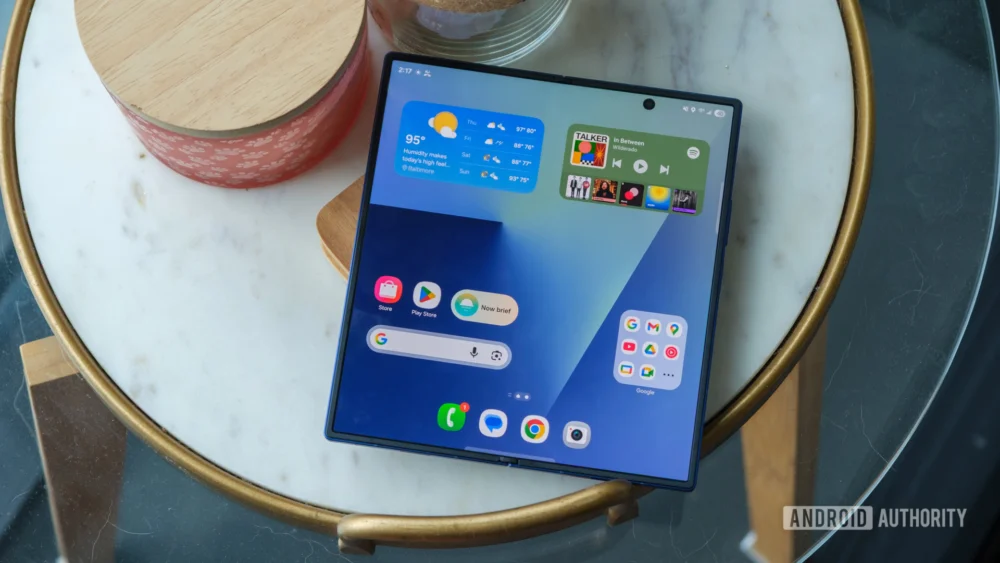
The landscape of premium mobile technology is continually reshaped by iterative hardware improvements and aggressive pricing strategies, particularly in the nascent but rapidly maturing foldable segment. Currently, the Samsung Galaxy Z Fold 7—the flagship device representing the pinnacle of Samsung’s book-style folding innovation—is experiencing a significant promotional markdown, presenting an unprecedented opportunity for consumers to acquire the high-capacity 512GB variant. Ordinarily commanding a substantial retail price of $2,119.99, this specific configuration, notably in the Jet Black finish, has seen its cost slashed to $1,599.99, translating to a substantial $520 saving for the discerning buyer. This particular discount, observed through major retail channels like Amazon, effectively bridges the gap between the standard storage tier and the premium offering.
This reduction is noteworthy not just for the sheer dollar amount saved, but for its immediate implications on market positioning. At this newly discounted price point, the 512GB Z Fold 7 is priced identically to the current discounted rate for the base 256GB model. For consumers who had been strategically waiting for the optimal moment to invest in Samsung’s top-tier foldable—balancing the desire for ample internal storage against the prohibitive cost—this event marks a critical inflection point.
The Context of Foldable Premiumization
To fully appreciate the significance of this $520 reduction, one must contextualize the inherent premium associated with foldable technology. Early iterations of foldable devices were often characterized by compromises: bulkier designs, visible screen creases, limited durability, and exorbitant initial price tags. Samsung, having pioneered this category with the original Fold, has spent several generations refining the core components—the hinge mechanism, the Ultra-Thin Glass (UTG) covering, and the software optimization necessary for a seamless large-screen experience.
The Galaxy Z Fold 7 embodies the latest advancements in this pursuit of perfection. It integrates the bespoke Snapdragon 8 Elite for Galaxy chipset, a processor tuned specifically for peak performance within the Samsung ecosystem, paired with a robust 12GB of RAM. This hardware configuration ensures that the device performs not merely adequately, but with the speed and fluidity expected of a true flagship, capable of handling intensive multitasking, complex applications, and demanding graphical loads with aplomb.
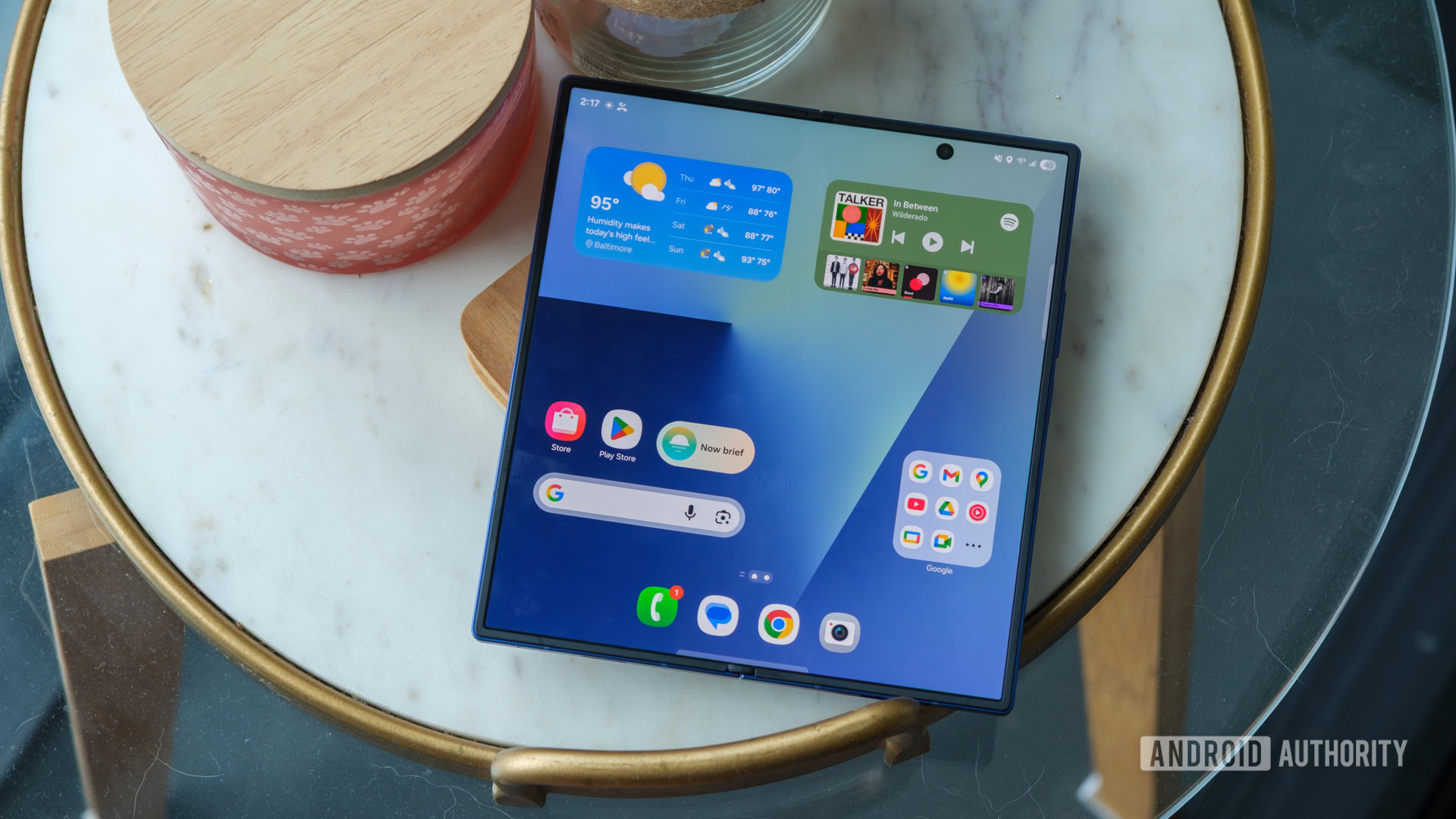
The hardware narrative is heavily centered on the dual-display architecture. The primary internal display is an expansive 8.0-inch Dynamic LTPO AMOLED 2X panel, boasting a crisp 2,184 x 1,968 resolution and a fluid 120Hz refresh rate. This is the device’s main draw—a tablet-sized canvas compressed into a pocketable format. Complementing this is the 6.5-inch external cover screen, facilitating quick interactions without the need to unfold the main display. Furthermore, Samsung has continued its incremental engineering improvements on the hinge assembly, aiming for a near-invisible crease, a perennial focal point for user scrutiny in this device class.
The inclusion of the latest iteration of Galaxy AI further elevates the utility, embedding sophisticated software features across core functions like computational photography, real-time translation, and productivity tools such as enhanced Circle to Search capabilities. These software enhancements are crucial differentiators in a saturated high-end market.
Industry Implications of Aggressive Discounting
When a manufacturer’s top-tier, recently launched flagship experiences such a dramatic, early-lifecycle price correction, it signals several key dynamics within the mobile technology sector.
First, it suggests a shift in market maturity for foldables. As production scales and component costs decrease—particularly for flexible displays and complex hinge modules—the barrier to entry for consumers lowers. Samsung appears to be strategically employing aggressive pricing to broaden the consumer base beyond early adopters and tech enthusiasts, aiming for mainstream penetration. Reducing the entry price for the high-storage model by over 20% effectively positions it against premium non-folding flagships, forcing a re-evaluation of value proposition.
Second, this move directly impacts competitive positioning. The foldable market is no longer exclusive to Samsung. Competitors like Google, with its Pixel 10 Pro Fold, are now offering compelling alternatives, often emphasizing software integration or specific design philosophies (such as superior IP ratings). By drastically lowering the cost of entry for its 512GB offering, Samsung preemptively neutralizes some of the competitive advantage held by rivals who might undercut them on price alone. When the Z Fold 7 matches the price of a competitor’s likely mid-tier or base model, the superior specifications of the Samsung device become overwhelmingly attractive.
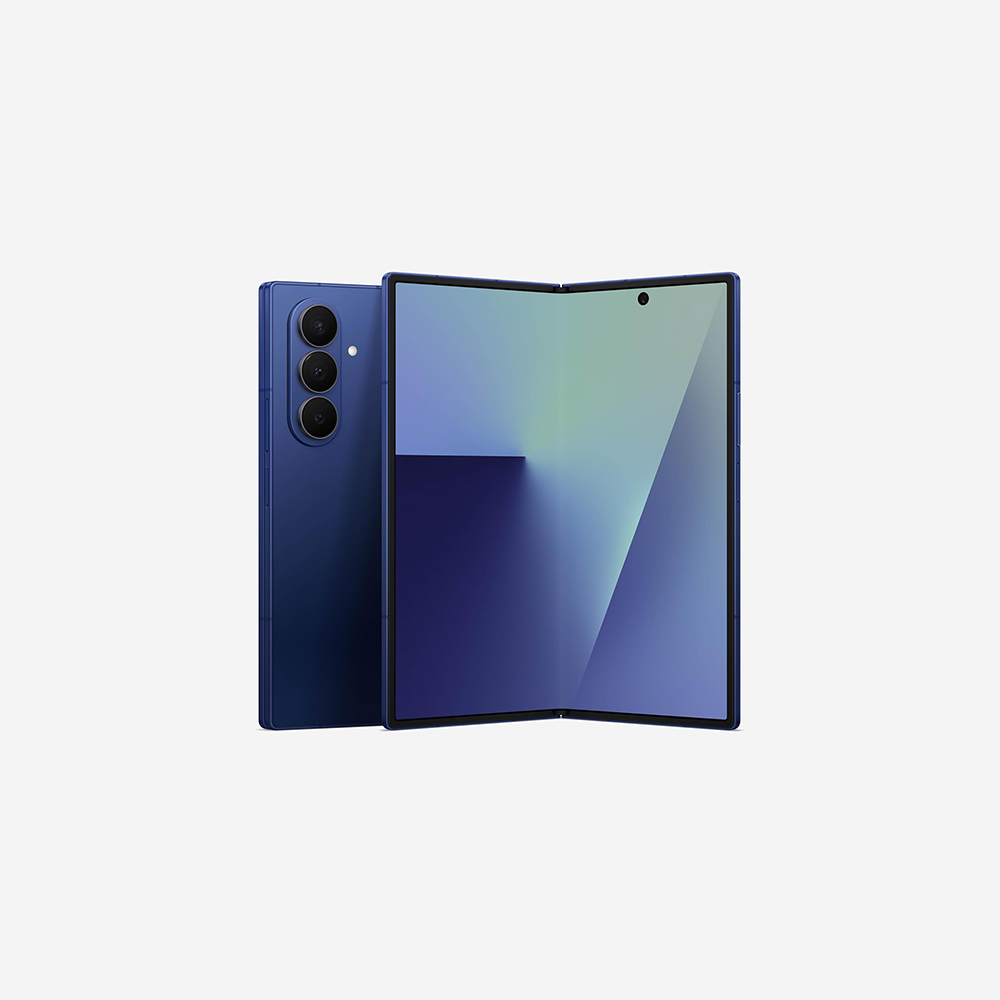
Third, inventory management and sales velocity are likely factors. While the Z Fold series is premium, the overall volume is lower than traditional slab phones. Retailers and manufacturers often seek to move high-value stock quickly to make room for subsequent hardware refreshes or to clear specific color variants (in this case, the Jet Black exclusivity).
Deeper Dive into Hardware Trade-offs at the New Price Point
While the $1,599.99 price tag for 512GB storage is exceptional, potential buyers must maintain a critical perspective on the device’s acknowledged constraints, as detailed in expert assessments.
The primary area of potential compromise lies in the battery and charging infrastructure. The Z Fold 7 utilizes a 4,400mAh battery. While this capacity is adequate for a device prioritizing thinness and portability, it is smaller than what is typically found in conventional flagship smartphones, which often exceed 5,000mAh. This is a direct consequence of the engineering challenge: integrating a complex hinge and two displays within a slim chassis limits internal volume for a larger power cell. Consequently, the device relies on 25W wired and 15W wireless charging speeds. In an era where many competitors offer 65W or even 120W charging solutions, Samsung’s charging speeds are decidedly conservative, requiring longer downtime tethered to a power source.
Another area demanding nuanced consideration is the camera system. While the device features a potent 200MP primary sensor, its overall photographic suite, when benchmarked against Samsung’s dedicated S-series flagships (like the presumed Galaxy S25 Ultra), often trails slightly in terms of telephoto capabilities, sensor optimization, or overall image processing consistency. The Z Fold line historically prioritizes form factor and display innovation over absolute photographic supremacy. For users prioritizing professional-grade mobile photography above all else, this remains a slight trade-off for adopting the folding form factor.
Durability, while vastly improved, also carries specific caveats. The IP48 rating indicates protection against dust ingress (the ‘4’) and water immersion up to 1.5 meters for 30 minutes (the ‘8’). This is commendable for a folding device, but it falls short of the industry gold standard for flagship resilience, the IP68 rating, which is notably achieved by its direct rival, the Google Pixel 10 Pro Fold. The internal flexible display, despite advancements in UTG, remains inherently more susceptible to abrasion or puncture than traditional fixed glass panels.

Future Trajectory and Consumer Adoption
This pricing dynamic is indicative of where the entire mobile industry is headed: the maturation of foldable technology will inevitably lead to a broader adoption curve catalyzed by reduced cost. The Z Fold 7, even mid-cycle, serves as an advanced proving ground for engineering solutions that will trickle down to more affordable folding devices in the coming years.
The performance metrics—driven by the specialized Snapdragon 8 Elite for Galaxy—suggest that this device is engineered for longevity, ensuring that its performance remains competitive well into its lifespan, mitigating concerns about rapid obsolescence often associated with high-cost electronics. The 12GB of RAM, coupled with optimized Android multitasking layers, ensures that the device can function effectively as a true pocket computer, blending phone portability with tablet productivity.
For the consumer, the calculus is straightforward: is the experience of having an 8-inch, high-refresh-rate OLED screen available instantly worth the ongoing compromises in battery capacity and charging speed, especially now that the price aligns closely with top-tier conventional phones? For those whose workflow benefits significantly from the expanded screen real estate—creatives, heavy email users, mobile gamers, or those frequently consuming media on the go—the $1,599.99 barrier clearance makes the Z Fold 7 a compelling proposition. It transforms the device from an aspirational luxury item into a highly capable, albeit still premium, productivity tool.
This promotional window, specifically targeting the 512GB model in Jet Black, represents a temporary but significant market correction. Given the typical life cycle of these promotions, this level of discount on the higher storage tier is unlikely to persist indefinitely. For those ready to commit to the foldable future, particularly those requiring substantial onboard storage for media, large applications, or extensive on-device work files, this moment offers the most financially accessible entry point to Samsung’s current folding zenith. The decision hinges on valuing storage capacity and screen utility over absolute camera supremacy and rapid charging speeds. The engineering prowess required to shrink a tablet experience into this form factor is undeniably present, and at this price, the value proposition tilts strongly in favor of the consumer ready to embrace the fold.
