

The digital landscape of 2026 continues to wrestle with the phantom limb sensation left by the demise of mainstream physical keyboards. As consumers increasingly gravitate toward monolithic glass slabs, a dedicated, yet persistent, segment of the market yearns for the tactile reassurance and efficiency of dedicated QWERTY input. This yearning has spurred several intriguing, albeit niche, hardware responses throughout 2025, culminating in the recent announcement of the Clicks Communicator—a device that sought to bridge the gap by integrating a physical keyboard into a compact form factor, following Clicks’ earlier experiments with add-on cases for flagship devices and early foldables. Now, however, a more established contender in the specialized Android hardware space is ready to present its answer to this enduring demand: the Unihertz Titan 2 Elite.
Unihertz, a Shenzhen-based entity that has carved out a significant space by catering to users demanding alternatives to the ubiquitous touchscreen paradigm, is not new to this arena. For more than half a decade, the company has consistently produced Android smartphones equipped with genuine, tactile QWERTY keypads, effectively serving as the unofficial custodian of this hardware segment following BlackBerry’s market exit. Their sustained commitment to this form factor provides them with an institutional memory and engineering expertise that newer entrants, such as Clicks, are only beginning to accumulate.
Historically, Unihertz’s flagship offering in this category has been the Titan series. These devices have typically leaned into a ruggedized aesthetic and a productivity-first ethos, often drawing direct inspiration from the bold, wide-screen format of the BlackBerry Passport. The Titan 2, introduced in 2025, exemplified this philosophy: a substantial device featuring a large 4.5-inch display balanced above a full physical keyboard, explicitly targeting enterprise users who prioritized data entry speed and durability over sheer portability. To contextualize the Titan 2’s footprint, even the most expansive modern flagship, such as the assumed Galaxy S25 Ultra lineage, typically maxes out around three inches in width, making the Titan series decidedly broad and robust.
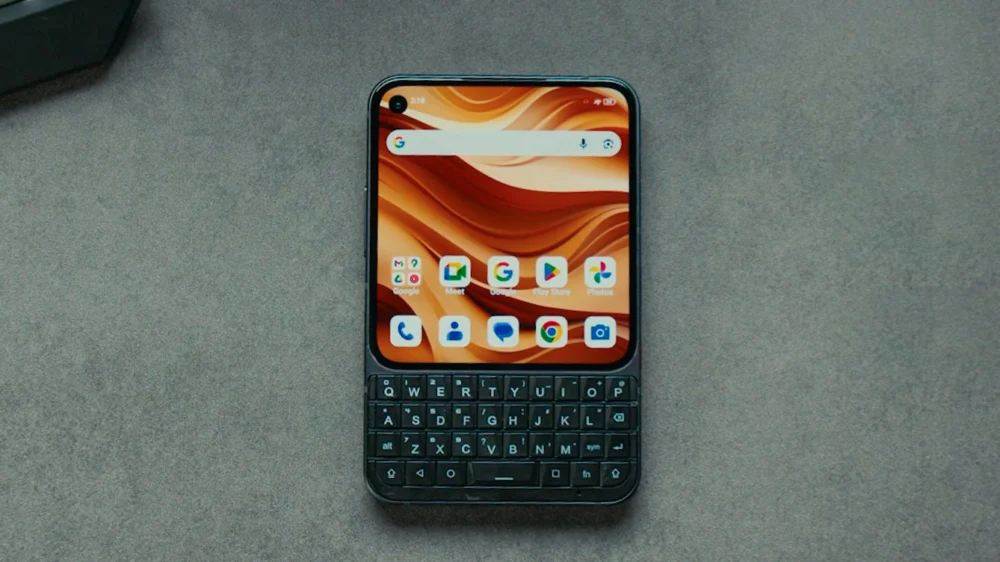
The newly teased Titan 2 Elite signals a significant strategic pivot for Unihertz. Moving away from the bulky, enterprise-focused design language of its predecessor, the Elite appears engineered for a dramatically different user profile. Early visual evidence, derived from a promotional teaser shared by the company, suggests a device that prioritizes compactness. The form factor is markedly scaled down, evoking the classic, pocket-friendly dimensions associated with earlier BlackBerry models, specifically drawing comparisons to the beloved Curve series rather than the expansive Passport.
While Unihertz has yet to finalize and publish the exact specifications for the display panel—the Titan 2 utilized an LCD, for instance—the visual progression is evident. The Elite seems to incorporate sleeker, minimized bezels, representing a crucial step toward modernizing the aesthetic of a keyboard phone. Perhaps the most telling modernization is the abandonment of the Titan 2’s prominent, thick top bezel. In its place, the Titan 2 Elite integrates a front-facing camera discreetly beneath the display, positioned in the upper left quadrant. This shift suggests a conscious effort to maximize screen real estate while retaining the physical input mechanism below, a delicate balancing act in hardware design.
The philosophical positioning of the Titan 2 Elite also warrants closer examination, particularly when contrasted with the Clicks Communicator. Clicks has deliberately positioned its product as an ancillary device—a companion or a specialized tool—rather than a primary smartphone replacement. Unihertz, conversely, appears to be presenting the Titan 2 Elite as a fully capable, primary mobile computing device. The demonstration footage shows the Elite running a standard, unadulterated Android launcher, capable of accommodating a full grid of application icons, perhaps five across, implying a complete operating system experience rather than a limited companion interface. This distinction is critical: Unihertz is aiming for the user who wants a single device that merges modern Android functionality with classic tactile input, whereas Clicks caters to the user who needs enhanced typing capability alongside their existing primary slab phone.
The immediate future for the Titan 2 Elite is anchored to the Mobile World Congress (MWC) 2026, scheduled for the first week of March. This is the traditional venue for such hardware announcements, offering Unihertz a global platform to unveil the final specifications, pricing tiers, and definitive market positioning. Following the MWC reveal, the company has indicated that further details regarding its upcoming Kickstarter campaign will be disseminated. Crowdfunding remains Unihertz’s preferred pathway for gauging demand and funding initial production runs, a model that inherently fosters a tightly knit, highly engaged early adopter community. For those tracking this niche evolution, direct registration via Unihertz’s dedicated landing page or participation in the specific community-led Facebook group serve as the current conduits for real-time updates.
The Resurgence of Tactile Computing: Industry Implications
The simultaneous emergence of devices like the Clicks Communicator and the imminent arrival of the Unihertz Titan 2 Elite are not mere nostalgic flashes; they represent a palpable market undercurrent. For over a decade, the industry narrative has dictated that the touch interface is universally superior. However, this narrative overlooks the demonstrable advantages of physical keyboards in specific contexts: speed, accuracy, and haptic feedback for long-form text composition, data entry, and efficient navigation via keyboard shortcuts.
The Titan 2 Elite’s evolution from a rugged, enterprise-focused behemoth to a more compact, modern device suggests that Unihertz has analyzed the feedback from its existing user base and the broader market shift. The shift towards a smaller footprint aligns better with contemporary expectations for daily carry, while the move to minimize bezels and integrate modern camera solutions addresses the aesthetic gap that often alienated potential buyers of previous Titan iterations.
From an industry perspective, these niche products serve as important pressure tests for the major players. They demonstrate that while 95% of the market may be satisfied with virtual keyboards, a tenacious 5% requires specialized hardware. This persistent demand validates the ongoing development of specialized Android kernels and input frameworks necessary to support these non-standard devices. Furthermore, the success of these niche players forces larger manufacturers to occasionally revisit their foundational design assumptions. While Apple and Samsung are unlikely to embrace QWERTY en masse, the very existence of a viable competitor like the Titan Elite might influence future specialized offerings or collaborations.
Expert analysis suggests that the Titan Elite’s success will hinge on two primary factors: performance parity and software optimization. If the Elite offers processing power, battery life, and camera performance that is merely "acceptable" by 2026 standards, it will thrive within the core Unihertz demographic. If, however, it manages to integrate mid-to-high-range specifications—perhaps an advanced MediaTek Dimensity chipset or a comparable Snapdragon equivalent—it could attract users migrating from older, less powerful QWERTY solutions looking for a modern upgrade path without sacrificing tactile input.
Ergonomics vs. Aesthetics: The Design Trade-off
The fundamental challenge in designing a QWERTY smartphone remains the zero-sum game between screen size and physical keyboard real estate. The BlackBerry Passport attempted to solve this by widening the screen, creating an unusual aspect ratio that worked well for emails but poorly for standard mobile video consumption. The Clicks Communicator attempts to solve it by making the keyboard a secondary accessory, sacrificing the integrated feel.
Unihertz’s apparent strategy with the Titan 2 Elite seems to be a return to the tried-and-true approach: sacrificing screen size vertically and horizontally to accommodate a functional, full-size physical keyboard below the display line, reminiscent of the classic "candy bar" keyboard design. This necessitates a carefully managed display resolution and aspect ratio to ensure that standard Android applications scale gracefully without excessive letterboxing or awkward UI element placement. The rumored in-display camera is a significant aesthetic win, as it eliminates the need for a large, static top bezel that was previously required to house the sensor and earpiece speaker—a common visual complaint on prior Titan models.
The tactile experience itself is paramount. Unihertz must deliver key travel, actuation force, and key spacing that appeals to the muscle memory of former BlackBerry power users. Any misstep here—keys that feel mushy, too shallow, or overly cramped—will alienate the very audience they are courting. This is where Unihertz’s long-standing experience provides a measurable advantage over newcomers like Clicks, whose keyboard experience is often contingent on the mechanical tolerance of a case attachment.
Future Trajectory and Market Segmentation
Looking toward the longer-term future of mobile hardware, the QWERTY revival suggests a fragmentation of the smartphone market into highly specialized segments. We are moving beyond the singular dominance of the "all-in-one" slab.
-
The Ultra-Productivity Segment: Devices like the Titan 2 Elite cater to professionals, coders, journalists, and data entry specialists who prioritize rapid, error-free input over immersive media consumption. For these users, the time saved through tactile typing outweighs the compromises in screen size or multimedia capabilities.
-
The Digital Detox Segment: A secondary, though growing, market segment seeks devices that naturally limit engagement with infinite scrolling social media feeds. A physical keyboard inherently slows down casual browsing, creating a friction point that encourages more deliberate, focused usage. The compact nature of the Elite makes it an attractive candidate for users seeking a capable primary phone that is less conducive to mindless scrolling than a 6.8-inch OLED panel.
-
Nostalgia and Collectibility: While a smaller factor, the allure of retro-inspired design ensures a baseline level of consumer interest, particularly when paired with modern Android functionality. This segment appreciates the engineering feat of integrating legacy hardware into a contemporary operating system environment.
The Titan 2 Elite, slated for its MWC 2026 debut, is positioned to be a significant benchmark in this specialized field. It is an acknowledgement by a specialized manufacturer that the physical keyboard is not dead, merely marginalized, and that a well-executed, modern Android device built around that input method can carve out a sustainable, profitable niche. Its success will be measured not against the S25 Ultra, but against the Clicks Communicator and Unihertz’s own historical performance in delivering on the promise of true, integrated tactile mobile communication in the modern era. The convergence of reduced size, updated aesthetics, and proven Android compatibility suggests this iteration might finally capture a broader segment of the QWERTY faithful than its predecessors.
