

The digital perimeter has dissolved. In the contemporary threat landscape, the concept of an external attacker "breaking in" is largely archaic. Today’s adversaries do not deploy sophisticated zero-day exploits to breach network defenses; they leverage the most trusted credential—the user identity. This fundamental shift mandates a strategic pivot: moving away from perimeter-centric defense models toward identity-centric resilience. For organizations planning their security posture for 2026 and beyond, embracing robust Identity Threat Detection and Response (ITDR) is not merely advisable—it is an operational imperative for survival.
The Identity Crisis: Understanding the Modern Attack Vector
Identity-based attacks represent the undisputed front line in corporate cybersecurity assaults. The ubiquity of cloud services, remote workforces, and increasingly sophisticated social engineering campaigns has made user credentials the single most valuable asset for threat actors. Phishing campaigns, brute-force credential stuffing, password spraying attacks, and the exploitation of weak or reused passwords are low-friction, high-yield methodologies. They are scalable, automated, and capable of overwhelming even the most meticulously managed security operations centers (SOCs).
The sheer volume of these low-effort, high-frequency attempts creates an environment of constant attrition. Security teams are forced to triage thousands of potential false positives, inevitably leading to alert fatigue. The critical danger lies in the inevitability of failure: if even a minuscule fraction of these automated attacks succeeds in compromising a single credential, the integrity of the entire digital ecosystem is immediately jeopardized.
Once an initial foothold is established via a compromised account, the adversary’s behavior transforms from reconnaissance to rapid lateral movement. They exploit the inherent trust granted to authenticated users, swiftly traversing internal systems, escalating privileges, exfiltrating sensitive data, and establishing persistent backdoors. The goal is often not immediate disruption but prolonged, undetected residency, allowing them to map the organization’s crown jewels before executing a catastrophic final payload, such as widespread ransomware encryption or data destruction.
Moving Beyond Mitigation: The Imperative for Proactive Visibility
Traditional security frameworks have long relied on preventative layers: advanced email filtering to block initial phishing lures, Multi-Factor Authentication (MFA) to block credential reuse, and strict adherence to the Principle of Least Privilege (PoLP) to limit blast radius. These controls remain foundational and essential components of a layered defense strategy. However, their collective efficacy is inherently imperfect. No security measure is 100% foolproof.
This reality forces security leadership to confront a difficult question: When prevention inevitably fails, how quickly can we detect the resulting intrusion? In the absence of granular, real-time visibility into identity behavior, organizations operate under a dangerous assumption of security until the catastrophic impact is undeniable—when data is already exfiltrated, systems are locked down, and business continuity is halted.
The transition required for 2026 is a strategic shift from reactive risk mitigation—hoping the preventative layers hold—to proactive, identity-focused detection and response. Identity Security must evolve from a supporting pillar to the central nervous system of the security strategy. This is the domain of Identity Threat Detection and Response (ITDR). ITDR solutions provide the deep, continuous telemetry necessary to observe identity interactions across the entire IT estate, enabling security teams to intervene decisively at the earliest stage of compromise.
Deconstructing the Attacker’s Playbook: The Power of Behavioral Analytics
Effective ITDR hinges on establishing an authoritative baseline of "normal" identity behavior and leveraging advanced analytics to detect deviations that signal malicious activity. To know your enemy, you must first intimately understand your user.
ITDR platforms achieve this by aggregating, normalizing, and analyzing event logs spanning all critical IT infrastructure components—from Active Directory and Azure AD to cloud workloads, endpoint management systems, and privileged access management (PAM) solutions. This consolidated view moves security teams beyond siloed monitoring into comprehensive environmental awareness.
Normal user activity typically adheres to predictable temporal, geographic, and resource-access patterns. A sales representative, for instance, is expected to access CRM data during standard business hours from a known geographical region, utilizing specific applications related to their role. Conversely, a compromised account exhibits anomalous behavior that immediately raises suspicion.

Key indicators that demand immediate investigation, often flagged by ITDR systems, include:
- Impossible Travel/Geographic Anomalies: A user authenticating in London one minute and attempting access from Singapore five minutes later.
- Privilege Escalation Attempts: A standard user account suddenly attempting modifications to global security groups, domain controllers, or service principals.
- Unusual Resource Access: An account accessing highly sensitive file shares, administrative consoles, or infrastructure-as-code repositories outside its established operational scope.
- Modification of Security Controls: Attempts to disable MFA, reset administrative passwords, or modify audit logging configurations—classic "covering tracks" behavior.
- Creation of Dormant Accounts: The provisioning of new, potentially malicious service accounts or user profiles that remain inactive, awaiting a later stage of the attack chain.
While benign explanations may exist for any single anomaly (e.g., an employee traveling unexpectedly), the aggregated pattern of deviations constitutes a high-fidelity threat signal. The ITDR approach mandates that security teams investigate these deviations immediately, adhering strictly to the "better safe than sorry" principle, thereby transforming potential disaster into manageable incident response.
Industry Implications: The Regulatory and Operational Shift
The increasing reliance on identity as the control plane has significant implications across industry sectors. Regulatory bodies are increasingly scrutinizing identity governance and privileged access management as critical risk areas. Failures in these domains are no longer viewed as technical missteps but as failures in fiduciary duty regarding data protection.
For organizations operating under frameworks like GDPR, CCPA, or forthcoming NIST standards, demonstrable proof of continuous identity monitoring—the core function of ITDR—will become a compliance prerequisite, not an optional enhancement. The ability to rapidly demonstrate when an account was compromised, what actions were taken, and how the incident was contained is paramount for demonstrating due diligence during post-incident audits.
Furthermore, the operational expenditure associated with managing identity sprawl—the proliferation of accounts, roles, and permissions across hybrid and multi-cloud environments—is becoming unsustainable. Traditional governance tools often operate separately from threat detection mechanisms, forcing security teams to stitch together disparate data sources. This fragmented approach slows response times and increases the likelihood of overlooking subtle, persistent threats.
The Future Trajectory: Unified Identity Security Platforms
The trajectory of enterprise security is moving toward consolidation and integration. The future demands unified platforms that seamlessly integrate the proactive controls of Identity Governance Administration (IGA) with the reactive capabilities of ITDR. This convergence creates a holistic Identity Security posture.
Solutions that successfully merge these disciplines offer significant advantages:
- Continuous Compliance and Posture Management: Governance functions (like regular access reviews and PoLP enforcement) feed directly into the threat detection engine, ensuring that the baseline for "normal" behavior is always aligned with the current, approved state of least privilege.
- Automated Remediation Context: When ITDR detects a threat, integrated governance tools can execute automated containment actions—such as immediately revoking specific session tokens or isolating the compromised account’s access rights—without requiring manual scripting or reliance on separate, slow provisioning systems.
- Lifecycle Integrity: From onboarding to offboarding, the entire user lifecycle is governed, reducing the risk of orphaned, dormant, or over-privileged accounts that serve as latent threats.
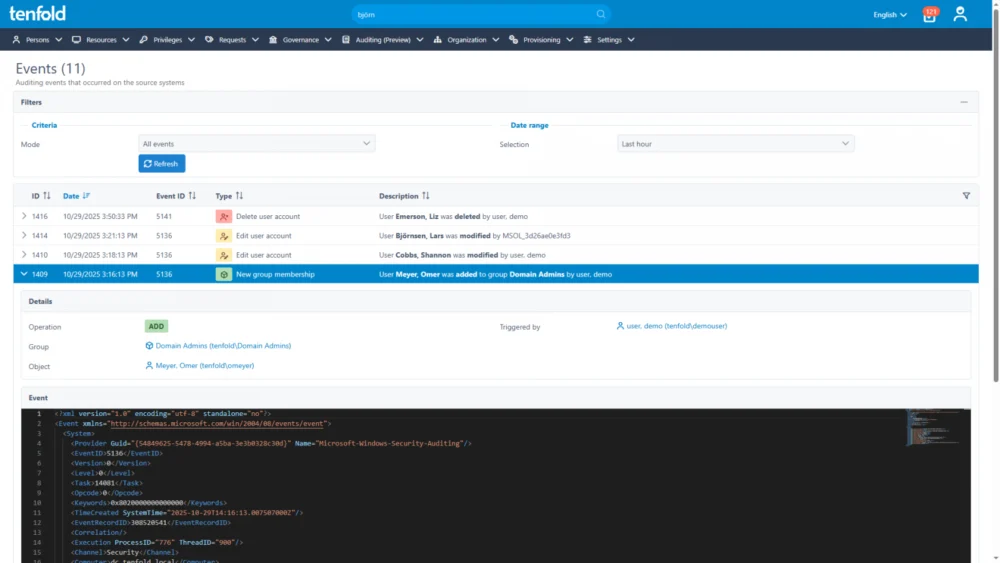
Platforms aiming for this unified approach provide comprehensive control over user identities and IT privileges, encompassing role-based access management, automated lifecycle workflows, and detailed event auditing, all housed within a single operational interface. This eliminates the need for multiple vendor solutions, reducing complexity, integration overhead, and subscription fragmentation.
The shift toward no-code or low-code platforms is also critical for accelerating adoption. Security teams are resource-constrained; solutions that require extensive development cycles for deployment and rule configuration will fail to meet the immediate demands of the threat landscape. A user-friendly, rapidly deployable platform allows organizations to achieve meaningful identity threat detection capabilities quickly, closing critical visibility gaps before the close of 2026.
In essence, securing the digital enterprise in the coming years means accepting that the lock has been bypassed, and focusing all resources on monitoring every internal movement. Identity Threat Detection and Response is the essential technology enabling this crucial transition from hoping you are secure to actively proving your resilience moment by moment. The integration of governance and threat intelligence into a singular, actionable platform is the defining cybersecurity architecture for the immediate future.
