

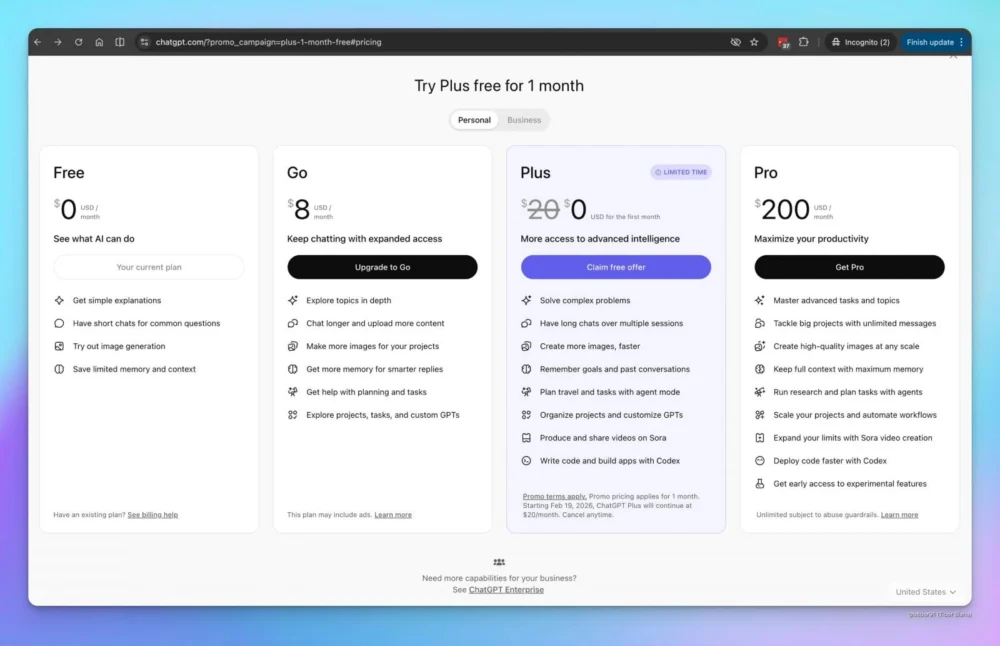
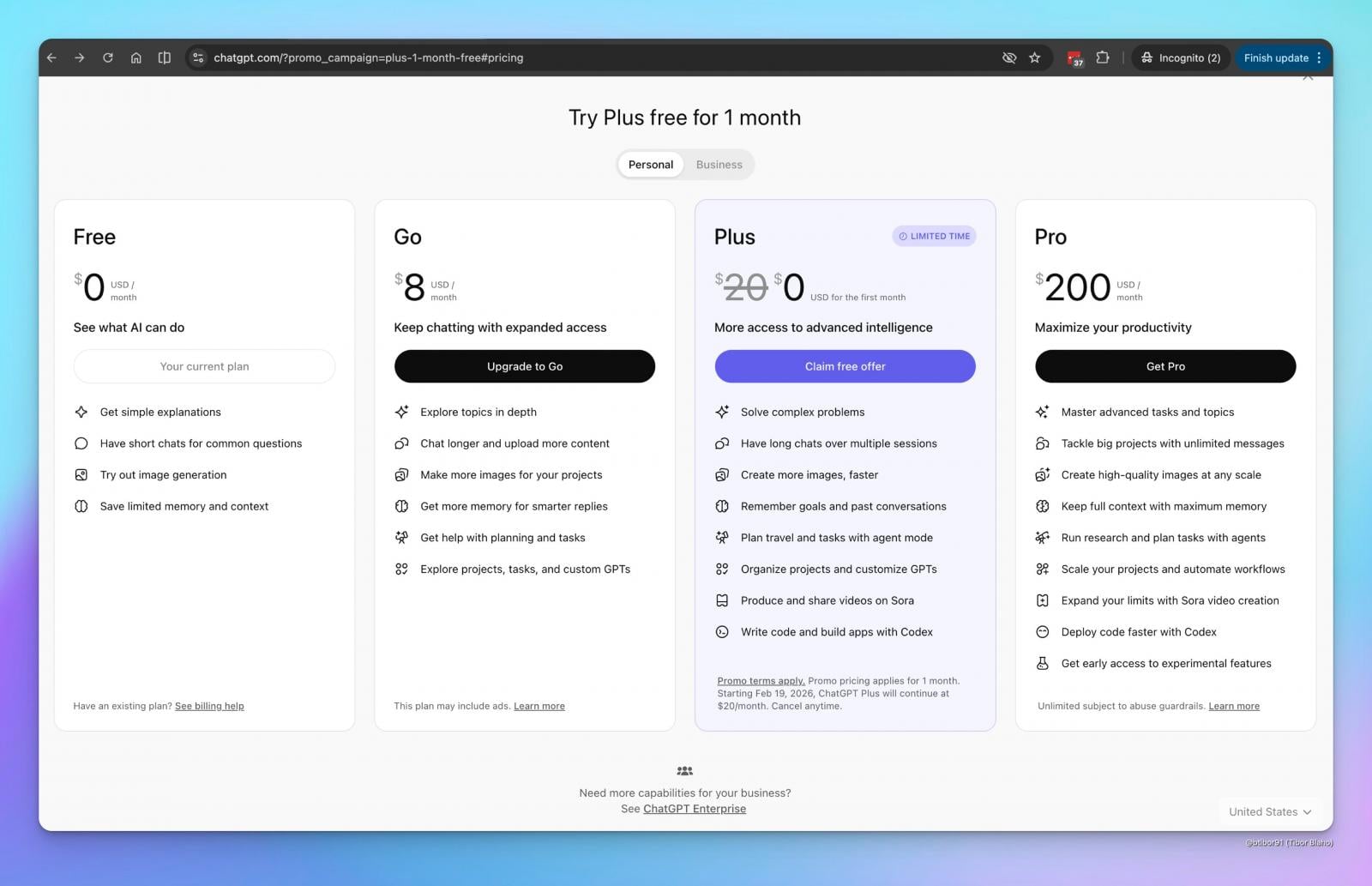
The landscape of generative artificial intelligence accessibility is undergoing a subtle but significant shift as OpenAI, the developer behind the globally recognized ChatGPT suite, begins piloting a new promotional strategy. While the company has meticulously tiered its offerings to monetize advanced features, recent observational data suggests a temporary relaxation of these paywalls, specifically targeting the highly valued ChatGPT Plus subscription, typically priced at $20 per month in key markets like the United States. This move, while currently appearing as a limited-time incentive, carries notable implications for user acquisition, retention strategies, and the overall perceived value proposition of premium AI services.
For context, OpenAI’s monetization model relies on a clear hierarchy of service tiers designed to segment users based on their computational needs and feature requirements. Historically, this structure has been critical to funding the intensive research and infrastructure required to maintain and advance the foundational models. While the precise details of the current subscription matrix can evolve, the core structure usually delineates between a foundational, likely ad-supported or rate-limited free tier, a mid-tier option (sometimes referred to in regional contexts like "GPT Go"), and the flagship ChatGPT Plus.
The significance of this promotional window cannot be overstated because, until this observed shift, the Plus tier was universally considered a non-negotiable paid feature. GPT Go, where available, represented a step up from the base free offering, perhaps providing marginally better speed or access during peak times, but it fundamentally lacked the robust feature set reserved for Plus subscribers. The sudden availability of the full Plus experience, even for a trial period, represents a substantial opportunity for the broader user base to sample capabilities previously reserved for paying customers.
Previous promotional activities had been noted, such as short-term complimentary access extended specifically to existing, loyal subscribers—a common tactic for securing long-term renewal or testing premium feature adoption rates among known users. However, the current iteration appears to be a broader, perhaps geographically targeted, campaign designed to onboard new, high-potential users or reactivate lapsed ones by providing unrestricted access to the platform’s pinnacle offering. The ability for users to activate this enhanced tier and subsequently cancel before the automatic renewal date—a standard 30-day trial mechanism—suggests a confidence in the product’s stickiness once users experience the enhanced performance metrics.

The core value proposition of ChatGPT Plus lies in its technical superiority and feature richness when benchmarked against its lower-tier counterparts. OpenAI explicitly positions Plus as the essential toolset for professional and intensive workloads. This includes tasks demanding high levels of cognitive processing, such as drafting complex legal or technical documents, performing sophisticated data synthesis and analysis, and engaging in deep, sustained academic or professional research.
Technically, the difference is manifested through several key performance indicators. Plus subscribers benefit from significantly higher message caps, mitigating the frustrating experience of hitting usage ceilings during critical work sessions. Furthermore, expanded memory and context window capabilities are crucial differentiators. The ability for the model to retain a far greater history of the conversation allows for more coherent, continuous workflows. For complex projects—like iteratively refining a software prototype or developing a comprehensive business strategy over several days—this extended memory prevents the model from losing crucial context, a fundamental limitation in less premium tiers. File upload capabilities, often critical for data analysis or providing source material for editing, are also typically prioritized for Plus users.
The impending introduction of advertisements across the Free and potentially the Go tiers serves as a powerful contextual backdrop for this promotion. The shift toward monetizing the free tier through advertising signals OpenAI’s maturing strategy to capture value from every segment of its user base. By introducing friction (advertisements) into the free experience while simultaneously offering a completely frictionless, premium experience for free for a month, the company creates a stark, tangible incentive for users to transition to paid subscriptions once the trial concludes. This is a classic ‘taste-test’ marketing approach, leveraging temporary scarcity and high performance to drive habit formation.
Industry Implications and Competitive Dynamics
This strategic promotion is not occurring in a vacuum; it is a calculated maneuver within a hyper-competitive artificial intelligence market. Competitors such as Google (Gemini Advanced), Anthropic (Claude Pro), and various specialized AI startups are aggressively vying for market share, particularly among enterprise users and high-volume developers.
From an industry perspective, offering the top-tier product for free is a high-cost, high-reward strategy aimed at cementing platform dominance. If a significant cohort of users integrates the advanced features of Plus—such as access to the latest large language models (LLMs), superior browsing capabilities, or advanced tool integration—into their daily professional routines during the free month, the switching cost becomes substantially higher. The friction associated with reverting to a limited free tier, or dealing with ads, becomes a significant deterrent.
Furthermore, this acts as a crucial feedback loop mechanism. By exposing a wider, more diverse set of professional users to the Plus feature set, OpenAI gains invaluable real-world performance data on the most demanding use cases. This data is critical for fine-tuning future model iterations and ensuring that the paid features remain genuinely differentiated and necessary for high-value tasks. It allows the company to validate the ROI justification for the $20 fee against the baseline offering.
Expert-Level Analysis: The Psychology of Perceived Value
From a behavioral economics standpoint, this promotion leverages the Endowment Effect and the concept of Loss Aversion. Once a user has "owned" the premium capabilities for 30 days—feeling the speed, enjoying the expanded context, and relying on the higher throughput—the removal of those features feels like a loss, rather than simply a return to the previous state. The perceived value of the Plus subscription inflates dramatically during the trial period.
Analysts often critique the $20 price point as potentially high for individual consumers, though it is generally considered competitive for professional-grade SaaS tools. By neutralizing the initial cost barrier, OpenAI shifts the user evaluation from "Can I afford this?" to "Can I afford not to have this?" This psychological pivot is far more effective in driving long-term conversion than simple feature comparisons.
The concurrent move to monetize the free tier with advertising is a deliberate pressure point. It ensures that even users who decline the Plus trial are subjected to a degradation of their baseline experience. This dual strategy—elevating the paid tier while slightly diminishing the free tier—compresses the value gap, making the transition to paid services feel more urgent and rational.
Future Impact and Trends
The success of this broad-based, time-limited Plus promotion will likely dictate OpenAI’s strategy for the remainder of the fiscal year. If conversion rates from the trial exceed internal benchmarks, we could see this become a standardized, cyclical marketing tactic, perhaps tied to major model releases or seasonal lulls in engagement.
Looking forward, this reflects a broader industry trend toward "Freemium Plus" models in AI. As foundational models become more democratized (e.g., open-source alternatives catching up on speed), the primary monetization battlefield shifts from access to the model itself to access to the experience—speed, reliability, advanced tooling integration (like code interpreters or data analysis environments), and an ad-free environment.
This strategic giveaway also anticipates the integration of more sophisticated AI agents. ChatGPT Plus is the gateway to the most capable versions of these future agents, which will require greater computational resources. By seeding the user base with the Plus experience now, OpenAI is preparing them for the next iteration of paid, agent-driven workflows, ensuring users are already accustomed to the infrastructure required to run them effectively.
In summary, what appears on the surface to be a simple discount is, upon closer examination, a sophisticated, multi-pronged marketing and product validation strategy. OpenAI is leveraging temporary generosity to solidify market positioning, gather crucial performance metrics under heavy load, and psychologically prime its user base for the inevitable monetization of an increasingly sophisticated AI ecosystem, all while simultaneously introducing friction points into its free offerings. The limited duration heightens the perceived scarcity, compelling immediate action from those seeking the best performance the platform currently has to offer.
