

The landscape of web navigation is on the precipice of a significant transformation, moving beyond simple query responses to genuine automated task execution within the browser environment. Google is currently deep in the internal testing phase of a crucial new feature for the Gemini integration within the Chrome browser, dubbed "Skills." This development signals a strategic shift from Gemini’s current role as a sophisticated, context-aware assistant to a proactive, goal-oriented digital agent capable of autonomously performing complex, multi-step operations across the web.
For months, the presence of Gemini within the desktop version of Chrome, initially available in the United States, has served as an advanced informational layer over the browsing experience. Users could leverage this AI to distill complex technical documentation, generate succinct summaries of lengthy articles, or perform comparative analysis across multiple open tabs. For instance, a user planning a trip could prompt Gemini to synthesize pricing, availability, and key features from separate tabs dedicated to airfare, lodging, and local activities, outputting a single, cohesive itinerary draft. This functionality established Gemini as an intelligent "helper"—a powerful summarizer and cross-referencer.
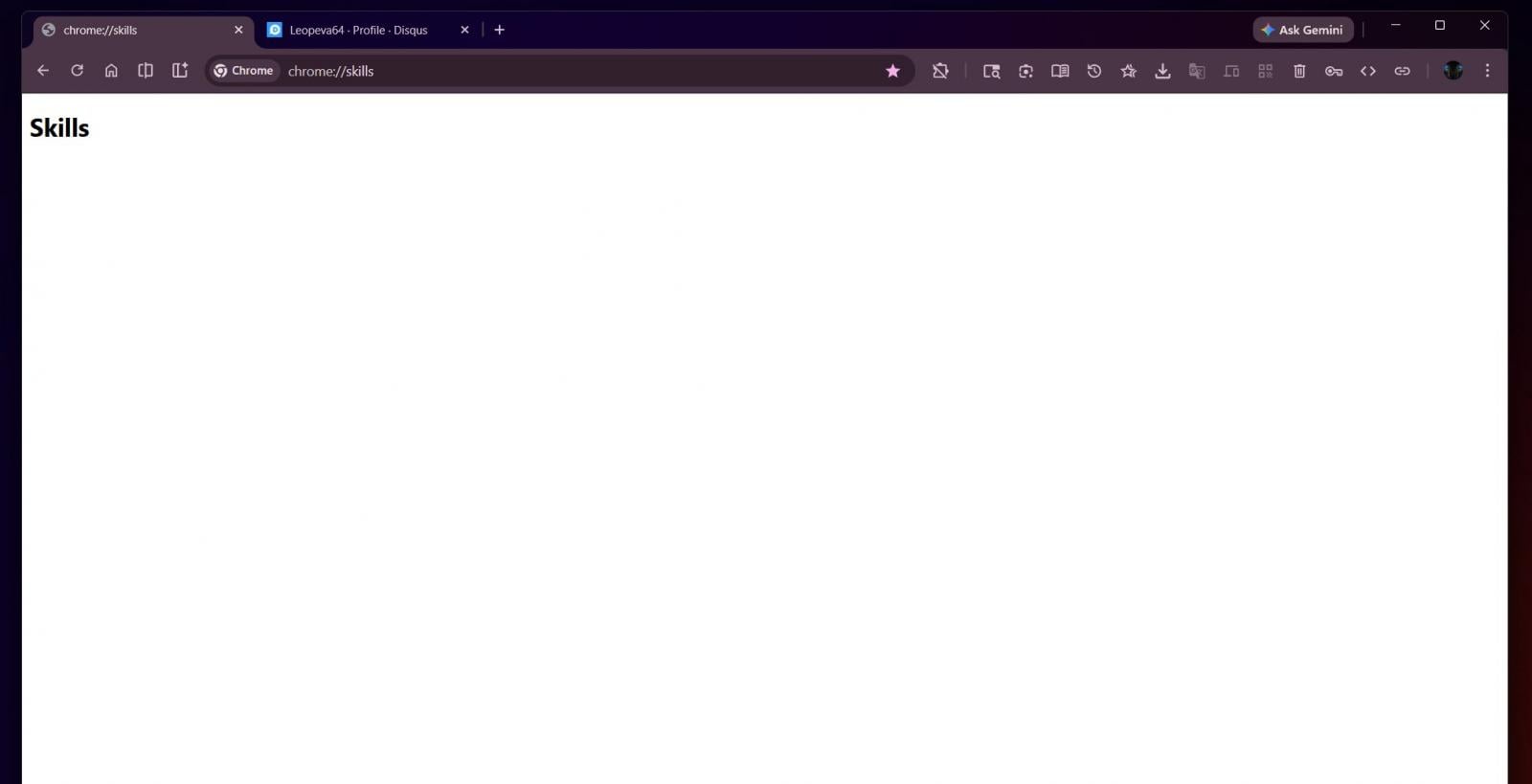
However, the newly surfaced "Skills" feature indicates that Google is rapidly progressing toward the deployment of what the company previously described as a true "agent" within Chrome. This shift is foundational. An assistant reacts to explicit requests; an agent anticipates needs, executes sequences of actions, and manages workflows. The evidence for this architectural evolution was discovered through internal builds, specifically pointing to a new, dedicated configuration page accessible via the chrome://skills: address.
The existence of this internal endpoint suggests a structured framework for action definition. Instead of relying solely on generalized natural language understanding to infer user intent for action, "Skills" appear to be discrete, definable capabilities. This interface allows developers or perhaps sophisticated end-users to define these capabilities with a specific name and a set of precise instructions. These instructions essentially program the AI model to interact with the browser environment—manipulating tabs, extracting specific data structures, initiating form fills, or navigating predefined paths on websites—to achieve a designated outcome.
Deeper Context: The Agentic AI Paradigm
To fully appreciate the implications of "Skills," one must understand the industry’s trajectory toward agentic AI. Large Language Models (LLMs) like Gemini excel at reasoning and content generation, but their utility is fundamentally limited until they can reliably interact with the real world or complex software ecosystems. The browser, being the primary interface for most digital activity, represents the most critical battlefield for this next generation of AI integration.
Previous attempts at browser automation often relied on brittle scripting or rudimentary macro recording. "Skills" represent an attempt to imbue the browser itself with high-level cognitive capability. By providing Gemini with access to defined, repeatable actions—or "Skills"—Google is essentially building a tool-use architecture directly into the browser core. This is far more robust than simply asking Gemini to "write me an email"; it enables Gemini to be told, "Use the ‘Book Flight’ skill, inputting these parameters, and then use the ‘Compare Prices’ skill on the results."
This development mirrors intense competition across the tech sector. Microsoft has integrated Copilot deeply into Windows and Edge, emphasizing proactive workflow management. Apple is expected to deploy advanced on-device intelligence across its ecosystem. Google’s strategy, focused squarely on Chrome, leverages its unparalleled market share to embed its foundational AI models directly at the point of digital interaction.
Industry Implications: Redefining Browser Utility and Competition
The rollout of "Skills" carries profound implications for user experience, software development, and competitive dynamics.
1. The Death of Tab Overload: The current browsing experience is often characterized by fragmented attention—the infamous "tab sprawl." The ability of Gemini to coordinate actions across disparate web properties without constant manual context switching (e.g., the travel planning example) moves the browser from being a container for websites to an orchestrator of digital tasks. If Gemini can reliably execute complex tasks like "research the top three competitors in this market segment, download their latest annual reports, and summarize the Q4 revenue figures into a spreadsheet," the value proposition of the browser shifts dramatically.
2. Competitive Differentiation: For Google, this is a critical move to solidify Chrome’s moat. If the most powerful AI agent capabilities are intrinsically linked to the browser environment, users have a significant incentive to remain within the Chrome ecosystem, even if competing LLMs offer marginally better raw conversational ability. This embeds AI functionality deeper than simple sidebar chat features.
3. Developer Ecosystem and Customization: The configuration page structure suggests a potential pathway for third-party integration, or at least deep user customization. If users can define and save their own "Skills," Chrome moves toward being a highly personalized operating environment atop the web. While initial "Skills" will likely be native to Google’s roadmap (e.g., Calendar integration, YouTube interaction), the architecture hints at future extensibility, potentially allowing specialized workflows for researchers, developers, or business analysts.
Expert Analysis: The Security and Privacy Tightrope Walk
The transition from passive summarization to active agent execution introduces significant technical and ethical hurdles, primarily centered on security and privacy. An agent that can navigate, input data, and execute actions on behalf of a user must possess elevated permissions and a highly sophisticated understanding of boundaries.
Data Access and Contextual Integrity: For Gemini to effectively use a "Skill" to, say, book a flight, it must be granted access to user preferences, potentially saved credentials (though ideally managed via secure token exchange), and the specific context of the active webpage. This level of access demands ironclad security protocols. Google’s success here hinges on transparent permission models. If a user defines a "Skill," they must explicitly understand what data that skill is allowed to read and what actions it is allowed to take. Any ambiguity could lead to unintentional data leakage or unauthorized transactions.
The Agentic Sandbox: The implementation likely requires a sophisticated "sandbox" environment for executing Skills. This sandbox must carefully mediate the AI’s access to the Document Object Model (DOM) and network requests. If Gemini misinterprets an instruction, the system needs safeguards to prevent it from looping indefinitely, spamming an API, or injecting malicious scripts—even if the script is generated internally by the model’s own reasoning process.
Natural Language vs. Explicit Instruction: The tension between the flexibility of natural language prompts and the precision required for automated tasks is a key analytical point. Current LLMs sometimes "hallucinate" steps or forget intermediate states. A robust "Skills" framework must translate ambiguous human requests into deterministic execution plans. This requires layered verification: the model must confirm its interpretation of the user’s request against the defined parameters of the Skill before execution begins.
Future Impact and Emerging Trends
The introduction of "Skills" is not merely an incremental update; it represents a foundational step toward truly ambient computing within the browser. Looking ahead, this capability will drive several key trends:
1. Hyper-Personalized Workflows: As these capabilities mature, the focus will shift toward long-running, multi-day tasks. Imagine asking Gemini to "Monitor these five investment news sites daily, alert me only if a specific CEO resigns, and compile a summary report every Friday." This requires the agent to maintain state and resume tasks across browser sessions—a significant leap beyond current capabilities.
2. Deeper Ecosystem Integration Beyond Search: The roadmap mentioned tighter integration with core Google applications like Calendar, YouTube, and Maps, enabling cross-app task completion without tab switching. This suggests that Gemini will gain access to APIs or structured data endpoints for these services. For instance, a user could ask, "Find the last five videos I favorited on YouTube related to astrophysics, check my Calendar for next Tuesday afternoon, and if I’m free, create a reminder to watch them then." This level of integration turns the browser into a unified command center, effectively collapsing the utility of multiple distinct applications into one AI interface.
3. Redefining Web Accessibility: For users with specific cognitive or physical needs, an agent capable of executing complex sequences based on simple voice or text commands offers unprecedented accessibility. If a user can articulate a multi-step process that would typically require fine motor skills or complex navigation, the "Skills" framework provides the mechanism for that process to be executed reliably.
4. The Rise of the "Browser Operating System": Ultimately, if the browser can manage information aggregation, task execution, and communication across disparate web services using high-level instructions, the browser moves closer to functioning as a lightweight operating system layer for the internet. This challenges traditional desktop application paradigms, favoring context-rich, web-native automation.
The internal testing of Gemini "Skills" in Chrome is a clear signal that Google views the next iteration of the web experience as one driven by autonomous agents embedded directly into the primary access point—the browser. The transition from AI helper to AI doer is underway, promising profound changes in how users interact with the vastness of the World Wide Web. The success of this initiative will depend not only on the raw intelligence of Gemini but on the robustness, security, and transparency of the "Skills" framework that grants it operational control.
