

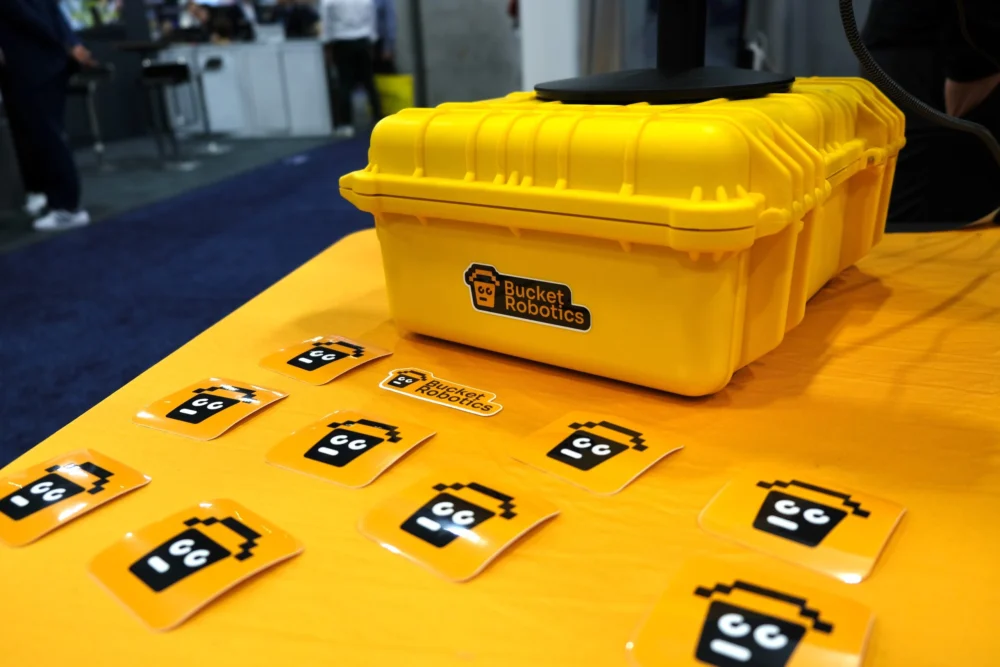
The road to the 2026 Consumer Electronics Show (CES) was less a glamourous flight into the Nevada desert and more a grueling 12-hour overland trek through inclement weather. For Bucket Robotics, a Y Combinator-backed startup specializing in advanced vision systems for industrial quality control, the journey symbolized the gritty reality of launching deep-tech innovation. CEO and founder Matt Puchalski, unwilling to risk crucial booth components being stranded by delayed flights, eschewed conventional logistics. Instead, he personally commandeered a packed Hyundai Santa Fe, transforming the cramped SUV into a mobile showcase for the burgeoning firm’s debut on the world stage.
Puchalski, recalling the tight squeeze upon arrival at the Las Vegas Convention Center’s automotive-focused West Hall, noted the irony of the situation. This low-key arrival marked the initiation of the young San Francisco-based company’s presence at an event defined by monumental scale and hyperbolic future promises. While Bucket Robotics was numerically insignificant among the thousands of exhibitors, its strategic location and highly specialized technology drew immediate, concentrated interest, confirming the founder’s conviction that the arduous journey was an indispensable investment.
The Pedigree of Precision: From AVs to QC
Puchalski’s relentless dedication and deep understanding of high-stakes engineering are rooted in his extensive background in autonomous vehicle development. Before founding Bucket Robotics, he spent nearly a decade navigating the complexities of machine perception and reliability at industry titans, including Uber’s self-driving division, Argo AI, Ford’s Latitude AI subsidiary, and SoftBank-backed Stack AV. This history provided him with an unparalleled network and a unique perspective on the intersection of computer vision, sensor fusion, and industrial deployment—a skillset critical to developing sophisticated automated inspection systems.
The founder’s presence throughout CES reflected this background. He was not merely confined to his modest booth; he was perpetually engaged in the ecosystem. Observers noted his active participation in late-night industry networking functions and his focused, technical debates in hotel lobbies, such as a lengthy discussion with mobility startup veteran Sanjay Dastoor (of Skip and Boosted fame) concerning the delicate balance between quality assurance stringency and achievable manufacturing yield—a foundational challenge for any physical goods producer.
This intense engagement underscored a strategic necessity for early-stage B2B startups at massive events like CES: visibility is earned not just through booth design, but through intellectual contribution and continuous outreach.
Disrupting the Data Bottleneck in Surface Inspection
Bucket Robotics, launched during YC’s Spring 2024 batch, addresses one of the most persistent, yet overlooked, challenges in modern manufacturing: the automated inspection of surface quality. While conventional quality control (QC) systems have largely mastered structural integrity checks (e.g., confirming a part’s dimensions or load-bearing capacity), the assessment of aesthetic or subtle cosmetic flaws remains stubbornly resistant to full automation.
Puchalski often illustrates the problem using the example of a car door handle. Ensuring the handle is structurally sound for safety and function is a solved engineering problem. However, confirming that the handle’s surface—which a customer touches daily—is flawlessly finished, possessing the correct color gradient, and free from microscopic scuffs, burns, or material blemishes, presents a significantly harder challenge.
This difficulty stems from the inherent nature of surface defects. They are often highly variable, context-dependent (affected by lighting, material gloss, and texture), and require subjective human judgment to classify. As Puchalski wryly notes, this complexity has traditionally resulted in high-volume manufacturers relying on dedicated human inspectors—the metaphorical "dudes in Wisconsin"—to perform repetitive, fatiguing, and ultimately inconsistent manual checks.
The core innovation of Bucket Robotics lies in its methodology for overcoming the industrial AI’s greatest hurdle: the scarcity of labeled defect data. Training a robust vision system conventionally requires capturing millions of real-world images of flawed parts, manually annotating the defects, and cycling that data through intensive training pipelines. This process is prohibitively slow and expensive, especially for manufacturers dealing with diverse, low-volume components or rapid design changes.
Bucket Robotics bypasses this constraint entirely through a synthetic data generation pipeline rooted in the part’s Computer-Aided Design (CAD) files.
The CAD-to-Defect Simulation Paradigm
The company’s software ingests the CAD blueprint of the component. It then utilizes advanced computational geometry and material simulation techniques to generate vast datasets of photorealistic virtual defects—simulating burn marks, micro-fractures, subtle color inconsistencies, and surface bumps—directly onto the digital model.
This process yields two critical advantages:
- Zero-Shot Deployment: The vision software is trained on perfect, scalable synthetic data, eliminating the need for manual data labeling or extensive real-world data collection cycles.
- Rapid Adaptability: Since the model is linked directly to the CAD file, any change in the product’s design or the manufacturing line configuration can be instantly reflected in a new synthetic training set, allowing the quality inspection model to be deployed and adapted "in minutes," according to the company.
Crucially, the technology is designed for seamless integration. Puchalski emphasized that Bucket Robotics does not require customers to rip out and replace existing production line hardware. The AI software can integrate with existing cameras and sensors, significantly reducing the capital expenditure barrier for adoption and accelerating time-to-value for manufacturers seeking to modernize their quality assurance processes.
Industry Implications: Addressing the Onshoring Imperative
The timing of Bucket Robotics’ entry into the market aligns perfectly with macro-economic and geopolitical shifts driving the resurgence of domestic manufacturing. The pressure to onshore production, driven by supply chain fragility experienced during the pandemic and increased geopolitical tensions, mandates higher efficiency and lower defect rates in localized production environments.
Automating surface inspection directly addresses a major cost component in manufacturing: the Cost of Poor Quality (COPQ). In high-volume sectors like automotive, minor cosmetic defects can lead to significant waste, costly rework, or, worse, brand damage if flaws reach the consumer. By introducing deterministic, tireless, and objective inspection criteria, AI vision systems promise to reduce scrap rates, optimize material usage, and accelerate production cycles—all vital levers for making domestic manufacturing competitive.
Expert analysis suggests that surface quality inspection automation is the final frontier in industrial machine vision. Structural defects are binary—a weld either holds or it doesn’t. Surface defects exist on a spectrum, requiring AI models capable of nuanced discrimination. Bucket Robotics’ approach—leveraging simulation—moves this challenge from a data acquisition problem to a sophisticated physics and graphics simulation problem, a domain where significant computational gains are still being realized.
The Strategic Value of Dual-Use Technology
The startup’s early customer base, spanning both the automotive industry and the defense sector, highlights its strategic positioning as a "dual-use" company. This designation—serving both commercial and national security applications—is increasingly favored by venture capital investors due to the inherent market stability and potential for large, government-backed contracts that defense work provides.
In the defense industry, the quality and reliability of components, whether for ground vehicles, specialized hardware, or aerospace systems, is non-negotiable. Applying high-fidelity surface inspection ensures that critical components meet stringent military specifications, where a microscopic flaw could compromise mission success. The ability of Bucket Robotics to generate highly specific training data for proprietary parts, without requiring sensitive real-world images to leave secure facilities, makes its synthetic data approach uniquely valuable in the defense supply chain.
For the automotive sector, the focus remains on mass production efficiency and brand perception. For the defense sector, the emphasis is on mission assurance and extreme reliability. Bucket Robotics’ ability to successfully pivot its core AI platform to satisfy these disparate, high-bar requirements validates the robustness and flexibility of its synthetic vision architecture.
The Crucible of CES: Validation and Velocity
The intense, high-stakes environment of CES served as an essential validation platform for the nascent technology. Puchalski described the first two hours after the show floor opened as "intense," characterized by a steady stream of executives, robotics engineers, and automation specialists scrutinizing the demonstration. The immediate engagement went beyond casual inquiry; attendees were conducting "real technical discussions," probing the underlying architecture and integration capabilities of the software.
This consistent, high-level interest throughout the week confirmed that Bucket Robotics was addressing a genuine and acutely felt market need, rather than merely pitching a novel gadget. The contacts made at the show—spanning prospective customers, strategic manufacturing partners, and venture capital representatives—immediately translated into post-conference velocity. In the weeks following CES, Puchalski dedicated significant time to follow-up calls, transitioning initial interest into tangible commercial and fundraising discussions.
Future Trajectories and Workforce Evolution
Surviving the logistical and commercial gauntlet of CES is merely the preamble. The true challenge now facing Bucket Robotics involves the monumental task of scaling operations, securing subsequent funding rounds, and executing complex commercial deployments across disparate industrial environments.
Looking forward, the company’s technology signals a fundamental shift in how quality control roles are defined. Puchalski maintains that the intent of automation is not to eliminate the human element, but to redefine it. The role of the human inspector—the proverbial "dudes in Wisconsin"—transcends simple defect spotting. These experienced professionals are often responsible for identifying the root cause of the flaw, tracing it back to a machine calibration error, a material inconsistency, or a process failure.
By offloading the tedious, high-volume task of aesthetic inspection to tireless AI systems, Bucket Robotics frees human experts to focus on higher-value activities: process optimization, root cause analysis, and strategic improvement of the manufacturing line. This perspective aligns with the broader Industry 5.0 trend, which emphasizes the synergistic collaboration between highly efficient automated systems and skilled human decision-makers.
Ultimately, Bucket Robotics is positioned at the forefront of the synthetic data revolution in industrial applications. Their success demonstrates that for complex visual inspection tasks, the generation of high-quality, perfectly labeled simulated data can often be more effective and scalable than relying on the messy, expensive collection of real-world examples. As global manufacturing continues its rapid adoption of AI to secure supply chains and boost domestic output, companies capable of delivering reliable, rapidly deployable vision solutions without the traditional data bottleneck—like Bucket Robotics—will be crucial infrastructure providers in the next phase of the industrial revolution. The journey from a rain-soaked drive to the vibrant show floor of CES has positioned them to tackle decades-old manufacturing challenges with a distinctly 21st-century solution.
