

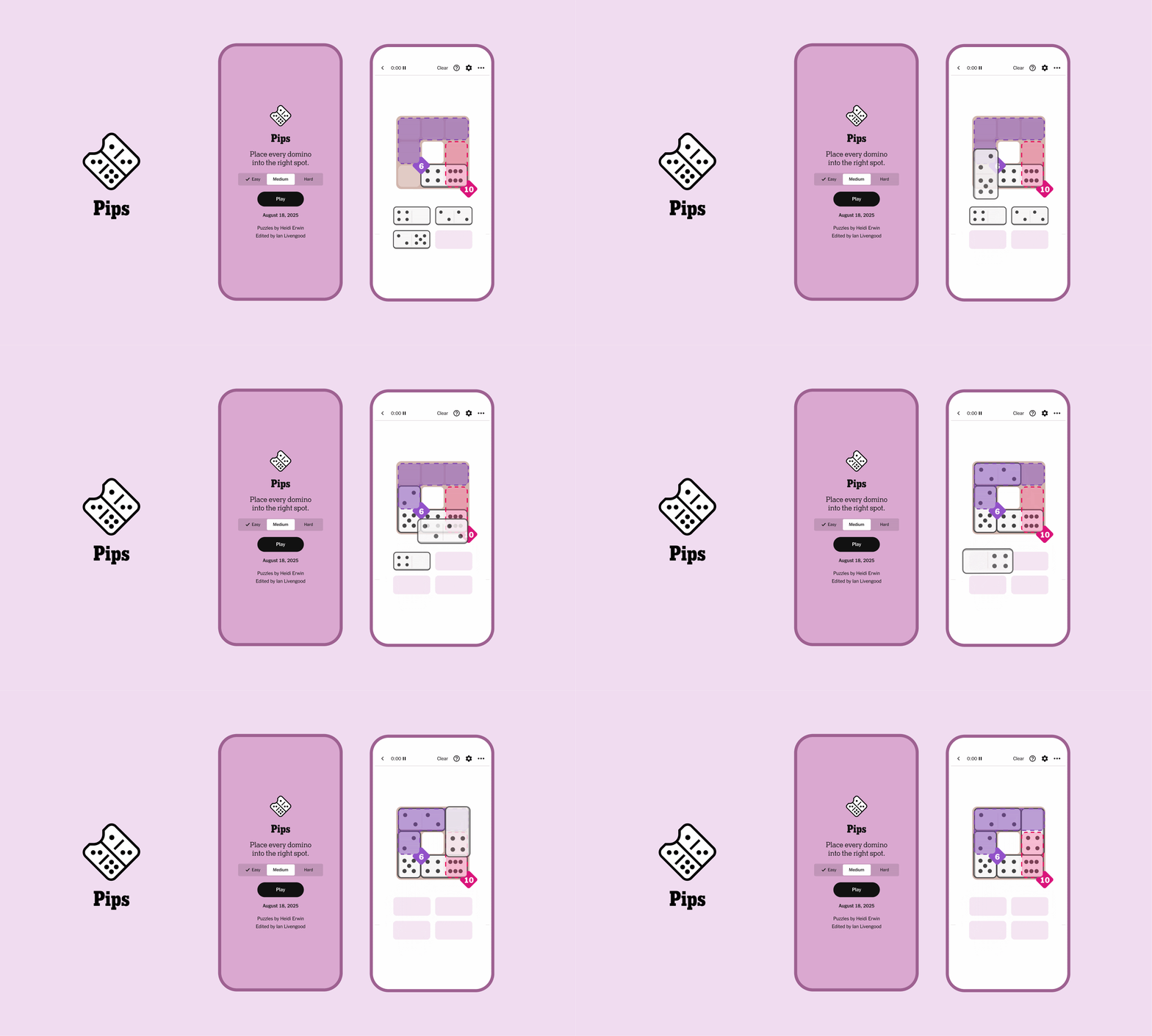
The landscape of digital gaming has undergone a profound transformation over the last decade, shifting from high-fidelity, resource-intensive experiences to the elegant simplicity of daily logic puzzles. Among the most compelling entries in this genre is the domino-based grid challenge known as Pips. As we navigate the specific hurdles of the Sunday, January 18 puzzles, it is essential to understand not just the "how" of the solution, but the "why" of the game’s design and its place within the broader ecosystem of cognitive entertainment.
The Evolution of the Digital Logic Puzzle
The rise of games like Pips is not an isolated phenomenon. It represents a convergence of classical board game mechanics—specifically dominoes and Sudoku—with the "daily habit" loop that has become a cornerstone of modern digital media. Publishers have recognized that providing a consistent, mentally stimulating challenge can drive user retention more effectively than traditional long-form content. These puzzles serve as a "digital palate cleanser," offering a discrete beginning, middle, and end in an era of infinite scrolls.
Pips, in particular, leverages the concept of "constrained optimization." Players are presented with a finite set of resources—dominoes with varying numerical values (pips)—and a grid with predefined mathematical constraints. The beauty of the game lies in its rigidity; there is often only one path to success, requiring the player to engage in deductive reasoning and spatial visualization.
Understanding the Mechanics of the Grid
Before diving into the January 18 solutions, one must master the symbology of the Pips interface. The grid is divided into multicolored zones, each representing a unique condition. Some zones require a specific sum (e.g., a "Blue 27" group requires the pips of all domino halves within that zone to total 27). Others demand equality (the "=" sign) or inequality (the "≠" sign). There are also directional constraints, such as "greater than" (>) or "less than" (<) symbols, which apply to the totals within those specific colored regions.
The difficulty tiers—Easy, Medium, and Hard—scale the complexity by increasing the number of dominoes and tightening the mathematical bottlenecks. On a Sunday, the difficulty is traditionally tuned to its peak, offering a "Hard" board that serves as a final exam for the week’s logic training.
Analyzing the Sunday, January 18 Challenge
Today’s puzzles presented a significant jump in complexity. Even the "Easy" tier utilized a deceptive layout that required early commitment to specific domino placements. The "Medium" board expanded the grid, introducing more "sum-based" constraints that necessitated a quick mental tally of the available pips. However, the "Hard" board is where the true strategic depth was revealed.
The Hard puzzle for January 18 featured a distinctive, sprawling layout that some enthusiasts have compared to a frog or an alien face. This aesthetic choice is more than just visual; the narrow "corridors" of the grid create high-pressure points where a single incorrect rotation of a domino can lead to an unsolvable board in the final stages.
The Hard Puzzle: A Step-by-Step Logic Walkthrough
Solving the Hard Pips puzzle requires a "bottleneck-first" strategy. Rather than starting at the edges, an expert player looks for the most restrictive zones. On today’s board, the Blue 27 group was the primary anchor. To reach a sum of 27 across five tiles, one mathematically requires a combination of high-value pips, specifically three 5s and two 6s. However, starting directly with the Blue 27 can be a trap, as those high-value tiles are also needed to satisfy the Purple 12 and Orange 6 conditions.
Step 1: Establishing the Perimeter
The most efficient entry point for the January 18 board was the Orange 6 tile leading into the Blue 2 zone. By placing the 6/1 domino here, you satisfy the high-value requirement for the Orange zone while setting up a low-value entry into the Blue 2. This immediately dictates the next move: the 1/0 domino must drop from the Blue 2 into the Pink "=" (equality) zone. This sequence is a perfect example of a "forced move" in logic puzzles. To complete the Pink equality chain, the 0/0 domino is the only viable candidate, followed by the 0/2 domino transitioning into the Orange 4 zone.
Step 2: Managing the Mid-Grid Intersections
With the left side of the "face" established, the focus shifts to the central constraints. The Pink 5 and Purple 3 zones are tightly packed. Placing the 5/1 domino from Pink 5 into Purple 3 allows for the 1/1 double to fill the remaining Purple 3 slots. This leaves the 2/1 domino to bridge Orange 4 and Green 1. A critical move here is the placement of the 0/6 domino, which moves from Green 1 into the Purple 12 zone. This 6 is vital for the Purple 12 sum, which is one of the most difficult conditions to meet on this specific board.

Step 3: Solving the Blue 27 Core
Now that the peripheral zones have "spent" the necessary lower-value pips, the player can tackle the high-sum Blue 27. The 6/3 domino transitions from Purple 12 into the Pink 7 zone, while the 4/3 domino slots from Pink 7 into the Dark Blue 6 area. This clears the way for the 3/5 and 6/5 dominoes to be placed in the Blue 27 zone. At this stage, the board begins to lock into place.
Final Solution Phase:
The remaining pieces must be placed with precision. The 6/2 domino bridges Blue 27 and Dark Blue 6, while the 2/2 double fills the remaining space in Dark Blue 6. Finally, the 5/4 domino moves from Blue 27 into the Green 10 zone, with the 3/3 double providing the final pips needed to satisfy the Green 10 sum.
Industry Implications: Why Pips Matters
The success of Pips and similar logic puzzles has significant implications for the digital technology industry. We are seeing a shift away from "attention-economy" games that rely on loot boxes or infinite loops, and a return to "merit-economy" games. These are puzzles where the value is derived from the user’s own cognitive effort.
For developers, the challenge is creating "solvable but difficult" content. The January 18 Hard puzzle is a masterclass in this balance. By ensuring there were "no free tiles"—meaning every single square on the board was part of a constrained zone—the designers forced the player to account for every single pip in the set. This level of density increases the "Aha!" moment upon completion, which is the primary driver of the game’s viral success.
Furthermore, these puzzles are becoming a key part of "bundled" digital subscriptions. As the cost of customer acquisition rises, tech companies are using logic games to create "sticky" platforms. A user who visits a site every morning for their Pips solution is significantly less likely to cancel their subscription than one who only visits for occasional news updates.
Expert Analysis: The Cognitive Load of Domino Puzzles
From a neuropsychological perspective, Pips engages several key areas of the brain. The spatial rotation of the dominoes activates the parietal lobe, while the mathematical summation and constraint-checking engage the prefrontal cortex. Sunday puzzles, like the one analyzed above, specifically test "working memory." A player must hold the sum of a zone in their head while simultaneously calculating how the remaining half of a domino will impact the next zone.
The January 18 board was particularly taxing because it lacked "low-stakes" areas. In many Pips boards, there are blank squares that act as "overflow" areas where any domino half can be placed. Today’s board offered no such luxury. Every move had a downstream consequence, making it a "tight" puzzle that rewarded forward-thinking players and punished those who moved impulsively.
Future Trends in Digital Puzzle Design
Looking ahead, we can expect the Pips formula to evolve. One likely trend is the integration of procedural generation informed by artificial intelligence. While the current puzzles appear to be hand-crafted to ensure a satisfying "flow," AI could theoretically generate infinite permutations of these constraints, tailored to a player’s specific skill level.
Additionally, we may see the rise of "social logic." Imagine a version of Pips where players contribute dominoes to a massive, global grid, or where the "Hard" puzzle is a collaborative effort. There is also potential for augmented reality (AR) integration, where players can "see" the domino grid on their physical tables, blending the tactile history of the game with modern digital interfaces.
For now, the Sunday, January 18 Pips board remains a testament to the enduring appeal of a well-constructed logic problem. It reminds us that in a world of complex algorithms and chaotic data, there is a deep, fundamental satisfaction in finding the one place where every piece fits perfectly. Whether you struggled with the Blue 27 or breezed through the Orange 6, the journey through the grid is a valuable exercise in clarity and persistence.
