

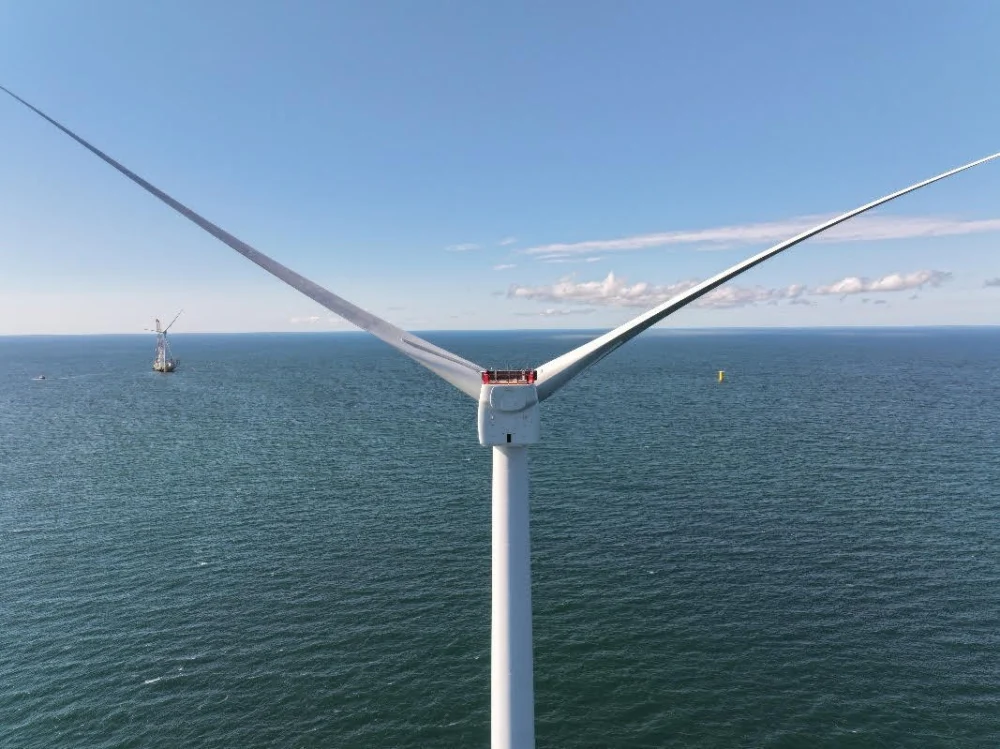
A critical series of judicial decisions this week has decisively invalidated the Trump administration’s abrupt attempt to halt several high-profile offshore wind energy projects along the U.S. East Coast, effectively clearing the path for the immediate resumption of construction activity. These rulings represent a significant affirmation of regulatory stability and contractual integrity within the nascent but crucial American renewable energy sector, directly challenging an executive action widely perceived as politically motivated.
The legal setbacks originated from the Department of the Interior’s (DOI) sudden stop-work order issued in December, which targeted five specific projects encompassing approximately six gigawatts (GW) of planned generating capacity. The administration cited vague national security concerns, specifically potential interference with critical radar operations, as the basis for the 90-day construction moratorium. Following swift legal challenges by the developers, federal judges in multiple jurisdictions have granted injunctive relief, allowing three major projects to proceed: Revolution Wind (located off the coasts of Rhode Island and Connecticut), Empire Wind (situated near New York), and the massive Coastal Virginia Offshore Wind (CVOW) project.
The immediate resumption of work is a major relief for the developers—including Equinor, Ørsted, and Dominion Energy—who faced substantial financial penalties and supply chain disruptions due to the sudden regulatory paralysis. The timing of the initial order, just days before the Christmas holiday, amplified the industry’s perception that the action was punitive and designed to maximize disruption rather than address legitimate technical concerns through established regulatory channels.
The Failure of Administrative Justification
The legal proceedings quickly revealed fundamental weaknesses in the government’s justification for the construction halt. Developers, arguing under the Administrative Procedure Act (APA), contended that the DOI’s order was "arbitrary and capricious"—a high legal bar that challenges the agency’s reasoned decision-making process.
In separate hearings in Virginia and Washington, D.C., federal judges exhibited profound skepticism regarding the administration’s rationale. U.S. District Judge Carl Nichols, an appointee of President Trump, delivered particularly sharp criticism during the hearing for Equinor’s Empire Wind project. Judge Nichols highlighted the administration’s failure to adequately address or even acknowledge the plaintiff’s core arguments regarding the arbitrary nature of the order. He pointedly noted that the government’s legal briefs failed to substantively engage with the allegation that the action lacked a rational basis.
Crucially, Judge Nichols questioned the logical disconnect between the stated concern and the remedy imposed. If the primary national security threat stemmed from operational interference—the reflection of radar waves by spinning turbine blades—why did the government mandate a halt to construction activities, such as foundation installation and cable laying, which do not inherently generate radar interference? This judicial observation underscored the developers’ argument that the order was grossly overbroad and disproportionate to the alleged threat.
Similarly, U.S. District Judge Jamar Walker, presiding over the Coastal Virginia Offshore Wind case brought by Dominion Energy, found the Interior Department’s directive to be excessively broad when evaluated against the specific context and advanced permitting stage of the Virginia project. These rulings collectively signal that executive authority, even when invoking national security, must adhere to established legal and administrative standards, including demonstrating a clear link between the perceived threat and the action taken.
Navigating the Radar Conundrum
While the courts rejected the manner in which the administration imposed the halt, the underlying concern regarding radar interference is a technically valid and long-standing challenge for large-scale offshore wind development globally. Rotating turbine blades can scatter or block radar signals, creating "clutter" that can degrade the effectiveness of military, aviation, and weather radar systems.
However, this is not an insurmountable obstacle. The process of siting and permitting offshore wind farms in the U.S. involves extensive, multi-year coordination between the Bureau of Ocean Energy Management (BOEM), the Department of Defense (DoD), the Federal Aviation Administration (FAA), and the National Oceanic and Atmospheric Administration (NOAA). This coordination is specifically designed to identify and mitigate conflicts, often resulting in developers adjusting project layouts, turbine locations, and hub heights.
Expert analysis confirms that the issue is primarily a technical one, solvable through engineering and technological upgrades. Solutions include:
- Siting Adjustments: Placing wind farms in areas that maintain safe distances or are shielded from critical radar lines of sight.
- Advanced Radar Systems: Upgrading existing radar infrastructure to newer, sophisticated systems equipped with advanced processing algorithms capable of filtering out the specific spectral signature generated by whirling turbine blades without compromising target detection.
- Turbine Technology: Designing stealthier turbines or incorporating radar-absorbing materials, though these solutions are often complex and costly.
The judges’ consensus was that the administration bypassed these established, collaborative mitigation pathways in favor of an arbitrary shutdown, suggesting that the underlying motive was disruption rather than genuine national security remediation.
Industry Implications: Stabilizing the Investment Climate
The series of favorable rulings provides desperately needed regulatory certainty for the burgeoning U.S. offshore wind supply chain. Prior to the halt, the industry was already grappling with headwinds, including inflationary pressures, increased component costs, and maritime labor scarcity. The unexpected 90-day stop order introduced a severe element of political risk that threatened to undermine long-term capital investment decisions.
Global financial markets and major energy conglomerates rely on predictable regulatory timelines. When an administration can unilaterally and without robust legal justification freeze multi-billion dollar infrastructure projects, it significantly increases the risk premium required by investors. This instability can deter European developers, who possess the most advanced offshore wind expertise, from committing fully to the U.S. market.
With these rulings, developers Equinor, Ørsted, and Dominion can now accelerate their procurement and deployment schedules, minimizing costly delays associated with specialized installation vessels and contracted labor. The industry views this judicial intervention as a critical safeguard against politically motivated regulatory interference, reinforcing the contracts and leases previously granted under federal authority.
Two major projects still await resolution, underscoring that the legal battle is not entirely over. Ørsted’s Sunrise Wind project has a scheduled court hearing, while developers for Vineyard Wind 1, which achieved financial close shortly before the legal disruption, only recently filed their own challenge. The outcomes of these remaining cases will further solidify the legal framework for the entire sector.
Grid Necessity and Economic Imperatives
The successful deployment of these East Coast offshore wind projects is not merely an environmental objective; it is an economic necessity critical for stabilizing the electrical grids serving the most densely populated and energy-intensive regions of the country.
The East Coast, particularly the Northeast and Mid-Atlantic, hosts major metropolitan hubs and serves as a global nexus for high-tech infrastructure, including massive data center campuses. These regions currently face some of the highest wholesale and retail electricity costs in the nation. Furthermore, regional grid operators, such as the organization managing the Mid-Atlantic transmission system, have recently faced intense scrutiny due to persistent electricity price volatility and reliability concerns, especially during extreme weather events.
Offshore wind offers a unique and powerful solution to these structural grid challenges. Unlike terrestrial solar or onshore wind, which peak during specific daily or seasonal cycles, offshore wind resources tend to be strongest and most consistent during periods of high demand, particularly winter months, and often exhibit a better correlation with regional load profiles.
According to Department of Energy (DOE) studies published recently, the East Coast possesses the technical potential to support up to 110 GW of offshore wind capacity by 2050. Achieving this capacity would fundamentally reshape the regional energy landscape, providing a massive influx of firm, clean power capable of offsetting reliance on expensive, often volatile, fossil fuel generation.
Economically, offshore wind has rapidly matured into one of the most cost-competitive forms of new utility-scale generating capacity, often rivaling or undercutting the Levelized Cost of Energy (LCOE) of combined-cycle natural gas plants, according to leading financial analyses. By introducing a massive volume of affordable, long-term contracted power, these projects possess the potential to significantly slow or even reverse the decade-long trend of escalating regional electricity prices, benefiting consumers and large industrial users alike, especially the power-hungry data center industry.
The Macro View: A National Energy Pivot
The importance of this legal victory extends far beyond the East Coast. On a national scale, the technical resource potential of offshore wind is staggering. Federal estimates suggest that U.S. waters could yield approximately 13,500 terawatt-hours (TWh) of electricity annually—a capacity three times greater than the nation’s current total annual electricity consumption.
Realizing even a fraction of this potential is foundational to the country’s decarbonization goals and long-term energy independence strategy. The legal affirmation of these early projects sets a crucial precedent for future development, signaling that regulatory agreements, once finalized, cannot be easily dismantled based on unsubstantiated executive claims.
This momentum supports not only the deployment of fixed-bottom turbines currently being built in shallower coastal waters but also encourages the innovation required for floating offshore wind technology, which is essential for tapping the vast, deep-water resources off the West Coast and in the Gulf of Maine.
Future Trajectories and Technological Synergy
Looking ahead, the successful integration of six GW of offshore wind power requires parallel advancements in grid infrastructure. The power generated offshore must be efficiently brought ashore and transmitted to load centers. This necessitates substantial investment in high-voltage direct current (HVDC) transmission lines, coordinated planning for substation upgrades, and the deployment of advanced grid management technologies, including battery energy storage systems (BESS).
Offshore wind projects are increasingly being viewed as anchor tenants for regional energy hubs. For instance, the power from Empire Wind will be crucial for decarbonizing New York City, enabling the retirement of older, less efficient fossil fuel peaker plants. This synergy between new renewable generation and localized grid hardening is a vital trend for future energy stability.
The judicial decisions confirming the restart of these projects serve as a powerful validation of the rigorous, multi-agency federal permitting process, despite its sometimes slow pace. They underscore the principle that regulatory agencies must adhere to standards of non-arbitrary governance. This outcome ensures that technological momentum, driven by market demand and long-term climate mandates, can overcome short-term political interference, cementing offshore wind’s role as a cornerstone of America’s future energy infrastructure. The successful deployment of Revolution Wind, Empire Wind, and Coastal Virginia Offshore Wind will provide the critical foundation, experience, and economic scale necessary to transform the theoretical potential of ocean energy into concrete, reliable power for millions.
