

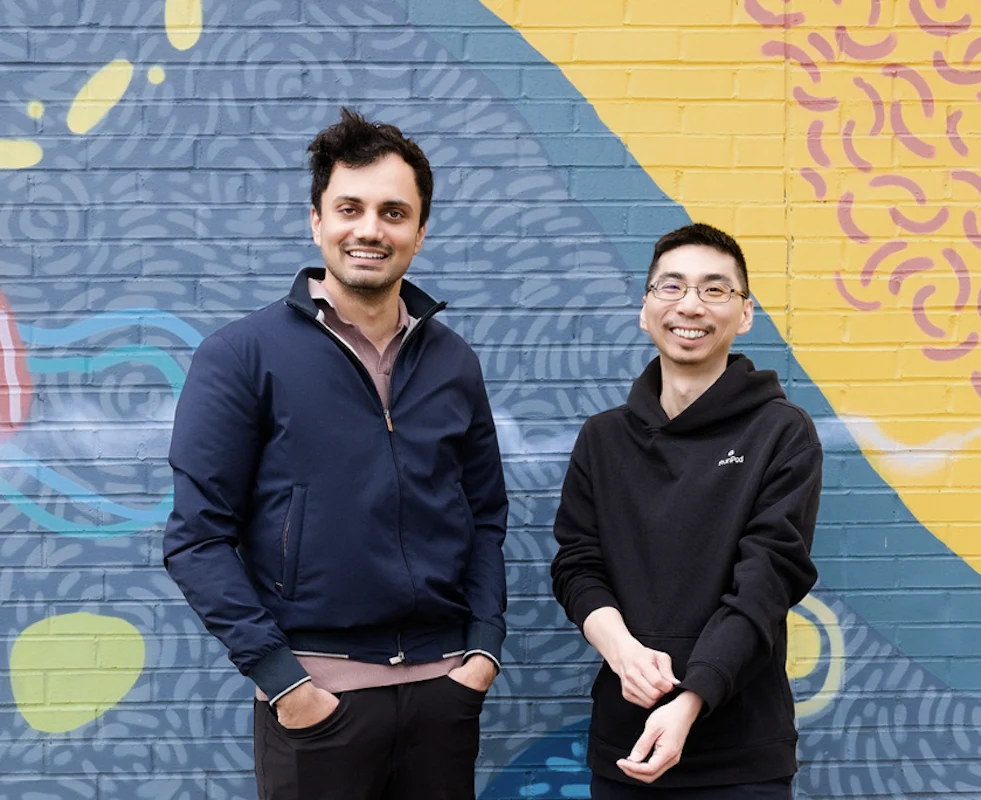
The trajectory of Runpod, an artificial intelligence application hosting platform, offers a compelling case study in capitalizing on precise technological timing and executing a developer-first strategy with ruthless efficiency. Four years after its inception, the company has vaulted into the upper echelons of specialized cloud providers, achieving a staggering $120 million annual revenue run rate (ARR), according to founders Zhen Lu and Pardeep Singh. This financial milestone is not merely a reflection of successful scaling; it represents a profound validation of a model that prioritized raw infrastructure performance and developer experience over traditional venture capital-led expansion, demonstrating that disruptive innovation can still emerge from the periphery of the established tech giants.
The foundation of Runpod’s success lies in an unconventional origin story, rooted in the speculative technology boom of late 2021. Lu and Singh, seasoned corporate developers at Comcast, initially ventured into cryptocurrency mining, establishing specialized Ethereum generation setups in their respective New Jersey basements. This endeavor, involving significant capital expenditure—estimated at $50,000 between them for GPU hardware—proved to be both financially underwhelming and professionally monotonous. Furthermore, the impending "Merge" network upgrade for Ethereum signaled the definitive end of GPU-based mining, necessitating a rapid pivot to salvage the substantial hardware investment and, perhaps more importantly, maintain domestic tranquility.
Recognizing the burgeoning relevance of graphical processing units (GPUs) beyond crypto—a shift already underway in their professional machine learning projects—the duo opted to convert their mining rigs into high-performance AI servers. This transition occurred in a market environment that predated the widespread public consciousness of generative AI, before the explosive release of DALL-E 2 and well ahead of the ChatGPT phenomenon. This early positioning was critical, but it immediately exposed a fundamental pain point in the infrastructure landscape.
Lu described the existing software stack for interacting with and deploying workloads onto these specialized GPUs as fundamentally flawed—a complex, frustrating, and often unreliable experience. The genesis of Runpod was thus purely pragmatic: solving a core infrastructure problem experienced by developers themselves. The market, despite its increasing hunger for AI capabilities, lacked a platform that treated GPU access not as an ancillary cloud service, but as a primary, easily consumable resource.
Runpod was formally launched in early 2022 as a dedicated platform for hosting AI applications, distinguished by its emphasis on operational speed, streamlined configuration, and a suite of developer tools designed for efficiency. Key features included powerful APIs, command-line interfaces (CLIs), and serverless options that automated complex hardware orchestration—a necessary antidote to the infrastructure complexity Lu had observed.
The challenge facing these first-time founders, however, was not technological development but market penetration. Lacking institutional marketing resources, they turned to the highly technical, community-driven corners of the internet. A simple, yet potent, offer was posted across specialized AI and reinforcement learning subreddits: free GPU access in exchange for rigorous beta testing and feedback. This direct engagement strategy bypassed traditional marketing channels, immediately securing a core user base of serious developers who valued performance and direct utility. This community-led approach rapidly converted beta users into paying customers. Within nine months of launching, Lu and Singh had generated over $1 million in revenue and successfully transitioned from corporate employees to full-time founders.
The Bootstrapped Path and Scaling Capacity
The early success introduced a new, critical scaling challenge. As the platform gained traction, especially among early business users, the initial infrastructure model—relying on the founders’ repurposed basement servers—became untenable. Enterprise users demanded reliability, security, and guaranteed capacity that consumer-grade hardware could not provide.
Crucially, Runpod initially eschewed the standard Silicon Valley playbook of immediate venture capital pursuit. Instead, they adopted a highly capital-efficient, bootstrapping approach to infrastructure expansion. They forged revenue-share partnerships with established data centers, a strategy that allowed them to rapidly increase GPU capacity without incurring massive upfront debt or ceding early equity.
This model, while avoiding external financial leverage, introduced intense operational pressures. Pardeep Singh highlighted the precarious nature of maintaining market confidence in the GPU-starved environment of 2022 and 2023. The market for high-demand GPUs, particularly Nvidia’s H100 and A100 series, has been characterized by acute scarcity. Any perceived lack of capacity on the Runpod platform would instantly drive users to competitors. The ability to forecast demand and secure hardware partnerships ahead of the curve became the operational cornerstone of the business.
This relentless focus on self-sufficiency meant Runpod operated without a free tier for nearly two years. Every service offered had to, at minimum, cover its own operational costs, ensuring the business was fundamentally sound and revenue-generating from day one. This contrasts sharply with many AI cloud rivals, some of whom also pivoted from crypto mining (like CoreWeave), but often utilized significant debt financing or immediate VC backing to secure their initial hardware fleets.
Capital Validation and Strategic Investment
The exponential growth, fueled by strong product-market fit and the subsequent explosion of interest following the launch of large language models (LLMs), eventually attracted the attention of institutional capital. The connection, fittingly, came via the same unconventional channel that initiated their user growth: Reddit.
Radhika Malik, a partner at Dell Technologies Capital, first encountered Runpod through their active community engagement on the platform. This outreach led to the founders’ first formal interaction with the venture capital ecosystem. Lu candidly admitted to initially being unprepared for the standard VC pitching process, relying on Malik’s guidance to navigate investor expectations.
The market’s intensifying "AI app fever" culminated in May 2024, when Runpod secured a $20 million seed funding round. This round was co-led by the corporate venture arms of two industry behemoths, Intel Capital and Dell Technologies Capital, underscoring the strategic importance of Runpod’s infrastructure solution to the broader hardware ecosystem. The round also featured participation from influential angel investors, including Nat Friedman (former GitHub CEO) and Hugging Face co-founder Julien Chaumond—the latter of whom had discovered and begun using the product through the support chat before becoming an investor.
By the time of the seed round, Runpod had grown its developer base to 100,000. Today, that number has quintupled, serving a massive community of 500,000 developers. Their customer base spans from individual AI hobbyists and researchers to Fortune 500 enterprise teams deploying multi-million dollar annual workloads. The platform’s infrastructure now spans 31 global regions, catering to high-profile users across various sectors, including established technology players like OpenAI, Perplexity, Replit, Cursor, Wix, and Zillow.
Industry Implications and Competitive Landscape Analysis
Runpod operates in one of the most intensely competitive and strategically vital sectors of modern technology: AI infrastructure. The landscape is dominated by the three major hyperscale cloud providers—Amazon Web Services (AWS), Microsoft Azure, and Google Cloud Platform (GCP)—all of whom possess vast resources, entrenched enterprise relationships, and extensive infrastructure footprints.
However, the specialized nature of AI development, particularly the need for instantaneous access to cutting-edge, high-bandwidth GPUs, has created significant market segmentation opportunities for specialized players. Runpod competes directly with dedicated AI cloud rivals like CoreWeave and Core Scientific, which also prioritize high-density GPU clusters and specialized networking solutions.
Runpod’s competitive edge lies in its architectural philosophy: a commitment to being a fundamentally "dev-centric platform." While hyperscalers offer immense scale and a dizzying array of services, they often suffer from complexity, higher egress costs, and deployment friction for developers focused solely on iterative model training and inference. Runpod’s core offering streamlines the deployment process, providing developers with raw, performant GPU compute with minimal overhead.
This positioning is crucial for the burgeoning ecosystem of independent AI companies and open-source model developers. These groups require agility, cost predictability, and the ability to spin up and tear down complex environments quickly—attributes where the specialized cloud providers often outperform the hyperscalers. By prioritizing speed, automation (via serverless options), and direct access to hardware, Runpod has carved out a loyal niche that values utility above ecosystem lock-in.
Future Impact and The Evolution of Software Development
The founders are now armed with a robust balance sheet and a business model that demonstrates exceptional unit economics, positioning them favorably for an imminent Series A funding round. This next phase of capital infusion will likely be directed toward securing even more constrained, high-demand hardware—specifically, expanding their inventory of advanced Nvidia chips—and further developing their proprietary software layer to enhance orchestration capabilities.
Looking forward, Runpod is betting on a transformative shift in the nature of software engineering itself. Zhen Lu articulated this vision, stating, “Our goal is to be what this next generation of software developers grows up on.” They foresee a paradigm where the role of the traditional programmer evolves from writing monolithic codebases to becoming "AI agent creators and operators."
This prediction aligns with broader industry trends toward autonomous systems and model-driven computation. As large language models and foundation models become integrated into every layer of the tech stack, developers will require infrastructure that supports complex orchestration, rapid iteration on model fine-tuning, and efficient, high-throughput inference serving. Runpod’s emphasis on serverless GPU deployment and developer tooling is designed precisely to meet the demands of this future AI-native workforce.
The success of Runpod also signals a critical trend in cloud infrastructure: the increasing viability of decentralized and specialized compute capacity. While the global demand for AI infrastructure continues to outstrip supply, platforms that can efficiently aggregate and monetize available GPU resources, particularly those offering superior cost performance and developer experience, are poised for significant growth. Runpod’s journey from a basement-based crypto pivot to a nine-figure ARR business, validated by top-tier enterprise customers and strategic investors, underscores the profound market hunger for accessible, high-performance AI compute—a hunger that the major clouds alone cannot fully satiate.
The firm’s early decision to forgo easy debt and prioritize revenue generation ensured a resilient operational structure. This disciplined approach, coupled with the serendipitous timing of the AI boom, transformed a tactical hardware salvage operation into a strategic player in the global infrastructure race. As the AI ecosystem matures, specialized platforms like Runpod will continue to exert significant influence, democratizing access to the powerful compute resources necessary to drive the next generation of artificial intelligence applications.
