

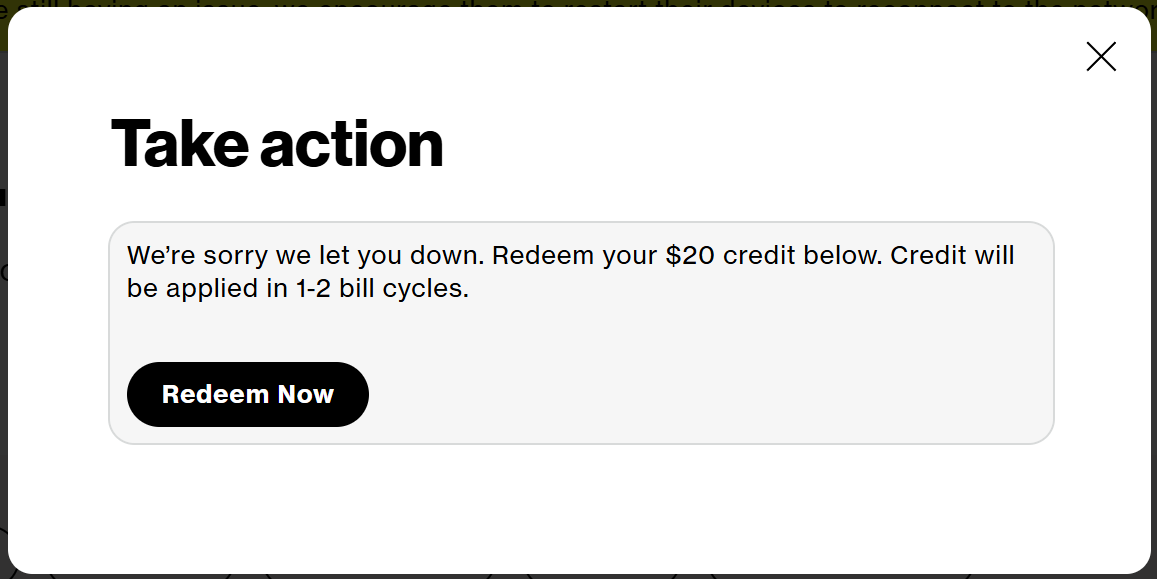
Verizon has commenced the distribution of goodwill gestures to its customer base following a significant, nationwide wireless service failure that rendered millions without connectivity. The carrier is disseminating text messages directing primary account holders to a dedicated portal for claiming a $20 service credit. This measure, while framed as an acknowledgment of the disruption, underscores the delicate balance carriers must strike between operational resilience and customer trust maintenance following major infrastructural lapses.
The content of the communication is notably direct, employing language intended to convey sincerity in the face of widespread inconvenience. The message reads: "Valued Verizon Customer – We let you down this week. For that we are truly sorry. We would like to extend you a $20 account credit that can be easily redeemed via the link below." This phrasing attempts to preempt potential regulatory scrutiny or escalation by proactively offering compensation. Furthermore, the accompanying text explicitly attempts to contextualize the value of the credit: "On average, this covers multiple days of service. This credit isn’t meant to make up for what happened. But it’s a way of acknowledging your time and showing that this matters to us."
This move is standard practice in crisis communications following service failures, aiming to mitigate reputational damage and reduce the volume of direct customer service inquiries. However, the mechanics of the rollout—a flat $20 credit applied once per account, irrespective of the number of lines—present a point of potential friction. For multi-line accounts, the actual value proposition is significantly diminished, raising questions about the fairness metric used in determining compensation.
The text message also includes a crucial secondary directive: advising customers still encountering sporadic connectivity issues to perform a device restart—a common troubleshooting step when network synchronization is required after an outage is declared resolved.
Operational Context of the Disruption
The outage in question struck on January 14th, causing a cascade of connectivity failures across the United States beginning around 12:00 PM Eastern Time. The most visible symptom for many users was the persistent "SOS Mode" notification on mobile devices, effectively severing access to standard voice calls and mobile data services. This failure mode is particularly disruptive as it indicates a complete inability for the handset to register on the carrier’s core network infrastructure.
Verizon’s response timeline indicated a prolonged restoration effort. While initial acknowledgment came swiftly, the network was not fully stabilized until approximately 10:20 PM ET that same evening. This duration of nearly ten hours of significant service impairment for a substantial portion of the subscriber base places this incident among the more severe recent disruptions affecting major U.S. carriers.
Crucially, Verizon officially attributed the cause to a "software issue," explicitly ruling out a cybersecurity event. This distinction is vital for regulatory reporting and public perception. A software failure suggests a problem within internal configuration, deployment, or operational procedures, whereas a cyberattack implies external compromise, which carries far greater long-term security implications and regulatory reporting requirements under various federal mandates. However, the lack of granular detail regarding the specific software component—whether it was related to core routing, authentication, or provisioning systems—leaves a significant information vacuum.
Expert Analysis: The Calculus of Customer Credits
From a risk management perspective, issuing the $20 credit is a calculated investment. The cost of the credit—the direct financial outlay—is typically dwarfed by the potential costs associated with regulatory fines, lost business from churn, and prolonged reputational damage.
Industry analysts specializing in telecommunications infrastructure suggest that the $20 figure is likely benchmarked against the average daily cost of service for a typical single-line postpaid account. By covering what they estimate to be "multiple days," Verizon is attempting to satisfy the regulatory expectation that compensation should reflect the severity of the downtime, while simultaneously keeping the payout small enough to avoid setting a precedent for larger claims in future incidents.

The decision to limit the credit to the primary account holder, rather than per-line, reveals an internal segmentation strategy. It streamlines the administrative burden by preventing thousands of individual line holders from seeking redress, focusing the resolution process on the contractual owner. While efficient for the carrier, this approach often frustrates end-users who experienced the outage equally on their secondary lines.
Furthermore, the reliance on SMS for notification introduces a dependency on the very network functionality that was compromised. While the SMS infrastructure may rely on a different, more resilient pathway than the primary voice/data connection, customers unable to receive the initial text might feel excluded from the remediation process, necessitating a secondary communication channel like email or direct website notification—a step Verizon appears to have initially omitted in favor of targeted texting.
Industry Implications: Resilience and Regulatory Scrutiny
This large-scale outage, regardless of its root cause being software or human error in deployment, feeds into a broader industry narrative concerning the fragility of modern, hyper-converged network architectures. The shift toward software-defined networking (SDN) and virtualization, while offering immense flexibility and cost savings, also concentrates failure points. A flaw in a single, central software module—like a database update or a configuration push—can propagate catastrophic failure across an entire geographical footprint almost instantaneously.
The Federal Communications Commission (FCC) has intensified its focus on network reliability following several high-profile outages across different carriers in recent years. The primary regulatory concern centers on the lack of immediate, detailed public reporting regarding the cause and scope of these failures. The industry is moving toward greater transparency mandates, particularly concerning outages that affect emergency services (E911) or extend beyond a specified time threshold.
For Verizon, the implication is heightened scrutiny on its Network Operations Center (NOC) protocols. Industry experts often point to the need for robust "blast radius" containment strategies. When a software deployment causes an issue, the architecture must possess inherent mechanisms to isolate the flawed component before it impacts the entire national backbone. The fact that this outage affected users across the entire nation suggests that either the initial deployment was too broad, or the rollback procedures failed to execute effectively.
The lingering question about the nature of the "software issue" is critical. If it was related to an integration between legacy systems and new cloud-native infrastructure—a common point of failure in modernization projects—it suggests deeper systemic challenges in managing technological transition at scale. If it was merely a flawed configuration file pushed to core routers, it points toward deficiencies in pre-deployment testing and validation pipelines.
Future Trajectory: The Push for Hardened Systems
The fallout from incidents like this invariably accelerates investment in redundancy and operational technology (OT). For Tier-1 carriers, this typically translates into several key areas:
- Geographic Diversity in Core Control Planes: Ensuring that the systems managing network state, routing tables, and authentication are physically and logically separated across multiple, independent data centers to prevent a single localized failure from propagating nationally.
- Immutable Infrastructure Principles: Adopting deployment models where changes are made by replacing entire systems rather than patching them in place. This reduces the risk of configuration drift and ensures that rollbacks return the system to a known, verified state swiftly.
- Enhanced Observability: Implementing sophisticated, real-time monitoring tools that don’t just track latency or packet loss, but actively map dependencies between software services. This allows engineers to identify the source of a degradation (the "first domino") rather than just observing the resulting widespread failures.
The $20 credit serves as a necessary, but ultimately superficial, balm. True long-term impact on customer loyalty will depend not on the token compensation, but on the demonstrable, measurable improvements Verizon implements to prevent recurrence. Customers, particularly enterprise clients who rely heavily on service continuity, view these outages not as minor inconveniences, but as direct threats to their business operations.
The necessity for carriers to move beyond simple apologies and towards verifiable metrics of improved resilience is the defining trend emerging from these widespread disruptions. As the telecommunications landscape becomes increasingly reliant on digital signaling for everything from basic voice services to IoT connectivity, the tolerance for systemic failures shrinks dramatically. Verizon’s current action is a required first step in the recovery phase, but the true test lies in the subsequent technical and organizational reforms implemented to secure the network’s future integrity. The process of redeeming the credit—requiring an active customer click—also serves as a soft audit, allowing Verizon to gauge the immediate reaction and potentially identify the subset of customers still experiencing lingering issues through tracking link engagement metrics, even if the primary network stability has been restored.
