

The banks of the Buriganga River near Dhaka have historically served as a stark environmental ledger, recording the true cost of global fast fashion. For decades, the river’s waters ran thick with the industrial effluent of the textile sector—a toxic cocktail of synthetic dyes, harsh processing chemicals, and heavy metals such as lead and cadmium. This environmental degradation was merely one facet of a sector burdened by a legacy of tragedy; the collapse of the Rana Plaza complex in 2013, which claimed 1,134 lives, crystallized the urgent need for structural reform in safety and operational integrity. While the world focused intensely on improving building safety protocols in the aftermath of that catastrophe, a parallel, quieter revolution was taking root: a sweeping commitment to environmental sustainability that has transformed Bangladesh into an unlikely, yet undeniable, global leader in certified green manufacturing.
This transformation is not incidental; it is a calculated, strategic pivot driven by a combination of geopolitical pressure, market demands, and a localized form of technological innovation often dubbed "frugal engineering." Bangladesh, which manages the world’s second-largest ready-made garment (RMG) industry—a sector valued at over $40 billion annually—now boasts the highest number of LEED (Leadership in Energy and Environmental Design) certified garment factories globally, surpassing 268 certified sites. This rapid accumulation of platinum, gold, and silver certifications signals a fundamental shift in operational priorities, moving from high-volume, low-cost production toward efficiency and resource conservation.
The term "frugal factory" aptly describes the unique blend of high-tech efficiency and localized resource management employed by these facilities. The philosophy centers on achieving maximum environmental impact reduction using practical, cost-effective technologies that offer a tangible return on investment (ROI). This strategy is vital in a highly competitive, low-margin industry. Factories are integrating photovoltaic solar arrays on rooftops, replacing outdated, energy-intensive equipment, and utilizing advanced systems for water and material management. Dyeing and finishing plants, traditionally the most polluting segment of the textile chain, are now aggressively adopting cleaner chemical processes and investing heavily in robust Effluent Treatment Plants (ETPs) capable of handling complex industrial wastewater before discharge, or, increasingly, facilitating closed-loop recycling.
A prime example of this paradigm shift is the LEED Gold-certified operations at facilities like Fakir Eco Knitwears. Located in the industrial belt near Dhaka, this factory exemplifies how architectural design can augment technological implementation. Strategic incorporation of high-efficiency skylights drastically reduces reliance on artificial electric lighting, cutting lighting energy consumption by nearly 40%. Furthermore, integrating Artificial Intelligence (AI) driven fabric cutting technology minimizes waste during the primary production phase. This technological synergy allows workers to channel up to 95% of fabric scraps back into the production cycle, recycling them into new yarn, thus drastically reducing material input costs and landfill contribution. As engineers within these facilities attest, leveraging local resources—like abundant daylight, rainwater harvesting systems, and solar power—is proving to be a highly effective and sustainable alternative to relying on energy-intensive solutions like heavy industrial air conditioning or inefficient boilers. The strategy is built around resilience, conserving precious water resources, and insulating production from volatile global energy prices.

The momentum behind this green evolution is sustained by a complex financial architecture. Factory owners provide a significant portion of the capital investment, motivated by long-term operational savings and market differentiation. Crucially, this domestic investment is amplified by targeted financial instruments, notably the Bangladesh Bank’s Green Transformation Fund, which provides accessible credit for eco-friendly upgrades. However, the most powerful driver remains external: the stringent procurement requirements set by international buyers—major European and North American retail brands—who leverage their purchasing power to enforce compliance. Compliance with sustainability metrics is increasingly rewarded with continued or expanded order volumes, creating a powerful "compliance dividend" for manufacturers.
Institutional support, spearheaded by global bodies, has been critical in scaling these practices. The Partnership for Cleaner Textile (PaCT), an influential initiative launched by the World Bank Group’s International Finance Corporation (IFC) shortly after the Rana Plaza disaster, has been instrumental. Since 2013, PaCT has provided technical assistance and financial guidance to over 450 factories, specifically focusing on process optimization to reduce resource consumption. The quantitative impact is staggering: PaCT estimates that its efforts have cumulatively saved approximately 35 billion liters of fresh water annually. This volume is sufficient to meet the yearly needs of nearly two million people, underscoring the macro-level environmental benefit of industry-wide efficiency gains.
Expert Analysis: The Dual Mandate and the Social Deficit
While Bangladesh’s success in environmental certification is globally recognized, expert analysis reveals a significant structural dissonance. The pursuit of the "E" (Environmental) in the broader Environmental, Social, and Governance (ESG) framework has not been matched by equivalent progress on the "S" (Social) component. The $40 billion industry employs approximately 4.4 million workers, predominantly women, and the shift toward technological efficiency and green compliance has yet to translate into meaningful improvements in worker welfare.
Labor rights groups highlight that systemic issues persist. Wage theft, delayed payments, and poor working conditions outside the strictly defined realm of physical factory safety remain widespread challenges. Despite incremental increases, the current monthly minimum wage, set around 12,500 taka (approximately $113 USD), falls dramatically short of the estimated living wage, which unions argue should be closer to $200 USD. This disparity frequently fuels labor unrest, leading to strikes and widespread protests centered on securing fair pay, overtime compensation, and job security.

A.K.M. Ashraf Uddin, executive director of the Bangladesh Labour Foundation, notes that while post-Rana Plaza efforts successfully enforced crucial structural and fire safety improvements, the underlying cultural framework governing the relationship between management and labor remains largely unchanged. The prevailing ethos still prioritizes maximizing profit margins above realizing workers’ fundamental rights, including the freedom of association and collective bargaining. The adoption of green technology, while laudable, risks creating an insulated elite of high-compliance factories that benefit from premium pricing and international stability, while leaving the majority of workers in precarious economic positions.
Industry Implications and the Looming Regulatory Wall
The push toward green manufacturing, while necessary for planetary health, poses an existential threat to the vast ecosystem of smaller and medium-sized enterprises (SMEs) that constitute the backbone of the Bangladeshi RMG sector. These smaller operations often lack the necessary capital reserves or access to the specialized loans required to implement sophisticated upgrades like advanced ETPs, solar power arrays, or AI-driven cutting systems.
This capital deficit is particularly perilous given emerging global regulatory trends. The European Union, a critical market for Bangladeshi textiles, is preparing to enforce sweeping legislation designed to hold companies accountable for human rights and environmental shortcomings across their entire supply chain. Specifically, the Corporate Sustainability Due Diligence Directive (CSDDD), slated for implementation starting around 2027, will require major corporations sourcing from countries like Bangladesh to demonstrate due diligence in both environmental performance and labor standards.
For factories that cannot afford the investments required for compliance—whether in environmental technology or demonstrable improvements in wage and safety standards—the consequence is simple: market exclusion. International buyers, facing legal liability under CSDDD, will increasingly consolidate orders with the established, certified, and compliant "green" factories. This phenomenon could dramatically exacerbate the existing inequality within the sector, concentrating wealth and security among the largest, most technologically advanced producers, while marginalizing the smaller factories and their workforce.

The future sustainability of Bangladesh’s RMG sector hinges not just on the technical efficiency of its production lines, but on achieving a true equilibrium between ecological stewardship and social equity. The environmental triumphs, symbolized by the cleaner effluent discharged into the Buriganga, represent only the initial phase of transformation. The next decade demands a holistic approach, where green technology is not simply an add-on for market access, but an integrated component of a broader, ethically grounded business model. Securing Bangladesh’s position as a global manufacturing powerhouse requires weaving the threads of environmental sustainability and robust labor rights into one unified, resilient fabric. If the country fails to address the inherent labor paradox, the global perception will remain anchored in the dual reality of technological advancement alongside social injustice, ultimately undermining the integrity and long-term viability of its spectacular green factory revolution. This comprehensive challenge necessitates deep policy intervention, not just in providing financing for ETPs, but in enforcing transparent wage structures and empowering worker representation to ensure that the profits generated by green efficiency are equitably shared. The true measure of success will be when the social ledger matches the environmental one.
Beyond Rana Plaza: How Bangladesh Engineered a Global Green Factory Revolution.
The banks of the Buriganga River near Dhaka have historically served as a stark environmental ledger, recording the true cost of global fast fashion. For decades, the river’s waters ran thick with the industrial effluent of the textile sector—a toxic cocktail of synthetic dyes, harsh processing chemicals, and heavy metals such as lead and cadmium. This environmental degradation was merely one facet of a sector burdened by a legacy of tragedy; the catastrophic collapse of the Rana Plaza complex in 2013, which claimed 1,134 lives, crystallized the urgent need for structural reform in safety and operational integrity. While the world focused intensely on improving building safety protocols in the aftermath of that catastrophe, a parallel, quieter revolution was taking root: a sweeping, market-driven commitment to environmental sustainability that has transformed Bangladesh into an unlikely, yet undeniable, global leader in certified green manufacturing.
This transformation is not incidental; it is a calculated, strategic pivot driven by a combination of geopolitical pressure, stringent market demands, and a localized form of technological innovation often dubbed "frugal engineering." Bangladesh, which manages the world’s second-largest ready-made garment (RMG) industry—a sector valued at over $40 billion annually—now boasts the highest number of LEED (Leadership in Energy and Environmental Design) certified garment factories globally, surpassing 268 certified sites. This rapid accumulation of platinum, gold, and silver certifications signals a fundamental shift in operational priorities, moving from high-volume, low-cost production toward verifiable efficiency and resource conservation.
The term "frugal factory" aptly describes the unique blend of high-tech efficiency and localized resource management employed by these facilities. The underlying philosophy centers on achieving maximum environmental impact reduction using practical, cost-effective technologies that offer a tangible return on investment (ROI). This strategy is vital in a highly competitive, low-margin industry where capital expenditure must be justified by long-term operational savings. Factories are integrating sophisticated photovoltaic solar arrays on rooftops, replacing outdated, energy-intensive equipment, and utilizing advanced systems for water and material management. Dyeing and finishing plants, traditionally the most polluting segment of the textile chain due to high water usage and chemical discharge, are now aggressively adopting safer, cleaner chemical processes and investing heavily in robust Effluent Treatment Plants (ETPs). These ETPs are increasingly designed not just to neutralize complex industrial wastewater before discharge, but to facilitate high-rate closed-loop recycling, significantly reducing the industry’s demand on fresh water sources.

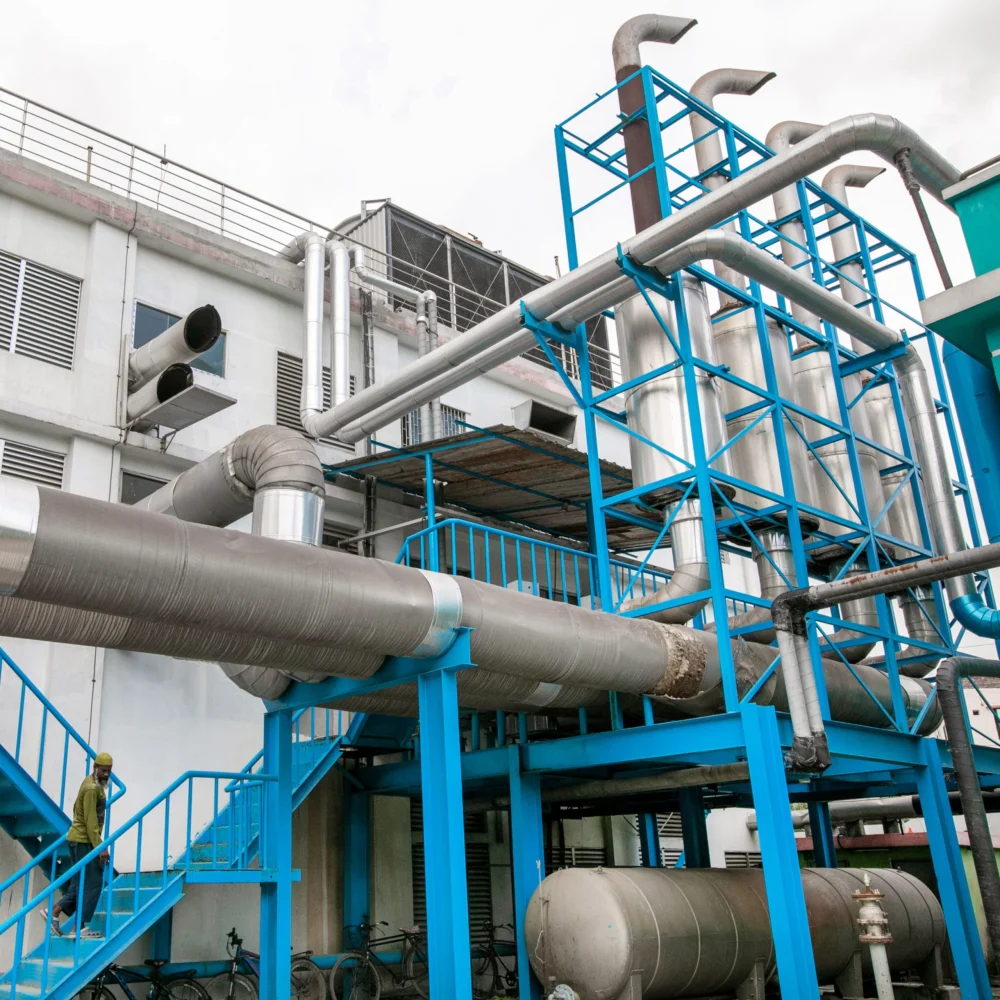
A prime example of this paradigm shift is the LEED Gold-certified operations at facilities like Fakir Eco Knitwears. Located in the industrial belt near Dhaka, this factory exemplifies how architectural design can augment technological implementation. Strategic incorporation of high-efficiency skylights drastically reduces reliance on artificial electric lighting, cutting lighting energy consumption by nearly 40%. Furthermore, integrating Artificial Intelligence (AI) driven fabric cutting technology minimizes waste during the primary production phase. This technological synergy allows manufacturers to channel up to 95% of fabric scraps back into the production cycle, recycling them into new yarn, thus drastically reducing material input costs and landfill contribution. As engineers within these facilities attest, leveraging local resources—like abundant daylight, rainwater harvesting systems, and passive cooling technologies, such as exhaust gas absorption chillers—is proving to be a highly effective and sustainable alternative to relying on energy-intensive solutions like heavy industrial air conditioning or inefficient boilers. The strategy is built around resilience, conserving precious water resources, and insulating production from volatile global energy prices and climate-related disruptions.
The momentum behind this green evolution is sustained by a complex financial architecture. Factory owners provide a significant portion of the capital investment, motivated by long-term operational savings and market differentiation. Crucially, this domestic investment is amplified by targeted financial instruments, notably the Bangladesh Bank’s Green Transformation Fund, which provides accessible credit for eco-friendly upgrades. However, the most powerful driver remains external: the stringent procurement requirements set by international buyers—major European and North American retail brands—who leverage their purchasing power to enforce compliance. Compliance with established sustainability metrics, particularly LEED certification, is increasingly rewarded with continued or expanded order volumes, creating a powerful "compliance dividend" for manufacturers.
Institutional support, spearheaded by global development bodies, has been critical in scaling these practices. The Partnership for Cleaner Textile (PaCT), an influential initiative launched by the World Bank Group’s International Finance Corporation (IFC) shortly after the Rana Plaza disaster, has been instrumental. Since 2013, PaCT has provided technical assistance and financial guidance to over 450 factories, specifically focusing on process optimization to reduce resource consumption. The quantitative impact is staggering: PaCT estimates that its efforts have cumulatively saved approximately 35 billion liters of fresh water annually. This volume is sufficient to meet the yearly needs of nearly two million people, underscoring the macro-level environmental benefit of industry-wide efficiency gains and showcasing a model for resource management applicable across developing economies.
Expert Analysis: The Dual Mandate and the Social Deficit
While Bangladesh’s success in environmental certification is globally recognized, expert analysis reveals a significant structural dissonance. The pursuit of the "E" (Environmental) in the broader Environmental, Social, and Governance (ESG) framework has not been matched by equivalent progress on the "S" (Social) component. The $40 billion industry employs approximately 4.4 million workers, predominantly women, and the shift toward technological efficiency and green compliance has yet to translate into meaningful improvements in worker welfare or economic security.

Labor rights groups highlight that systemic issues persist. Wage theft, delayed payments, and poor working conditions outside the strictly defined realm of physical factory safety remain widespread challenges. Despite incremental increases, the current monthly minimum wage, set around 12,500 taka (approximately $113 USD), falls dramatically short of the estimated living wage, which unions argue should be closer to $200 USD. This disparity frequently fuels labor unrest, leading to strikes and widespread protests centered on securing fair pay, overtime compensation, and job security.
A.K.M. Ashraf Uddin, executive director of the Bangladesh Labour Foundation, notes that while post-Rana Plaza efforts successfully enforced crucial structural and fire safety improvements, the underlying cultural framework governing the relationship between management and labor remains largely unchanged. The prevailing ethos still prioritizes maximizing profit margins above realizing workers’ fundamental rights, including the freedom of association and collective bargaining. The adoption of green technology, while laudable, risks creating an insulated elite of high-compliance factories that benefit from premium pricing and international stability, while leaving the majority of workers in precarious economic positions. This disparity suggests that environmental compliance is often viewed as a technical hurdle for market access, rather than an element of a broader commitment to sustainable human capital management.
Future Impact and Regulatory Trends: The Inequity Threat
The push toward green manufacturing, while necessary for planetary health and long-term business resilience, poses an existential threat to the vast ecosystem of smaller and medium-sized enterprises (SMEs) that constitute the backbone of the Bangladeshi RMG sector. These smaller operations often lack the necessary capital reserves or access to the specialized loans required to implement sophisticated, expensive upgrades like advanced ETPs, solar power arrays, or AI-driven cutting systems. The entry barrier for full LEED certification is simply too high for many.
This capital deficit is particularly perilous given emerging global regulatory trends. The European Union, which represents a massive and critical market for Bangladeshi textiles, is preparing to enforce sweeping legislation designed to hold companies accountable for human rights and environmental shortcomings across their entire supply chain. Specifically, the Corporate Sustainability Due Diligence Directive (CSDDD), slated for phased implementation starting around 2027, will require major corporations sourcing from countries like Bangladesh to demonstrate verifiable due diligence in both environmental performance and labor standards. This directive represents a paradigm shift from voluntary compliance to mandatory legal liability.

For factories that cannot afford the investments required for compliance—whether in environmental technology or demonstrable improvements in wage and safety standards—the consequence is simple: market exclusion. International buyers, facing legal liability under CSDDD, will increasingly consolidate orders with the established, certified, and compliant "green" factories. This phenomenon could dramatically exacerbate the existing inequality within the sector, concentrating wealth and security among the largest, most technologically advanced producers, while marginalizing the smaller factories and their workforce. Without government intervention or collective industry financing mechanisms tailored to SMEs, the green transition risks creating a bifurcated industry structure: a compliant, profitable, and secure tier of large exporters, and a struggling, non-compliant tier relegated to less regulated, lower-value markets.
The future sustainability of Bangladesh’s RMG sector hinges not just on the technical efficiency of its production lines, but on achieving a true equilibrium between ecological stewardship and social equity. The environmental triumphs, symbolized by the cleaner effluent discharged into the Buriganga, represent only the initial phase of transformation. The next decade demands a holistic approach, where green technology is not simply an add-on for market access, but an integrated component of a broader, ethically grounded business model. Securing Bangladesh’s position as a global manufacturing powerhouse requires weaving the threads of environmental sustainability and robust labor rights into one unified, resilient fabric. If the country fails to address the inherent labor paradox—specifically through meaningful wage reform and stronger enforcement of labor protections—the global perception will remain anchored in the dual reality of technological advancement alongside social injustice, ultimately undermining the integrity and long-term viability of its spectacular green factory revolution. The true measure of success will be when the social ledger finally matches the environmental one.
