

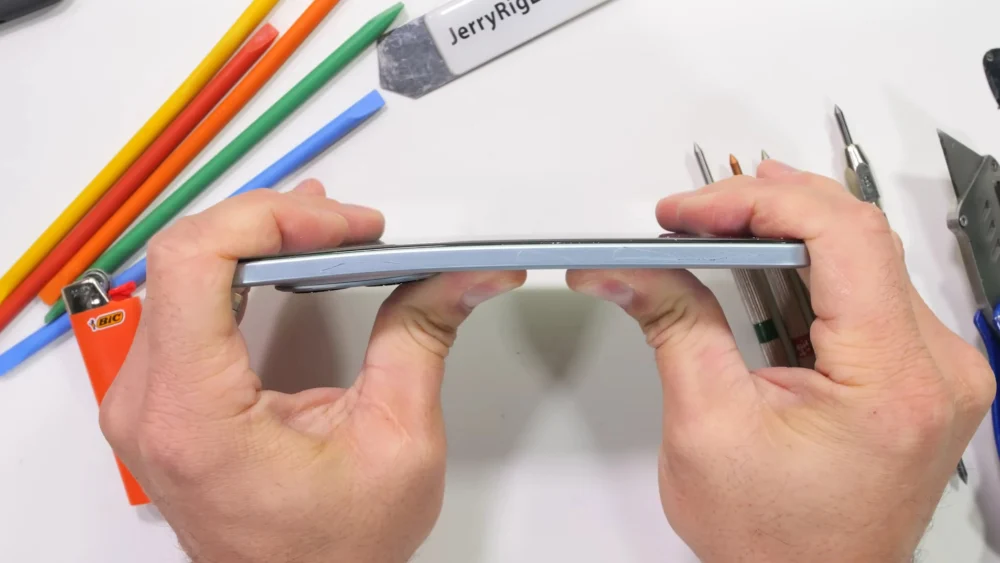
The landscape of smartphone manufacturing is undergoing a subtle but significant recalibration, evidenced by recent durability assessments that challenge the long-held assumption that premium pricing directly correlates with superior build resilience. Specifically, the rigorous, independent evaluation conducted by the influential YouTube channel JerryRigEverything on a new entrant in the mid-range sector has sent ripples through the industry, suggesting that engineering compromises once reserved for budget devices are being systematically dismantled in devices targeting the middle segment of the market. This scrutiny, spearheaded by host Zack Nelson, provides crucial, unfiltered insight into the physical fortitude of modern hardware, moving beyond marketing claims to empirical data points that matter to the everyday user.
The device under the microscope was the recently unveiled Xiaomi Redmi Note 15 Pro Plus, positioned competitively with an approximate European retail valuation hovering near €499.99 (roughly $581 USD). For many consumers, this price point represents the sweet spot—offering advanced features without demanding the top-tier expenditure associated with flagship devices from established titans like Samsung, Apple, or Google. Nelson’s testing methodology, which has become the de facto standard for assessing consumer electronics durability, subjects phones to scratch, burn, and bend tests designed to simulate real-world abuse and catastrophic failure scenarios.
The most compelling finding emerged during the structural integrity evaluation: the bend test. Nelson reported observing "barely any flex" when applying significant lateral force to the handset. This level of resistance is not accidental; it is the result of deliberate, often expensive, internal design choices that have historically been reserved for devices priced significantly higher. The reported engineering behind this resilience includes the integration of a "high-strength" motherboard, which acts as a foundational backbone against torsion, complemented by a frame utilizing a reinforced plastic structure nested within a metallic sub-structure. Furthermore, the internal architecture incorporates what the manufacturer describes as a "multi-layer shock-absorbing design," an approach usually seen in ruggedized or ultra-premium phones intended to dissipate kinetic energy away from sensitive components.
The performance parity demonstrated by the Redmi Note 15 Pro Plus in this specific test is perhaps the most significant industry implication. Nelson’s observations place this mid-range performer on par with, and in some instances exceeding, the structural stability of devices widely considered the pinnacle of mobile engineering. Comparative examples cited include flagships such as the Samsung Galaxy S25 Ultra, the OnePlus 15, and the Google Pixel 10 Pro XL. In a particularly telling moment, the mid-ranger reportedly outperformed the significantly more expensive $1,100-tier Galaxy S25 Edge, which reportedly suffered a deleterious separation between its back panel and frame under stress—a failure mode entirely absent in the Redmi device during Nelson’s evaluation. This stark contrast forces a critical examination of the value proposition offered by ultra-premium phones; if a sub-$600 device can resist structural failure better than a device costing twice as much, consumers are increasingly justified in questioning where the excess capital is being allocated.
Beyond structural rigidity, the display component also underwent standard protocol assessment. The screen, fortified with Corning’s Gorilla Glass Victus 2, exhibited expected behavior: initial scratching commenced at level six on the Mohs hardness scale, with more pronounced gouges appearing at level seven. This outcome aligns perfectly with the industry benchmark for top-tier protective glass, confirming that in terms of surface scratch resistance, the material choice is standardized across price tiers.
However, the material science applied to the rear housing presents a more intriguing divergence. Instead of conventional glass—often utilized even on high-end models—Xiaomi opted for a fiberglass back cover. This material choice is bold, particularly when paired with the manufacturer’s claim of ten times greater impact resistance compared to standard glass panels. While many modern flagships use robust glass composites, the application of fiberglass in a mainstream device suggests a strategic trade-off: sacrificing the aesthetic sheen of polished glass for quantifiable, real-world drop protection. Nelson’s use of a sharp implement to test the surface confirmed its inherent resistance to slicing, though the long-term implications of sustained abrasive wear versus standard Gorilla Glass backs remain an open question for future comparative analysis.
Furthermore, the device’s ingress protection (IP) ratings push the boundaries of what is typically expected in this price bracket. The Redmi Note 15 Pro Plus boasts an astonishing combination of IP66, IP68, IP69, and IP69K ratings. While IP68 is the current standard for high-end water resistance, the inclusion of IP69 and IP69K ratings signifies an ability to withstand high-pressure, high-temperature water jets—a capability usually reserved for industrial equipment or highly specialized rugged phones. Although industry analysts often view these extreme IP ratings as somewhat hyperbolic marketing tools, Xiaomi backs this up with a specific endurance claim: the ability to survive submersion in two meters of water for a full 24 hours. If verifiable, this level of waterproofing significantly surpasses the capabilities advertised by current generations of the iPhone series, the Samsung Galaxy S25 lineup, and the Google Pixel 10 family, which generally adhere strictly to the IP68 standard.
This focus on comprehensive, certified durability is further solidified by the device carrying SGS Premium Performance Certification, which validates its resilience against drops, crushing forces, and bending under controlled laboratory conditions. Combined with an independent drop claim of surviving impacts from 2.5 meters (8.2 feet), the narrative surrounding the Redmi Note 15 Pro Plus is one of uncompromising physical integrity.
The underlying hardware specifications are equally compelling for the price. The device is powered by the Snapdragon 7s Gen 4 processor, an SoC engineered for efficient high performance in the upper mid-range segment. It supports a substantial 6,500mAh battery, which, when coupled with the efficiency of the chosen chipset, promises exceptional endurance. Charging is handled swiftly via 100W wired technology, allowing for rapid replenishment of the large cell. Visual output is managed by a 6.83-inch, 120Hz OLED display, ensuring fluid motion and deep contrast typical of premium panels. On the imaging front, the phone features a primary 200MP sensor paired with an 8MP secondary lens, indicating Xiaomi’s continued prioritization of high-resolution main camera hardware even in non-flagship offerings.
The broader implications of this durability demonstration are transformative for the smartphone market structure. Historically, consumers accepted that achieving peak durability—especially resistance to bending and extreme water ingress—required purchasing the most expensive models. This was based on the perception that superior chassis materials (like aerospace-grade aluminum or titanium) and meticulous internal bracing were prohibitively costly for mass-market production. The success of the Redmi Note 15 Pro Plus suggests that advancements in material science and manufacturing automation are democratizing these protective measures. Manufacturers are finding ways to implement robust internal frameworks and advanced sealing techniques at a fraction of the previous cost, forcing a re-evaluation of the flagship premium.
This trend signals a potential erosion of the perceived value gap between $600 phones and $1,200 phones. If core user anxieties—the fear of a cracked screen from a minor drop (addressed by Victus 2) or catastrophic frame failure from being sat upon (addressed by the internal structure)—are effectively mitigated in the mid-range, the justification for the flagship price premium narrows considerably. The remaining differentiators—cutting-edge camera sensors, advanced optical zoom, faster chipsets for intensive gaming, and aesthetic refinements—must now carry the entire weight of the price differential.
From an engineering perspective, this shift implies a move away from purely aesthetic finishes toward functional material choices. While glass backs are aesthetically pleasing and aid wireless charging efficiency, materials like high-density polymers or fiberglass composites, when engineered correctly, offer superior fracture toughness and impact absorption. The industry must now balance consumer desire for premium feel with the proven utility of robust function. If durability testing becomes a primary driver of purchasing decisions—and JerryRigEverything’s audience size suggests it is increasingly influential—manufacturers will be compelled to invest in structural integrity across their entire product stacks, not just their halo devices.
Looking ahead, this trajectory suggests future innovations in mobile hardware will likely focus intensely on material science in the mid-range. We might anticipate greater adoption of self-healing polymers for minor abrasions, advanced structural adhesives that enhance joint strength without adding significant bulk, and continued exploration into ceramic or advanced composite backings that balance weight, feel, and resilience. The consumer expectation for longevity is rising; today’s mid-range durability may become tomorrow’s baseline requirement for entry-level devices. The Redmi Note 15 Pro Plus is not just a durable phone; it represents a market inflection point where engineering excellence is successfully decoupled from exorbitant pricing, offering a compelling blueprint for the next generation of mass-market mobile computing. For consumers weary of high replacement costs, this robust mid-tier offering is arguably the most significant hardware development of the current cycle.
