

The landscape of mecha anime is poised for a seismic shift as the industry prepares to celebrate the 50th anniversary of Sunrise, the legendary studio now operating under the Bandai Namco Filmworks umbrella. In a move that bridges the gap between classic military science fiction and avant-garde cinematic philosophy, it has been confirmed that a brand-new entry in the venerable Armored Trooper VOTOMS franchise is slated for release later this year. Titled VOTOMS: The Grey Witch, the project represents a rare convergence of elite talent, featuring the directorial prowess of Mamoru Oshii and the high-end technical execution of Production I.G. This announcement has ignited a fervor within the global fan base, not merely because of the return of the franchise, but because of the specific creative alchemy involved in this revival.
For the uninitiated, Armored Trooper VOTOMS is not just another "giant robot" series; it is the definitive pillar of the "real robot" subgenre. Since its debut in 1983, the series has eschewed the heroic, almost magical tropes of mecha in favor of a bleak, industrial, and hyper-realistic depiction of mechanized warfare. The announcement of VOTOMS: The Grey Witch suggests a continuation of this legacy, but through the singular lens of Mamoru Oshii—a director whose name is synonymous with intellectual depth, political intrigue, and the haunting intersection of humanity and technology.
Oshii’s involvement is perhaps the most significant aspect of the project. Known worldwide for his seminal work on the 1995 Ghost in the Shell and the evocative Patlabor: The Movie series, Oshii has spent decades exploring the psychological and societal ramifications of technology. His return to the mecha genre via VOTOMS is a homecoming of sorts. While Patlabor dealt with the police application of "Labors" in a near-future Tokyo, VOTOMS operates on a much grander, intergalactic scale of perpetual war. However, both franchises share a fundamental DNA: the mecha are treated as tools—expendable, mass-produced hardware that requires maintenance, fuel, and strategic deployment. Oshii’s ability to ground fantastical concepts in mundane, gritty reality makes him the ideal successor to the franchise’s creator, Ryosuke Takahashi.
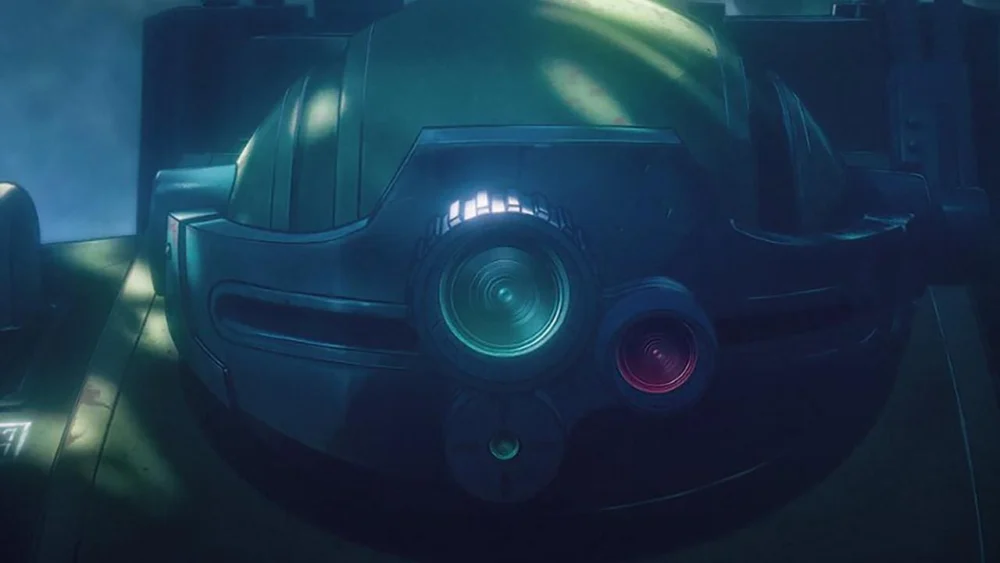
The historical weight of Armored Trooper VOTOMS cannot be overstated. Created by Takahashi and featuring the iconic mechanical designs of Kunio Okawara, the original series introduced the world to the Scopedog—a mecha that stands as the antithesis of the "hero" robot. The Scopedog is an ATM-09-ST, where ATM stands for "Armored Trooper" and VOTOMS itself is an acronym for "Vertical One-man Tank for Offense and Maneuvers." These machines were small, roughly four meters tall, and designed with a utilitarian aesthetic that emphasized functionality over form. They featured wheels in their feet for "roller dashing" across terrain and a rotating three-lens turret for varied visual sensors. In the VOTOMS universe, pilots are often more afraid of their own machines than the enemy, as the Scopedogs are notoriously prone to exploding due to their highly volatile "polymer ringers" liquid fuel.
VOTOMS: The Grey Witch appears to be maintaining this aesthetic continuity. Early visual teasers indicate that the production will utilize Kunio Okawara’s original Scopedog designs as a baseline, though they will undoubtedly undergo the refined detailing expected of a modern Production I.G feature. Notably, the project will continue the franchise’s transition into 3D CGI mecha animation, a trend that began in earnest with The Pailsen Files. While some purists remain wary of the shift away from hand-drawn cel animation, modern CG techniques allow for a level of mechanical complexity and "weight" that aligns perfectly with the industrial nature of the VOTOMS world. Under the supervision of Production I.G, a studio renowned for its technical precision in titles like Psycho-Pass and Ghost in the Shell: Stand Alone Complex, the 3D models are expected to exhibit a level of weathering and physical presence that honors the "dirty" sci-fi roots of the series.
The choice of title, The Grey Witch, hints at a narrative that may lean into the more mystical or psychological elements that have occasionally bubbled beneath the surface of the VOTOMS lore. Throughout the 40-year history of the franchise, Ryosuke Takahashi has woven a complex narrative involving the "Perfect Soldier" program, ancient galactic conspiracies, and the enigmatic protagonist Chirico Cuvie. While it remains to be seen if Chirico will lead this new installment, the involvement of Oshii suggests a story that will look beyond the battlefield. Oshii’s films often prioritize atmosphere and philosophical dialogue over raw action, suggesting that The Grey Witch may explore the existential dread of the "bottoms"—the nickname given to the pilots who are considered as expendable as the machines they operate.

From an industry perspective, this project is a cornerstone of the Sunrise 50th-anniversary celebrations. Sunrise (now Bandai Namco Filmworks) has been the custodian of the mecha genre for half a century, producing everything from Mobile Suit Gundam to Code Geass. Reviving VOTOMS for this milestone signals a commitment to the "hard" sci-fi roots that built the studio’s reputation. It also reflects a broader trend in the anime industry: the "prestige revival." By pairing a legendary director like Oshii with a classic IP and a top-tier studio like Production I.G, the producers are aiming for a crossover hit that appeals to both veteran "mecha-heads" and a new generation of viewers who value high-concept storytelling.
The influence of VOTOMS extends far beyond the borders of Japan, making this revival a global event. The franchise’s emphasis on mass-produced, modular machines was a primary inspiration for the Western Heavy Gear series and has left an indelible mark on games like BattleTech and the armored core designs of modern gaming. The Scopedog’s "roller dash" mechanic remains one of the most unique movement systems in mecha history, influencing the kinetic feel of many contemporary action games. For international audiences, VOTOMS: The Grey Witch represents an opportunity to engage with a franchise that prioritizes geopolitical strategy and the grim realities of the infantryman over the flashy, superpower-driven combat found in "Super Robot" titles.
Furthermore, the collaboration between Sunrise and Production I.G is a significant logistical feat. While Sunrise owns the IP, Production I.G is often the go-to studio for high-fidelity cinematic experiences. This partnership suggests that The Grey Witch is being treated as a high-priority "event" anime, likely intended for a theatrical run or a premium streaming debut. The synergy between Oshii’s directorial vision and I.G’s animation pipeline has historically produced masterpieces, and there is little reason to expect otherwise here.
As we look toward the release later this year, several questions remain. Will Ryosuke Takahashi, the architect of the VOTOMS universe, serve as a consultant or writer? Takahashi has spent four decades refining the narrative arc of the Astragius Galaxy, and his blessing would carry significant weight. Additionally, how will Oshii’s penchant for slow-burn pacing mesh with the high-octane, desperate combat that defines the Scopedog experience? In many ways, this tension is what makes the project so exciting. A VOTOMS story that focuses on the quiet, haunting moments between battles—the maintenance of the machines, the political maneuvering in the shadows, and the psychological toll of being a "disposable" soldier—could provide the most profound exploration of the franchise to date.
The return of VOTOMS also highlights the enduring relevance of the "Real Robot" philosophy in an era dominated by digital warfare and drone technology. In the 1980s, VOTOMS was a reflection of Cold War anxieties and the industrialization of death. Today, as we stand on the precipice of AI-driven combat and autonomous weaponry, the story of a lone pilot in a mass-produced, fragile tin can feels more relevant than ever. Oshii, who has always been a futurist at heart, is uniquely positioned to update these themes for the 21st century.
VOTOMS: The Grey Witch is more than just a nostalgic trip; it is a bold statement about the future of adult-oriented science fiction in anime. By honoring the mechanical heritage of Kunio Okawara and the narrative foundations of Ryosuke Takahashi, while injecting the philosophical depth of Mamoru Oshii, the project promises to be a landmark release. Whether you are a long-time follower of the Gilgamesh and Balarant conflict or a newcomer drawn in by the prestige of Production I.G, this is a cinematic event that demands attention. The Scopedog is ready to roll once more, and if history is any indication, the results will be as explosive as they are thought-provoking. As the 50th anniversary of Sunrise reaches its zenith, The Grey Witch stands as a testament to the power of mecha to tell deeply human stories in a world of cold, unfeeling steel.
