

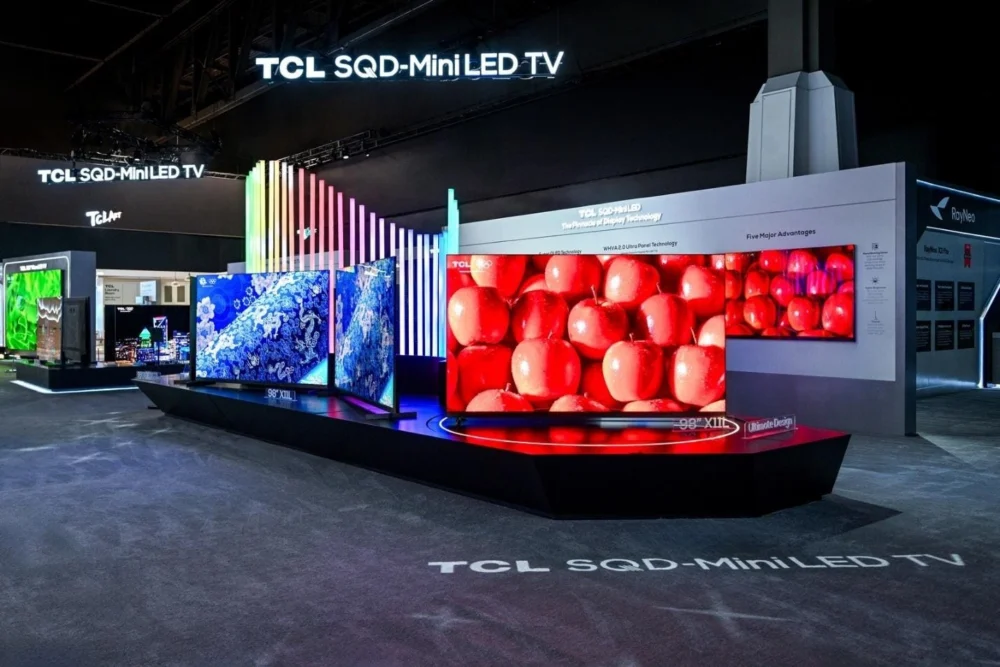
The annual Consumer Electronics Show in Las Vegas has long served as the ultimate barometer for the television industry, a neon-lit stage where the world’s most influential manufacturers draw battle lines for the coming year. As CES 2026 unfolded, the narrative appeared to be written in stone: RGB MiniLED was the undisputed protagonist. This technology, characterized by using individual red, green, and blue LEDs in the backlight rather than a single-color source, was hailed by many as the definitive bridge between traditional LCDs and the self-emissive future of MicroLED. Industry giants signaled a collective pivot toward this "Micro RGB" approach, promising unprecedented color purity and contrast. However, TCL, a brand that has rapidly ascended to the upper echelons of the global market through aggressive vertical integration and backlight innovation, chose this moment to perform a surprising tactical pivot.
While TCL did not ignore the RGB MiniLED trend entirely, it made a statement that reverberated across the show floor: its most premium, high-performance televisions for 2026 would not utilize the RGB MiniLED architecture favored by its rivals. Instead, the company is doubling down on a proprietary evolution of its existing technology, dubbed "Super Quantum Dot" (SQD) MiniLED. This decision represents more than just a different hardware choice; it is a fundamental bet that traditional Quantum Dot architecture, when pushed to its absolute physical limits, can still outperform the nascent RGB MiniLED systems in the areas that matter most to high-end consumers: peak brightness, granular light control, and manufacturing scalability.
At the heart of this strategy lies the X11L series, TCL’s new flagship line for 2026. Available in cinematic 75, 85, and 98-inch configurations, the X11L is designed to be a showcase for the Super Quantum Dot era. To understand why TCL is "swimming against the tide," one must look at the technical hurdles that RGB MiniLED currently faces. While RGB backlighting offers theoretically superior color control by removing the need for a color filter, it is notoriously difficult to drive at high luminance levels due to the varying efficiency and heat signatures of red, green, and blue diodes. TCL’s SQD approach sidesteps this by using a highly efficient, ultra-powerful single-color backlight—likely blue—combined with a "super condensed" Quantum Dot color filter.
The results, at least on paper, are staggering. TCL claims the X11L can achieve a peak brightness of 10,000 nits. In the context of modern HDR (High Dynamic Range) mastering, where most content is currently graded for 1,000 or 4,000 nits, a 10,000-nit ceiling provides the overhead necessary to render specular highlights—like the glint of sun on water or the core of an explosion—with a realism that has been previously unattainable in a consumer display. By comparison, TCL’s own premium RGB MiniLED offering, the RM9L, tops out at 9,000 nits. While 1,000 nits might seem like a negligible difference at that scale, it represents a significant engineering achievement in heat dissipation and power management, areas where the SQD architecture currently holds a distinct advantage.
Furthermore, the X11L addresses the most common criticism of LCD technology: the "blooming" or "halo" effect where light bleeds from bright objects into dark backgrounds. To combat this, TCL has crammed a record-breaking 20,736 independent local dimming zones into the X11L. This level of granularity approaches the point where the distinction between a backlit display and a self-emissive one (like OLED) begins to blur for the human eye. Interestingly, the RGB-based RM9L features fewer zones, totaling 16,848. TCL’s engineering team suggests that the SQD structure allows for a higher density of zones because the single-color backlight system is less complex to tile and control at scale than a tripartite RGB array.
The SQD technology also takes a direct shot at the primary selling point of RGB MiniLED: color gamut. For years, the industry has chased 100% coverage of the BT.2020 color space, a spectrum so wide it encompasses colors rarely seen on consumer screens. RGB MiniLED was supposed to be the key to unlocking this. However, through the use of an enhanced Quantum Dot design and a new, more efficient filtration layer, TCL claims the X11L also hits that 100% BT.2020 milestone. If these claims hold up under independent testing, it would effectively nullify the color-based argument for switching to the more expensive and less bright RGB MiniLED systems in the immediate term.

TCL’s refusal to follow the herd extends to its "mainstream premium" models as well. The C8L (known as the QM8L in North American markets) will also benefit from the Super Quantum Dot treatment. While specific metrics for these models were more guarded during the CES reveal, the strategy is clear: use SQD to maintain a performance lead over competitors who may be struggling with the high costs and lower yields of early-generation RGB MiniLED panels. Even with a lower zone count and reduced peak brightness compared to the flagship X11L—expected to be roughly half the luminance—the QM8L/C8L series aims to dominate the mid-to-high-end market by offering "flagship-adjacent" performance at a price point that competitors using more experimental backlights simply cannot match.
Beyond the panel technology, TCL is attempting to redefine the "all-in-one" home theater experience through a high-profile partnership with the legendary Danish audio brand Bang & Olufsen. The X11L features a sophisticated integrated sound system that functions essentially as a built-in front-firing soundbar, supplemented by rear-mounted woofers. In an era where most flagship TVs are becoming thinner at the expense of audio quality, TCL’s decision to prioritize acoustic performance—tuned by B&O engineers—signals a move toward a more holistic luxury product. While the RGB-based RM9L also features B&O integration, it lacks the prominent front-firing hardware of the X11L, further cementing the SQD model’s status as the true "king" of the 2026 lineup.
The industry implications of TCL’s move are profound. For the past decade, the TV market has been defined by the rivalry between OLED’s perfect blacks and MiniLED’s superior brightness. As OLED continues to improve its luminance through technologies like Micro Lens Array (MLA) and QD-OLED, MiniLED manufacturers have been forced to innovate or risk irrelevance. By pushing SQD MiniLED to 10,000 nits and 20,000+ zones, TCL is attempting to move the goalposts so far that OLED cannot catch up in terms of raw impact, while simultaneously questioning whether the industry’s rush toward RGB MiniLED is premature.
There is also a significant manufacturing component to this story. TCL’s vertical integration through its panel-manufacturing arm, CSOT (China Star Optoelectronics Technology), allows it to experiment with panel structures like the second-generation WHVA (Wide High-contrast Vertical Alignment) LCD designs. These panels are engineered to improve off-axis viewing angles and native contrast, two areas where VA-type panels traditionally struggle. By combining WHVA with SQD, TCL is refining a mature supply chain rather than betting the farm on a radical new sub-pixel architecture that may suffer from low production yields in its first few years.
Looking toward the future, TCL’s 2026 lineup suggests a bifurcated market. On one hand, we see the emergence of RGB MiniLED as a prestigious, experimental technology that offers a glimpse into the future of MicroLED. On the other, we have the "Super" evolution of Quantum Dot technology, which represents the pinnacle of what is possible with traditional liquid crystal displays. For the gamer, the X11L and its siblings offer a powerhouse feature set: 4K resolution at 144Hz for PC and console enthusiasts, and a staggering 288Hz refresh rate at 1080p for competitive players. Combined with comprehensive support for HDR10+ and Dolby Vision, TCL is ensuring that its "alternative" path doesn’t sacrifice the standard features expected of a modern flagship.
As we move deeper into 2026, the success of TCL’s gamble will be measured not just in nits and zones, but in consumer adoption. If the X11L can truly deliver the color purity of RGB MiniLED with the superior brightness and zone control of SQD, it may force other manufacturers to reconsider their roadmaps. The "Nit Wars" are far from over; in fact, TCL has just opened a massive new front. By choosing to refine and supercharge a proven technology rather than chasing the latest industry buzzword, TCL is positioning itself as the pragmatist’s innovator—a brand that values measurable performance ceilings over the theoretical benefits of a new sub-pixel arrangement. Whether the rest of the industry will eventually swing back toward this refined QD approach or continue its march toward RGB MiniLED remains the most compelling question in the world of display technology today.
