

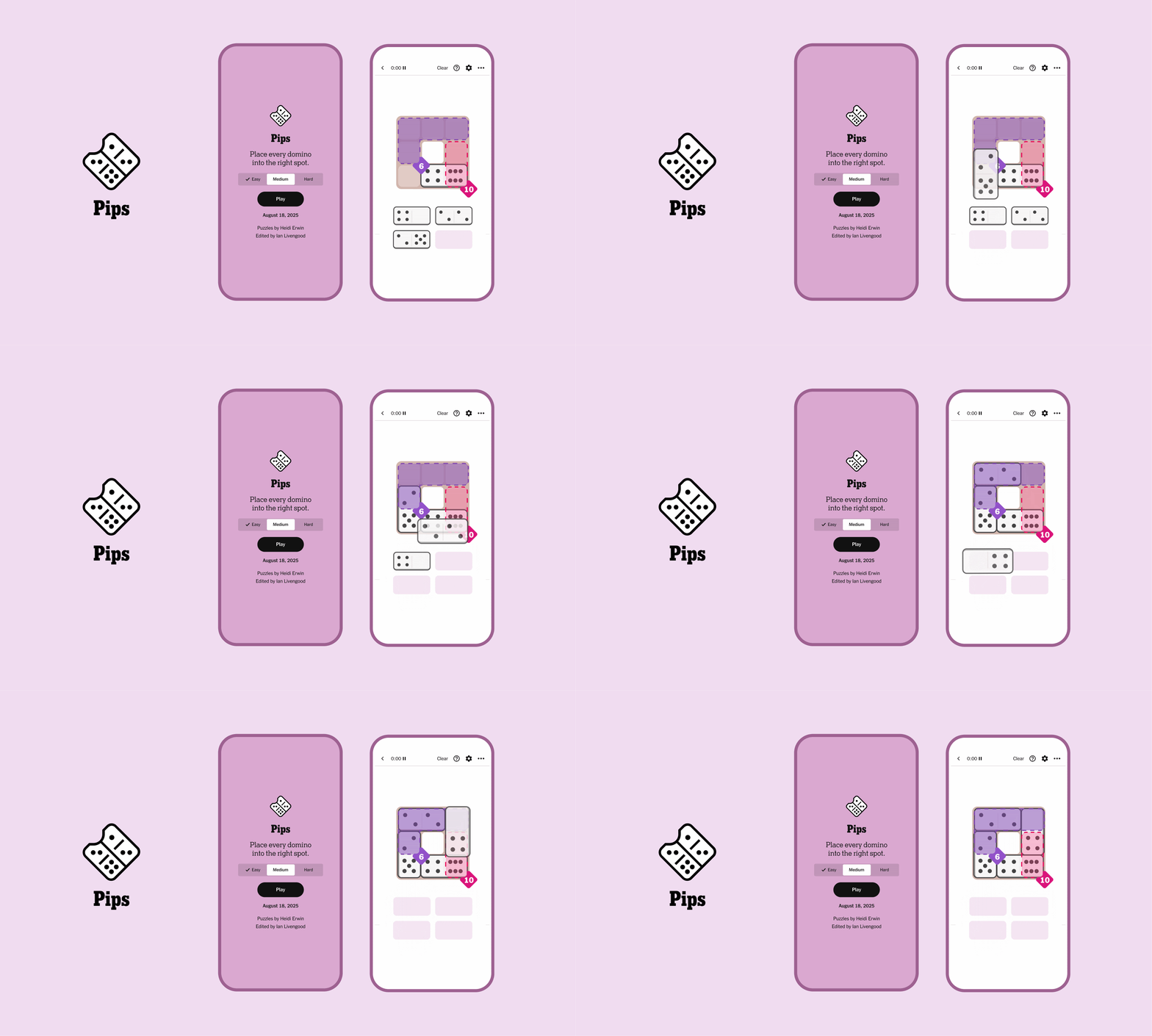
The landscape of digital gaming has undergone a profound transformation over the last decade, shifting from high-octane, graphics-heavy experiences to the refined, intellectual satisfaction of daily logic puzzles. Among the latest entries to capture the collective attention of the "daily ritual" gaming community is Pips, a game that marries the ancient tactile appeal of dominoes with modern algorithmic constraints. As we cross the mid-point of January, the puzzles have begun to reflect a heightened level of complexity, challenging players to move beyond simple trial and error toward a more sophisticated form of deductive reasoning. The January 15 set serves as a perfect case study in how spatial-mathematical logic can be leveraged to solve multi-layered constraints within a confined grid.
The Mechanics of Constrained Optimization
To understand Pips is to understand the mathematical concept of constrained optimization. Unlike traditional dominoes, where the goal is often to empty one’s hand or match ends in a linear fashion, Pips requires the player to fill a pre-defined geometric grid while adhering to specific "conditions" assigned to colored zones. These conditions—ranging from equality (=) and inequality (≠) to greater-than (>) and less-than (<) requirements—turn the game into a visual representation of a system of equations.
In professional gaming circles, this is often compared to the "Satisfiability Problem" (SAT) in computer science. Each domino represents a set of variables, and the grid represents the clauses that must be satisfied. Because the dominoes are physical objects that occupy two adjacent squares and can be rotated, the player must manage both the numerical values (the "pips") and the spatial orientation. This dual-layer challenge is what makes the January 15 puzzles particularly engaging, as the "Hard" tier puzzle today utilizes a unique "dumbbell" shape that forces players to think about the flow of numbers from one end of the grid to the other.
The Psychology of the Daily Puzzle
The rise of Pips and its contemporaries can be attributed to the "micro-gaming" trend. In an era of information overload, the human brain craves "closed-loop" tasks—activities with a clear beginning, a defined set of rules, and a definitive end. Solving the January 15 Pips puzzle provides a localized dopamine hit, a sense of order in an otherwise chaotic digital day. Furthermore, the social aspect of daily puzzles—comparing solutions and strategies—creates a "watercooler effect" that spans global time zones.
As we analyze today’s specific challenges, it is important to note that the difficulty tiers are designed to scale the number of variables. While the Easy tier may only require one or two logical leaps, the Hard tier demands a "chain-link" approach, where one incorrect placement can lead to a total system failure ten steps later.
January 15: The Easy and Medium Solutions
For many players, the Easy and Medium tiers are warm-ups designed to internalize the grid’s current logic. On January 15, the Easy puzzle focused on simple equality clusters. The primary strategy here is to identify the "anchor" domino—the one with the most limited placement options. Often, this is a double (like a 4/4 or 5/5) or a domino that must bridge two different colored zones with conflicting rules.
The Medium tier for January 15 introduced more complex "greater than" conditions. In this scenario, the total value of the tiles within a specific colored zone must exceed a certain threshold. Expert players know that the most efficient way to solve these is to "over-satisfy" the condition early with high-value pips, leaving the lower-value dominoes for the "blank" or less restrictive areas of the grid. This requires a quick mental inventory of the available domino set before the first tile is ever placed.
Deep Dive: The Hard Tier "Dumbbell" Walkthrough
The Hard Pips puzzle for Thursday, January 15, is a masterclass in bottleneck logic. The grid is shaped like a dumbbell, with two heavy clusters connected by a narrow bar. This architectural choice is not merely aesthetic; it limits the movement of dominoes and forces the player to find a specific sequence that allows the numbers to "flow" through the center.

Step 1: Identifying the Anchor
The first move in any high-level Pips puzzle should be the placement of the most restrictive tile. Today, that tile is the 6/6 domino. By examining the Purple (=) tiles, we can deduce that this zone requires a double because of its interaction with the neighboring Pink 5 zone. The 6/6 is one of only two doubles available that fits the mathematical requirements of the surrounding clusters. Specifically, because the Blue (=) zone above it also requires an equality match that is more flexible, the 6/6 must be committed to the Purple zone to ensure the Pink 5 condition can be met by the adjacent 5/3 domino.
Once the 6/6 is placed, the logic begins to cascade. The 5/3 domino is slotted into the Pink 5 area, which then dictates the placement for the Green (≠) zone. Simultaneously, on the other side of the "dumbbell," we look at the Dark Blue (>) 3 zone. By placing the 5/2 domino here, we satisfy the "greater than" condition while simultaneously feeding a "2" into the Orange (=) group. This then necessitates placing the 2/1 domino into the Blue (>) 0 zone, a move that effectively "clears" the right side of the dumbbell.
Step 2: Bridging the Gap
With the ends of the dumbbell partially stabilized, the focus shifts to the center and the remaining inequality zones. The 1/3 domino is placed into the Green (≠) area, which naturally leads to the 2/0 domino being placed in the Dark Blue (≠) section. This is a critical juncture: the 2/0 domino serves as a bridge into the top Orange (=) group. The logic here is airtight—if a different domino were used, the "0" value would not be available for the Pink (>) 1 condition, which is satisfied by the 0/3 domino.
The Final Solution
The endgame of the January 15 Hard puzzle involves the 1/1 double and the 1/4 domino. The 1/1 is placed in the two rightmost tiles of the Blue (=) group. This leaves the 1/4 domino to be placed into the Purple (>) 3 zone. It is worth noting that Pips puzzles occasionally allow for "alternative" solutions where two dominoes can be swapped without violating any conditions. In today’s Hard puzzle, a slight variation in the Orange and Blue groups is possible, but the 6/6 and 1/1 placements remain the foundational pillars of the solution.
Educational and Cognitive Implications
Beyond mere entertainment, the puzzles presented on January 15 offer significant cognitive benefits. Educators have begun using Pips-style logic as a way to teach "if-then" reasoning and spatial orientation. For older adults, these puzzles are a form of "cognitive resistance training," helping to maintain neuroplasticity by forcing the brain to reconcile visual patterns with numerical constraints.
From a mathematical perspective, Pips is an exercise in set theory. Each colored zone is a set, and the dominoes are elements that must be partitioned into these sets such that all properties (the conditions) are preserved. This is a fundamental skill in high-level programming and engineering, where "resource allocation" under strict constraints is a daily reality.
The Future of the Daily Logic Genre
As we look toward the future of digital puzzles, we can expect games like Pips to become even more integrated with emerging technologies. We are likely approaching an era of "procedural puzzle generation," where AI will create daily challenges tailored to a player’s specific skill level, ensuring they are always in a state of "flow"—neither too bored by easy tasks nor too frustrated by impossible ones.
Furthermore, the industry is seeing a shift toward "narrative puzzles," where the shape of the grid (like today’s dumbbell) tells a story or relates to a global event. This adds a layer of "meta-context" to the gaming experience. We may also see the introduction of "competitive Pips," where players solve the same grid in real-time, with speed and "efficiency of logic" (number of moves or undos) determining the winner.
The January 15 Pips challenge is a reminder that in the world of logic, every piece has its place. Whether you are a casual solver looking for a morning distraction or a logic enthusiast dissecting the "dumbbell" layout for its mathematical elegance, the game provides a universal language of dots and boxes. As the month progresses and the puzzles undoubtedly grow more devious, the core strategy remains the same: find the anchor, respect the constraints, and let the logic lead the way.
