

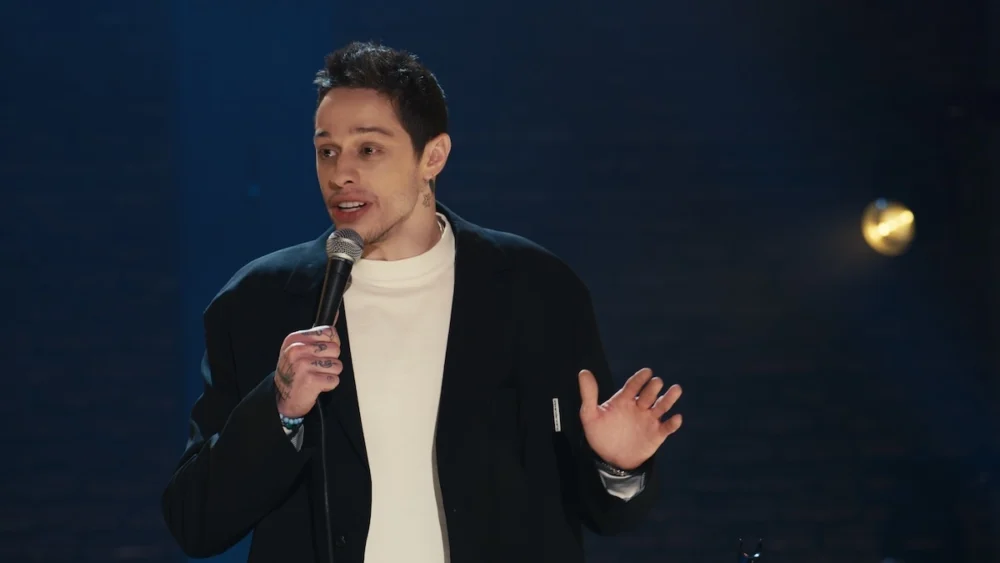
The global streaming behemoth, Netflix, has formalized its ambitious push into the conversational media space, signaling a strategic shift away from purely cinematic, high-budget scripted content toward the frequent, intimate, and often cheaper format of original video podcasts. This move is cemented by the upcoming launch of two flagship, wholly-owned series anchored by significant celebrity talent: comedian Pete Davidson and NFL legend Michael Irvin. This initiative is not merely an experiment; it represents a calculated attempt to capture a substantial segment of viewer time currently dominated by Google’s YouTube ecosystem, particularly on living room devices.
The streaming giant confirmed the debuts of The Pete Davidson Show and The White House with Michael Irvin, set to premiere on January 30 and January 19, respectively. Crucially, these programs are designated as "Netflix Originals," meaning they are exclusive content offerings restricted to the subscriber base. This exclusivity is fundamental to the platform’s broader strategy of transforming these high-frequency, non-scripted formats into powerful tools for subscriber retention and engagement, rather than just supplemental content.
Leveraging Established Star Power for Targeted Audiences
The selection of these inaugural hosts reveals a deliberate strategy aimed at diverse, yet established, Netflix user demographics. Pete Davidson, whose raw, often self-deprecating comedic style resonates strongly with younger audiences, already possesses a proven track record of engagement on the platform, having successfully launched multiple stand-up specials. The Pete Davidson Show is positioned as a casual, behind-the-scenes look at the comedian and his circle, filmed candidly in his own garage and scheduled to air weekly every Friday. This approach mimics the lo-fi, authentic production aesthetic that has allowed independent podcasters to thrive on platforms like YouTube, but applies Netflix’s distribution scale and star curation.
Conversely, the acquisition of Michael Irvin, a Pro Football Hall-of-Famer, addresses a critical area of growth for Netflix: dedicated sports commentary and fandom. Irvin was a central figure in the critically acclaimed documentary series America’s Team: The Gambler and His Cowboys, establishing a recognizable and credible presence within the Netflix sports content library. His show, The White House, is designed to be a hard-hitting sports news and analysis program, scheduled twice weekly and leveraging high-profile guest co-hosts such as former NFL All-Pro wide receiver Brandon Marshall. This programming is directly intended to appeal to the millions of gridiron enthusiasts who already pay for the service, providing them with a reason to log in frequently beyond binge-watching scripted dramas.
The dual focus—candid celebrity life and serious sports analysis—demonstrates Netflix’s intent to cover the high-value sectors of the conversational media market. These segments are characterized by their high frequency of consumption and the deep loyalty they engender among viewers, often functioning as habitual, "ambient" content that viewers leave on in the background.
The Macro Strategy: Competing for Ambient Attention
The impetus for this aggressive foray lies in the shifting dynamics of digital media consumption. Video podcasts, once niche offshoots of audio programs, have evolved into a primary form of entertainment, particularly within the living room environment. Data suggests that consumers are dedicating hundreds of millions of hours monthly to watching podcasts on connected TV devices, a metric where YouTube currently holds near-monopoly status. For Netflix, a company whose entire model is predicated on capturing maximum viewer attention, allowing a competing platform to dominate such a significant and growing consumption category is untenable.
This content acquisition strategy is fundamentally about competing for the "daytime talk show" slot—the routine, low-commitment viewing that occupies the space between blockbuster series launches. Video podcasts offer an unparalleled content solution: they are relatively low-cost to produce compared to episodic television, can be rapidly scaled, and provide a consistent, frequent content cadence that dramatically improves platform stickiness. While a high-production drama series might cost tens of millions per episode and deliver content weekly or less frequently, a conversational media program can be produced for a fraction of that cost and delivered multiple times a week, ensuring the Netflix app remains a daily destination.
Netflix is not starting from zero in this space. These new originals will complement an already growing slate of licensed video podcast content secured through significant agreements with major players, including iHeartMedia, Spotify (specifically their Ringer network content), and Barstool Sports. Titles like Dear Chelsea, My Favorite Murder, and selections from The Ringer stable are already available, often with the exclusive provision that the full video versions are not accessible simultaneously on YouTube. This locking down of licensed content serves as a tactical defensive measure, attempting to fragment the dominant YouTube audience and redirect premium viewing traffic to the Netflix platform.
Industry Implications and Content Economics
From an industry perspective, Netflix’s commitment to original video podcasting signifies a crucial pivot in content economics. The conventional wisdom for subscription video-on-demand (SVOD) services focused on maximizing high-quality, high-cost content to attract initial subscriptions. However, in an increasingly saturated market, the focus has shifted toward reducing churn (subscriber turnover). High-frequency, personality-driven content is highly effective for reducing churn because it builds a personal relationship between the viewer and the host, creating a habitual viewing pattern that is harder to break than a reliance on episodic dramas.
Furthermore, the video podcast structure allows Netflix to experiment with emerging monetization models, specifically advertising. As Netflix continues to develop its ad-supported tier, integrating mid-roll advertisements into conversational, unscripted content is far more seamless and commercially acceptable than interrupting high-stakes cinematic productions. The lower production costs of these shows inherently provide higher margins, making them excellent candidates for generating revenue in the ad-tier environment.
The move also implicitly addresses the need for content agility. Scripted series require years of development, writing, and production, locking up capital for extended periods. Video podcasts, conversely, can react instantaneously to cultural moments, sports outcomes, or breaking news, offering a timely relevance that traditional streaming content lacks. This editorial immediacy is a key characteristic of the platforms Netflix is trying to challenge.
Technological Hurdles and User Experience Integration
Integrating highly variable, conversational content into a UI fundamentally designed for movies and TV series presents significant technological and user experience (UX) challenges. Netflix’s standard interface, built around large cinematic art, genres, and continuous playback of 16:9 aspect ratio video, must now accommodate the often vertical, occasionally low-fidelity, and non-linear nature of podcast viewing.
Elizabeth Stone, Netflix’s Chief Technology Officer, previously addressed the company’s broader ambitions regarding content experimentation, noting that the expansion into video podcasts is part of a larger strategy to explore new interactive content types and vertical video formats. This suggests that Netflix is prepared to adapt its technology stack to support these media types, possibly introducing dedicated sections for non-cinematic content or experimenting with UI elements that better support short-form, frequent consumption, similar to how they integrated "Fast Laughs."
The challenge is to ensure that the user experience for a casual, 30-minute chat in a garage is intuitive and doesn’t clash jarringly with the experience of launching a feature film. Success in this category will require Netflix to master the art of contextual discovery—guiding users to these shows not just as "podcasts," but as personalized, routine content choices.
The Competitive Gap and Scaling Strategy
Despite the high-profile nature of the Davidson and Irvin launches, Netflix remains in the early stages of building a comprehensive podcast library when compared to entrenched rivals. YouTube’s sheer volume of content—millions of available podcasts, both large and small—provides an insurmountable advantage in terms of breadth. Spotify, through aggressive acquisitions (like The Ringer and Gimlet Media) and a focus on both audio and video distribution, has established deep consumer habits in the audio space that often migrate to video.
For Netflix to truly compete for a "decent chunk" of this audience, as industry analysts suggest, the initial star-driven originals must be the blueprint for a much larger, global scaling effort. The strategy mirrors the early phases of its scripted content dominance: identify high-potential genres, leverage premium talent to establish credibility, and then rapidly scale production, often through international adaptations and localization.
The immediate goal is not necessarily to dethrone YouTube in volume, but to capture the highest-value, most exclusive talent. By paying significant fees to lock down A-list personalities—who traditionally maintained open distribution across YouTube—Netflix creates a unique gravitational pull. If a viewer wants to watch the full, high-production video version of a major conversational series, they must subscribe to Netflix. This shift makes Netflix not just a destination for movies and TV, but a mandatory stop for premium, personality-driven conversation.
The future of this vertical will likely see Netflix expand rapidly into international markets with localized conversational media. A celebrity-driven talk show format is highly adaptable and can be replicated quickly across different territories—from India to Brazil—utilizing local stars to build regional viewer habits, much faster than commissioning international scripted series.
Ultimately, Netflix’s investment in original video podcasts, beginning with the calculated bets on Pete Davidson and Michael Irvin, signifies a recognition that the battle for streaming supremacy is no longer confined to the quality of cinematic output. It is a continuous engagement war, fought daily, and the high-frequency, personality-driven nature of conversational media is now recognized as a vital, high-leverage weapon in the arsenal of maintaining global subscriber attention. The move transforms Netflix from a purely on-demand, blockbuster platform into a more comprehensive media ecosystem designed to be integrated into the viewer’s everyday digital routine.
